
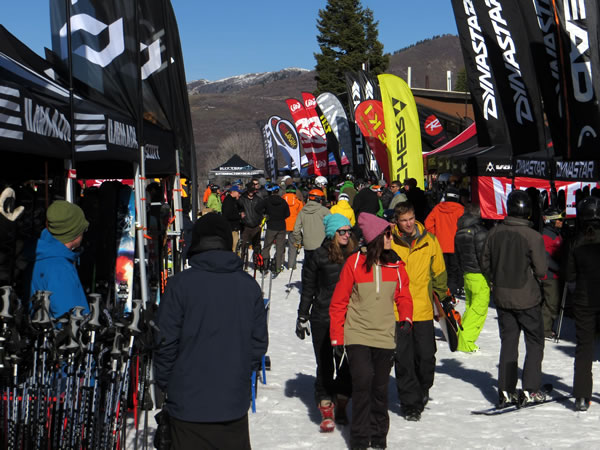
We’ve spent the last three weeks devoted to the nuts and bolts of our trade, gorging on new product information and indulging in as many test runs as we could squeeze in a day. We were blessed in that a couple of our test venues, after teetering on the brink of unskiable, received fresh infusions of snow just in time to not only salvage these industry demo sites, but to optimize them.
Of course it’s still too soon to render any serious judgments about how this or that ski fared against the field, but it’s not too impetuous to offer observations about the overall direction of the equipment market.
The overriding impression after skiing on a representative cross-section of the 2016 ski market is that it’s getting harder to find a bad ski. It’s still more than possible to trip over a poorly prepared ski – when are techs going to learn that aggressive linear grinds don’t work on winter snow – or anywhere? – and it’s no problem at all to ski an inappropriate ski for any given condition. But most skis debuting in 2016 are fine exemplars of the ski maker’s art.
While all skis are getting better, there remains no doubt as to which genre of skis are best in a qualitative sense. Sorry all you fat boys, it’s the citizen race category (often referred to as “beer league” models) that is producing the most exquisite set of on-snow sensations for the skilled recreational skier. What’s insane about this state of affairs is that practically no one in America buys technical skis, almost invariably preferring a ride with a wider girth to these slender rockets with a velvet touch.
The prevailing presumption is that such skis are temperamental divas that can’t cope with anything but adamantine, manicured slopes. Piffle. Even late-day, Slurpee-thick spring snow can’t disconcert a race ski driven in high gear.
Which ski genre one prefers is a matter of taste; what is beyond dispute is that the variety of flavors and sensations, in the form of multifarious sidecut, baseline, flex and mass distribution concoctions, has never been more abundant. No matter where or how one chooses to slide, whether fast or slow, on prepared pistes or untrammeled snowfields, there’s a ski for your pace and personality.
The tooth-and-nail competition for ski consumers’ affection impels every major brand to rejuvenate a couple of ski model families every season. By our count, major brands will introduce close to 100 new models for the 2016 season, and that doesn’t count lower-priced package skis, garage brands, kids gear or the booming backcountry market, where a lot of design energy has gone in the past year.
That’s a lot of turnover in a relatively small market, a sign of just how rough the battle is for the high-end ski dollar. Even the most entrenched brands fear – rightly or wrongly – that they imperil success if they keep a successful ski unchanged for more than a couple of seasons.
The robust pace of technology turnover pales in comparison to how fast skis change their façades. Virtually every significant alpine model will sport some sort of redecoration or completely new aesthetic in 2016. If a model happens to carry over to next year utterly unchanged, it’s most likely because a surfeit of 2015 stock is still in inventory.
Because almost every ski, new and old, is going to look different next season, determining what’s new technology from what’s new only cosmetically will require some study by the discerning consumer.
We at realskiers are grateful that our industry has elected to blur the distinction between innovation and decoration as it allows us to serve as a source of demystification and decoding, a role we zealously embrace.