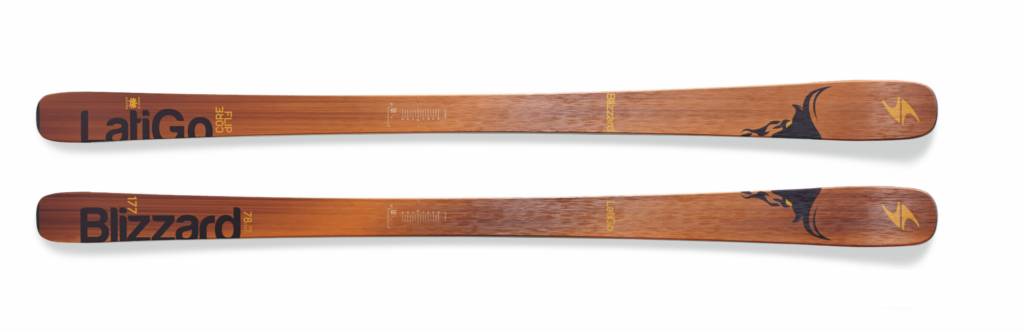
[The test results for the Latigo are from 2015; its only changes for 2017 are cosmetic.]
If we were to categorize skis according to their attitude as opposed to their actual dimensions, the Blizzard Latigo wouldn’t even be in the Frontside family. The grandchild of the burly Cochise, the Latigo’s lineage is all about adapting to off-road conditions. That it still connects so well on groomers is testament to the clever inversion of conventional wisdom embodied in Blizzard’s Flip Core.
The Flip Core models are molded with their innards upside down, so the core’s natural curvature is upwards at the ends, i.e., rockered. This places virtually no stress on the ski in the critical transition zone between rocker and mid-section; when the skier applies a modicum of pressure, the bowing action blends the full ski length into a unified arc. Carving accomplished.
If its baseline didn’t telegraph its off-piste preferences, there’s another dead giveaway visible at first glance: no binding interface, meaning the Latigo isn’t part of an arranged marriage with a Marker or other brand. It maintains its coveted free agent status, one of the few skis in this genre that comes to the dance without a partner.
Many carving-crazed Frontside skis are too rigid to conform well to the crazy contours of today’s mogul fields, but the Latigo’s baseline and flex pattern make it the best suited to bumps in our Frontside fraternity. Even though the Latigo doesn’t have a big surface to float on, it probably makes off-trail skiing by and large easier than the field, without giving up much in on-trail prowess.