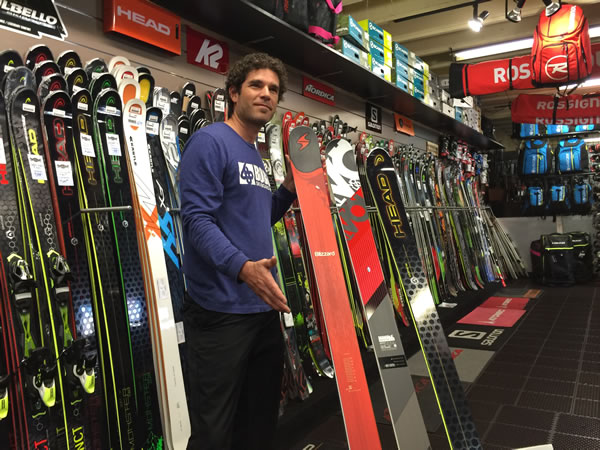

It’s too soon to reveal particulars about the 2015 ski model universe, but the overall shape of next year’s market is already clear. There’s no sea change afoot, no sudden shift in the paradigm. Instead, change will be evolutionary, following a cycle of renewal that’s specific to each brand.
As one might expect in an equipment market that’s been on the ropes for several seasons, no publicly owned company is going to invest in major surgery when a facelift and a couple of fill-in models will impart the aroma of innovation. By our count, only a little more than 25% of the unisex market next year will consist of new models. There’s been more turnover in the women’s field, concentrated in a few brands that were ripe for an overhaul.
The good news for ski buyers is that the overall trajectory of the market is toward richening constructions and, wherever possible, lightening them compared to what came before. We’d love to say that we’ve observed a downward shift in ski dimensions, but the market continues to cover every bet, meaning that there continues to be every kind of fat ski imaginable. If there’s going to be a transition to narrower skis, it’s going to have to be consumer led.
There’s plenty of rejuvenation in the highly competitive “All-Mountain West” (95–100mm waist) genre that occupies the current home of the ultimate utility tools. Some stalwart models in the category are up for renewal and there are a couple of new contenders, all of which means the consumer’s choices of superior, do-it-all partners will only get better.
If skiers continue to under-patronize the Frontside (74-84mm waist) genre, it won’t be for lack of options. The category of skis to which most people would be directed for hard snow performance is awash in excellence, represented by both returning models and fresh faces.
The costs of launching a new boot line exceed those of creating a new ski collection by several-fold. So it’s no surprise that the boot world is moving forward at an even more deliberate pace than the ski domain. Two trends stand out: more good boots for skiers with wide feet and more heat-moldable shells. The already ubiquitous hike-mode market will be ever more diverse, headlined by more supportive boots for the advanced woman with backcountry aspirations.
As this is a brief field bulletin and not one of my more long-winded perorations, permit me the space to append a speculation on our current era is ski and boot design.
Not so very long ago, every important company in the ski equipment trade was family owned, often by the founder. Now every important brand in the ski racket is part of a publicly traded company. There isn’t a visionary maverick at the helm, willing and able to risk his name and his investors’ stake in the service of making a superior ski or boot.
The real power in any company today is its financial arm. They contain the boundaries of risk, whether in capital for fundamental industrialization, re-tooling or expanding production. At this stage of ski and boot making, no one you’ve heard of is going to go all-in on a new technology.
All of which is just fine. The market doesn’t need product renewal to occur on a more rapid cycle than what we observe today. People don’t buy new skis with such frequency that the market needs to metamorphose every season to keep them interested. If consumers skip two generations of product refreshment, it’s no loss to them.
The passion of an individual’s vision hasn’t departed from the ski-manufacturing world. It burns today everywhere skis are fabricated, whether by engineers toiling at the CAD/CAM consoles of the major brands or the persevering iconoclasts who have an image of a possible ski and can’t sleep well until it, or something nearly like it, is brought to life.
– Jackson Hogen