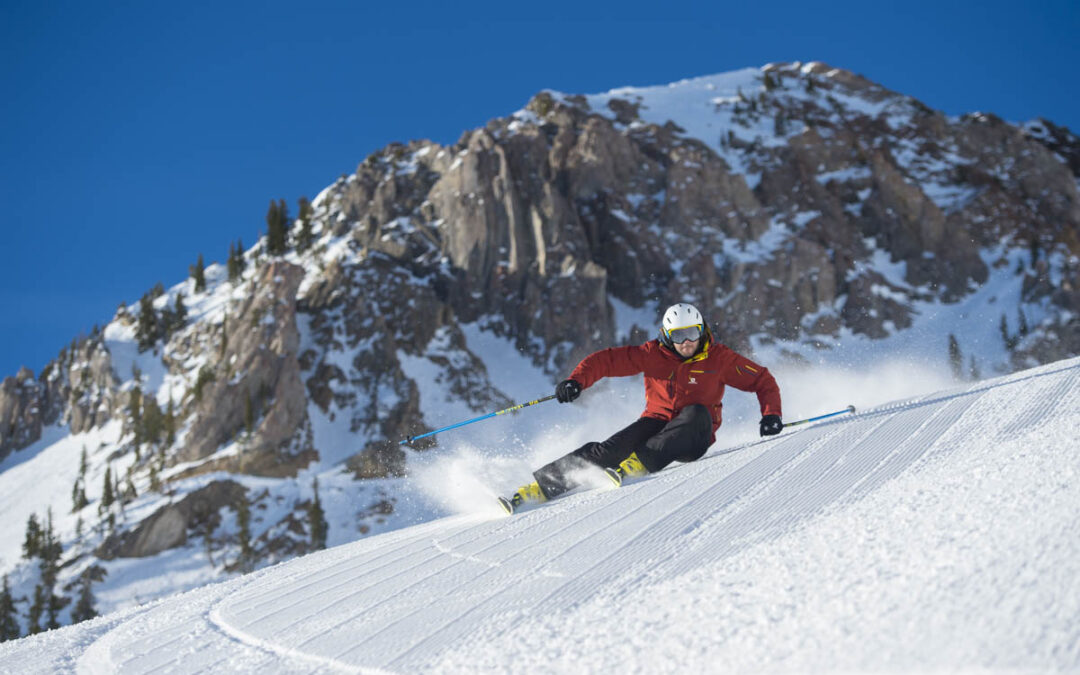
While the ink is still wet on the headlines proclaiming Ted Ligety’s utter dominance of the Olympic field in the men’s giant slalom, it seems a fitting moment to extol the virtues of Frontside (74mm-84mm) and Carving (66mm-72mm) skis. The conditions at the Mammoth trade fair were ideal for investigating the virtues of these genres, both in their wheelhouse on hard snow and in the off-piste domains where they are often presumed to be at a disadvantage.
Maybe it’s the effect of three low-snow years in a row, but interest in narrower-waisted skis was riding high. Nowhere was this more in evidence than at the Head tent, where the iSupershape Titan (80mm), Rally (76), Magnum (72) and Speed (66) left testers struggling to find new superlatives.
The iSupershape Speed is the ski Head has handed to their athletes to parade before the cameras from the podium, where it’s appeared with regularity. The message seems to be, “You couldn’t survive our race skis, but if you want to ski something like Ted, Bode, Julia, Lindsay, Aksel et al. [PK: add to list?], this little black model here will make their style accessible to the non-Olympian.”
The Speed not only delivers all the delicious performance one would expect from an exquisite race ski, it doesn’t lose its zest for life when directed into moguls or loose snow. The Speed, and its slightly plumper brothers, was made to reward skiers who took the trouble to learn how to carve a turn.
Just because this skill set has yet to be adopted by the ski population at large doesn’t mean the general public shouldn’t deploy skis that at least make the skill attainable. Perhaps no ski has coaxed more Americans on edge than the K2 AMP Rictor 82 XTI, particularly when one factors in its predecessors and current kin.
Experts raised on race skis tend to overlook K2’s carving capabilities, much as low-handicap golfers look down on cavity-back clubs. But there’s no harm in game improvement technology as long as the gear still performs once the skills are in place, which explains why the Rictor 82 continues to attract a fervent following: it brings high performance skiing in reach of the average skier.
Just as the good-natured affability of K2’s skis is a reflection of the all-American attitude that inspired them, Stöcklis seem suffused with the Swiss passion for precision. Their meticulous craftsmanship is applied primarily in service to one rule: first skier to the bottom wins.
Stöcklis are the bullet trains of skis: they perform best at high speeds, where they remain magnetically connected to your line of travel. But skis like the Laser SX also exhibit the very un-train-like trait of releasing an arsenal of stored energy when loaded. If you’ve forgotten what fun it is to slingshot out of an arc to an edge as secure as Gibraltar, take a Stöckli out for a spin.
Even a brief compendium of carving skis’ ruling class wouldn’t be complete without a nod to Kästle and the luxury-sedan ride of their MX 83. I would likewise be remiss not to mention perennial powerhouses like Nordica’s Fire Arrow 84 EDT EVO and Völkl’s stealth bomber, the V-Werks RTM.
The damping technology that goes into the finest Frontside skis isn’t on the menu at your local garage brand. Unlike a lot of fat skis, they’re more than just a shape with a flat baseline. They’re built to take on the mountain at its meanest and leave their pilots breathless and beaming.
– Jackson Hogen