
Overview
If one were to distill Fischer to its essence, the resulting elixir would be made of equal parts precision and speed. Rigorous quality control has been the defining feature of its corporate culture going back to the days of Vacuum Technic that ensured even distribution of glue in an era of loosey-goosey QC. The infatuation with speed comes with the territory, namely Austria, where winning World Cups is considered a national necessity on a par with strudel and snow.
Despite the recent spectacular results of American racers on the World Cup, American interest in alpine racing remains a pale shadow of Austria’s national obsession with the sport. As skiers, we gravitate towards models that are more forgiving than precise. Except where Fischer is concerned. Over the course of the past decade, the Fischer models our panelists have preferred ran contrary to the Zeitgeist of the smeared turn; they were unapologetically accurate and geared to run smoothly on the Autobahn. In the language of Realskiers, Fischer has had its greatest success making Power models that reward speed and technical skill.
Fischer’s fortunes in the American market found a fresh foothold when the brand introduced its first boot a couple of decades ago. Fischer capitalized on its opportunity when it created a moldable shell material it could vacuum-fit around the skier’s forefoot. Overnight, Fischer went from being a bit player in the boot world to a market force. As other brands with more market penetration entered the heat-molding fray, Fischer gradually lost ground to more convenient methods.
On the ski front, Fischer’s credibility with the racing community has never been in question, but supporting racing in the U.S. entails as much expense as revenue, so building up the brand’s image with the recreational market has been job one. In the arcane arena of slo-mo, where skiers race uphill instead of down, Fischer’s mastery of lightweight design, developed in the cross-country sector, makes it a market leader. But this is likely to remain a fringe activity in America, so cracking the mainstream market is still the paramount objective.
There are basically two sides of the recreational coin, on-trail, where carving is the desired skill, and off-trail, where the ski needs to be looser. Fischer has always had game in the carving arena, going back to the era of the first shaped skis when it made one model with a tail wider than the tip. More recently, its Progressor series of carvers achieved both acclaim and a measure of popularity, as did the Curv collection that followed.
The race-derived Curv remains in the line as it has strong following in central Europe, where dual-track carving remains important, but in the U.S. the emphasis has shifted to the RC One 86 GT and RC One 82 GT. If you know how to carve a ski, you will fall in love somewhere in the middle of the first turn. The RC Ones do not kowtow to the cult of all things lightweight, but instead pours on the Titanal for a grip as fierce as King Kong’s handshake.
It’s on the ungroomed, backside side of the mountain where Fischer has struggled to establish the identity of its multi-model Ranger series. The first series were basically wider race skis, a clear misfire, so the next series was ultra-light, which didn’t fare much better. Up until this year, Rangers came in two iterations, one with Titanal and one without, and both were better than anything that came before.
A brand is only as good as the people it can attract, and four years ago Fischer added one of the most admired men in the equipment world to its roster, Mike Hattrup. (BTW, 2019 marked the 20th anniversary of Greg Stump’s magnum opus, The Blizzard of Aahhhs, in which Hattrup teamed up with Scot Schmidt and Glen Plake to create celluloid magic.) Hattrup is well known for his work in the backcountry arena, so he was especially qualified to guide the creation of the new generation of Rangers that debut this year.
In the current market conditions, the backcountry market is on fire, and Fischer is well positioned to capitalize. Its hybrid Ranger boots are, frankly, the best Alpine boots Fischer has ever made, and more products that will work both in-resort and in the backcountry are most likely in a short pipeline.
On a more somber note, the Fischer factory in Ukraine, the largest in the world, burned down in the fall of 2020. It is now completely rebuilt and again capable of churning out wood-core skis by the truckload. Of course, Ukraine is top-of-mind now for other reasons. Currently, the re-built factory isn’t in imminent danger, but neither is it making skis, as its workforce is busy beating back the Russian invasion.
There’s every indication that Fischer’s fortunes in the American Alpine ski market are ascending. Given my professional preoccupations, I naturally look at a brand through the prism of its products, like a fortuneteller inspecting tea leaves. I like what I read in Fischer’s leaves.
The 2023 Season
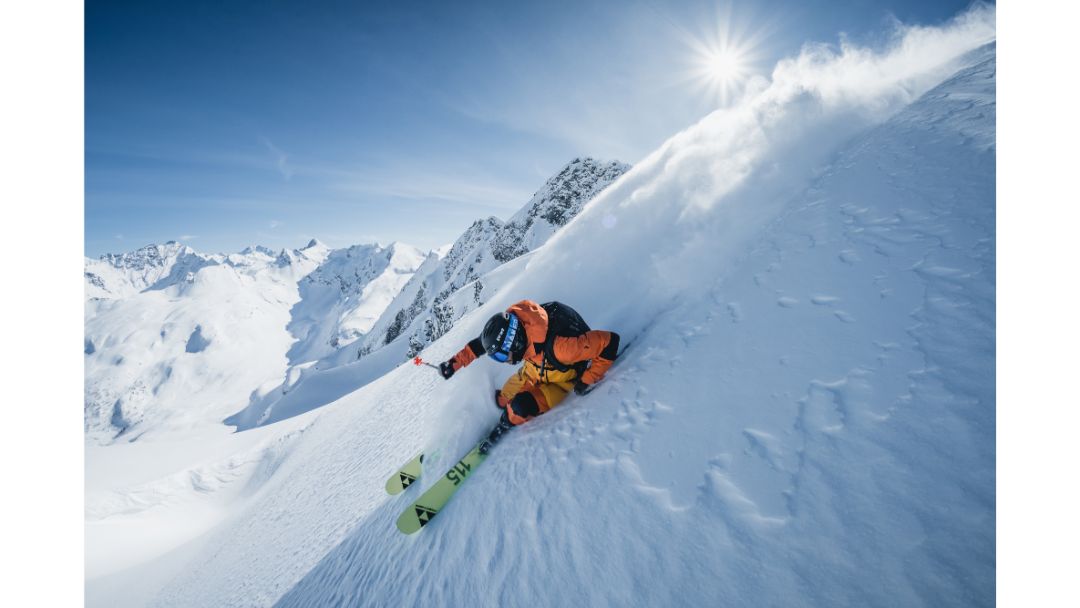
As predicted in this space, Fischer has indeed introduced a new Ranger series for 2023. The pendulum-swing between metal and no-metal has ended somewhere in the middle: every new Ranger (except the lowest rung on the price/performance ladder) has a Titanal configuration underfoot that extends farther into the tip and tail the narrower the Ranger it adorns. Because the dose of Titanal is carefully calibrated, the tip and tail stay playfully loose and the overall sensation leans to the Finesse side of the Finesse/Power divide. As is entirely appropriate for an expressly off-trail series, the design of the new Rangers tends to favor the wider widths, particularly in the broken, ungroomed terrain where they shine.
Like the sheriff who rode into a rough-and-tumble western town as an out-of-towner, quickly earned the respect of the locals, brought peace to the valley and then rode on, Hattrup, after successfully re-creating the Ranger series, has taken his considerable talent to Black Diamond. A great fit for a great person, who will soon be inducted in the U.S. Ski and Snowboard Hall of Fame. About time.
One thing Hattrup didn’t change about the Ranger series: men’s and women’s models remain the same throughout the line.