No doubt about it, heat molding has become a wildly popular feature wherever alpine ski boots are sold. Lightly toasting the inner boot so that it will readily conform to an inserted foot has become all but standard practice. Since the introduction of heat-moldable shell materials several seasons ago, the popularity of this additional personalization feature has skyrocketed.
Any time there’s a stampede for a new idea, it’s worth slowing the headlong rush for a few seconds to pose the obvious question, “Are we over-serving the skiing public?”
To some degree, the answer depends on your feet. If your feet are what Dr. Frankenstein’s lab assistant Igor referred to as “Abby Normal,” then heat-moldable shells give your boot fitter an extra weapon in his arsenal to support your wretched pedal extremities.
However, if you are possessed of fairly normal feet and are buying a medium width (100mm) boot or wider, the chances that you’ll need to heat-mold the shell are close to nil. From both a comfort and performance perspective, you and your skiing will benefit far more from the addition of a properly molded custom insole compared to the relatively trivial advantages derived from cooking the shells.
The Alpine boot market is divided over the benefits of heat-moldable shells.
Are we over-indulging in elaborate shell modifications or failing to take full advantage of them often enough?
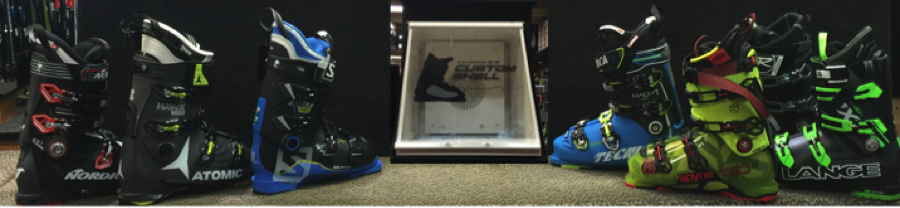
Over the past few seasons I’ve fit a few hundred ski boots, many of them with heatable shells, so I’ve seen exactly what heat molding a shell can and cannot do. But just to be sure my suppositions weren’t delusional, I recently bopped over to Bobo’s and tried on 7 pairs of 2017 models. I made no modifications of any kind and used only stock components.
While every shell I donned was a size 27.5, the flexes varied from 100 to 130 and the lasts ranged from narrow (97mm) to medium (100mm). Three shells were potentially heat-moldable.
After rotating through the assembled cast (pictured above), I distilled my observations to these points:
- My skinny lower leg and rear-foot instantly identify with the narrow confines of 97/98mm shells; medium (100mm) lasts tend to feel oddly over-comfortable.
- Flex indices are useful even if they aren’t terribly consistent from model to model. For me a 120 flex or a relatively soft 130 feels right.
- I wouldn’t heat mold any of these shells; there’s no need. I had only one pressure point in one boot, on my right navicular. A custom insole would have eliminated the issue. The shell was also dimpled in this area so a small dose of localized heat would have readily relieved the pressure.
- Nordica’s new 100mm-lasted Speed Machines are so instantly comfortable it’s hard to imagine anyone needing to use their sexy new Infrared heat and vacuum pump set-up to modify the shell.
- What few pressure points might pop up during the first few days on hill could be addressed with simple shell modifications.
Of course my anecdotal experiences hardly account for every contingency. If I had a nasty protuberance sticking out of the top of my instep or my feet were two different sizes, the global heat-mold-ability of the Salomon or Atomic would have been salvation itself. Even in these extreme cases, the re-molding of the shell only affects fit – often over a very small area – and usually has no effect on boot function.
In other words, heat-mold-ability is not what defines a boot’s performance. Heat molding a Nordica Speed Machine shell doesn’t make it a Lange RS. A boot’s essential character is going to still be determined by stance angles, materials, point of cuff rotation, shell and cuff shapes, energy transference and other properties unaffected by a one-time, heating and cooling event.
The marketing fanfare surrounding heat-molded shells has tended to obscure the fact that all polyurethane-based shells and cuffs have always been heat moldable. A local application of heat and pressure is still the preferred method to create a nest for a persistently protruding bone.
To compare boot work to medical practice, there’s no need for general anesthesia and the trappings of major surgery if a local and a few stitches gets the job done.
There’s no problem with heating a shell globally to fix a small issue that could be handled otherwise, unless – and it’s a big “unless” – it’s to alleviate a source of discomfort that should have been addressed with a custom insole.
To reiterate the moral of this Revelation, lest it be lost: just because a shell can be heated in its entirety doesn’t mean the foot within is necessarily being properly supported. Before resorting to any serious shell medication, discuss with your boot fitter the benefits of a custom insole and how it might mitigate or eliminate any problems.