If you’re like most advanced skiers, you’d like your next pair of skis to do everything well. Even if you aren’t the master of all terrain conditions, your want your skis to be. Much as you’d like to own several pairs of skis, it isn’t going to happen. No need to heed the weather report; you’re grabbing the same pair of sticks no matter what.
It was for this skier that marketers coined the term, “All-Mountain.” As mountains come in several sizes and snow arrives in more than one condition, the All-Mountain name covers quite a range of territory. The linchpin issue in narrowing selection is: how much deep snow are you anticipating?
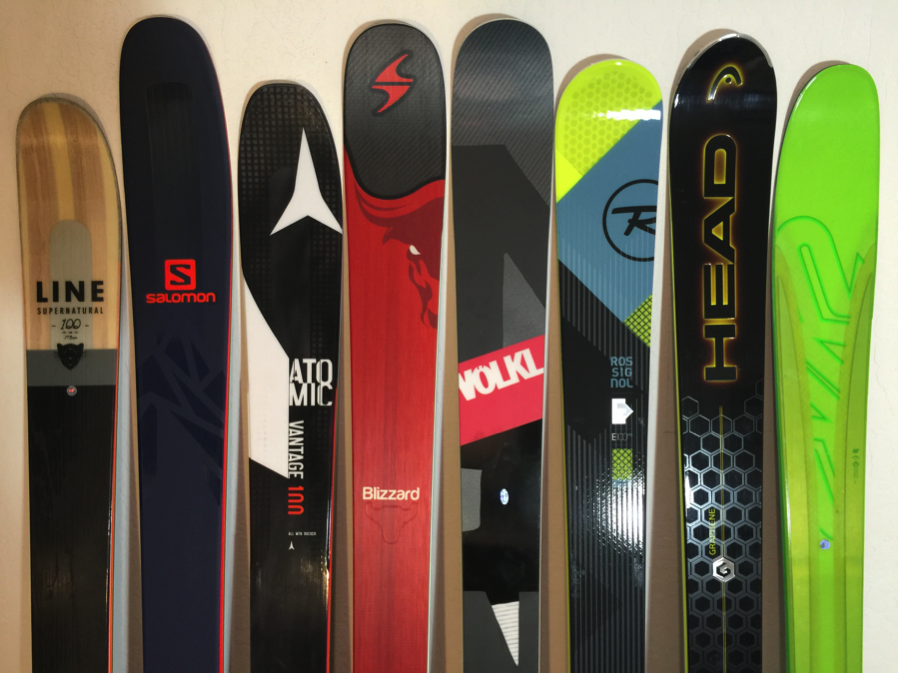
The selection of All-Mountain West skis for men is vast and varied, with plenty of options for both Power and Finesse skiers.
You can’t fake fat. Fatter skis with less pronounced sidecuts will float better in unbroken snow than narrower skis with more shape, period. So presumably you’ll want the widest ski you can get for those glorious but rare powder days, without losing the ability to accurately steer the ship on hard snow.
Here lies the crux of the “how-wide-is-too-wide” issue: to ski well on groomed snow – i.e., under control and able to change trajectory – requires tilting the ski and increasing edge angle, a move that becomes increasingly difficult – and potentially more injurious – the wider the ski.
There’s an easy way to tell if a ski is too wide for you to serve as an everyday model: is the ski waist width wider than your knee (or more specifically, the head of your tibia)? In general, men can find the all-terrain, Goldilocks width in the All-Mountain West (95mm-100mm) genre, while women are better served – and safer – on an All-Mountain East (85mm-94mm) ski.
Women looking for a one-ski quiver are best served by hunting in the
All-Mountain East genre.
Allow me to veer slightly off topic to mention that manufacturers are not unaware of this development. Both the men’s All-Mountain West genre and the women’s All-Mountain East selection are stocked to the gills with excellent options. No matter how you describe yourself as a skier, your perfect one-ski quiver resides within the All-Mountain realm.
Advanced skiers are hardly the only skill group that’s looking for a monogamous ski relationship; the same applies in spades to the first-time ski buyer, the ex-renter, the longtime drop-out and those for whom skiing is a social event as much as a sport. All these skiers share an affinity for groomed terrain and, generally speaking, need all the help they can get.
Every one of these skiers will find their bliss on a Frontside ski. Unlike the All-Mountain genres, the Frontside category declines vertically, marketing-speak meaning it includes skis made for everyone from rank beginners to sterling experts, with prices running the gamut from $399 to $1,949, usually with the binding included.
Frontside skis are the widest models made for groomed terrain, making them both easier to balance on and less arduous to tip on edge, helpful traits for building skills without eroding confidence. Frontside skis are typically rockered in the forebody so they’re often better adapted to off-trail conditions than their owners are. Point being, as your skills improve and the allure of off-trail adventure beckons, Frontside skis are ready and able to make the transition with you.
The most likely purchaser of a new ski model during the soon-to-be-upon-us season is someone who already has an everyday ski that works for him or her, yet yearns for more. Having the middle of the model spectrum covered, these avid participants are looking for specialty models that are adapted for the particular conditions that prevail at opposite ends of the snow density scale. They seek easier access to more intense sensations than mainstream All-Mountain can provide.
Nothing makes powder skiing as effortless as a Big Mountain or Powder ski. The problem is finding the powder. Unless you have an extremely well organized life, your chances of having more than a handful of runs in knee-deep freshies in any given season are slim. This isn’t meant as an argument against owning a super-fat ski; quite the opposite. If you only get a few shots at glory, be prepared.
On the other hand, if skiers bought more with their heads than their hearts, more second pairs would be Technical or Non-FIS race skis, the narrowest, most accurate and fastest models one can easily procure. The polar opposite of Powder skis along every axis, such models invariably have cambered baselines, deep sidecuts and an elevated binding interface (often with binding included). They are so much fun on hard snow I’m grinning like The Joker just writing about them.
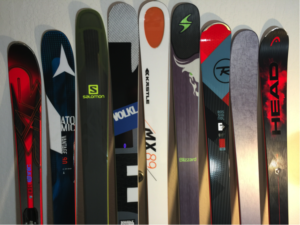
The men’s All-Mountain East genre is likewise loaded with talented performers.
The lesson of this Revelation is that the first step in selecting your next ski is to understand which genre best matches the description of where and how you want to ski. Every ski within that category is a potential mate; which one you’ll prefer is a matter of taste more than technicity.
The brilliant editor John Fry compared the sampling of ski behaviors evoked in a ski review to the comments of a wine taster. I believe he used the wonderful word, “oenophile,” in defense of our methods at Snow Country Magazine. Let the tasting of this year’s harvest begin.