
If you are a lifelong skier, no matter how long that life may currently be, either you or someone you know has taken a nasty spill while crossing a slick parking area in their ski boots. These types of falls tend to be sudden and unmerciful, the landing area of unrelenting density. The injuries range from wounded pride to broken femurs. The broken bits aren’t binding related and we tend not to think of these incidents as skiing-related. Yet they are intrinsic to our sport.
But they don’t have to be. The solution, or at least a very considerable remedy, is already on the market. The walking sole walks among us, but because they’re only rarely standard equipment, and their adoption may obsolete any current bindings in your personal fleet, the concept is confined to a corner of aftermarket products that have yet to gain much traction.
What I’m about to discuss may sound hopelessly arcane, but stay with me and all will be revealed. The reason walking soles are in a state of limbo has to do with standards, or in this case, a missing standard. Markets move faster than the standard-setting process, allowing two different solutions to reach the ski trade before a standard could be written specific to the requirements of this boot/binding system.
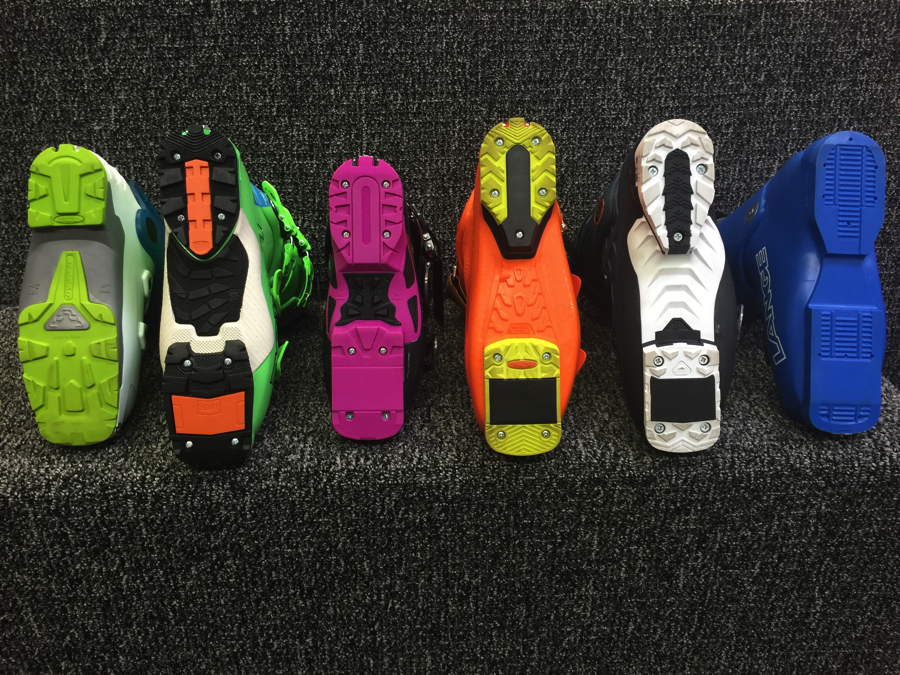
The once simple choice of boot sole has grown complicated.
To simplify what is not a simple situation, walking soles currently fall under the same specifications as touring soles (ISO 9523, for those taking notes), those rockered, fully treaded beasts that scream “mountaineering!” But walking soles aren’t fully treaded: they retain a partial AFD (Anti-Friction Device) area that’s smooth where the boot will contact the pad behind the toe piece. This allows them to work with certain compatible bindings that can accept either a standard alpine sole (ISO 5355) or a walking sole.
The reason there are boot standards in the first place is so that bindings can be built around their dimensions and materials, thereby assuring predictable functionality as a release/retention system. (Sorry for all this jargon. I served as General Secretary of the ASTM Committee on Snow Skiing just after the first alpine boot sole standard was passed by the DIN.) The current market is in a multi-norm miasma with the walking sole at the center of the fog.

These bindings will accept walking soles as well as standard alpine soles.
To recap the current market realities:
- Walking soles are mostly aftermarket products, not original equipment.
- The majority of the boot market still uses alpine soles and the majority of bindings are still alpine bindings.
- There are two competing walk-sole-binding system, each with a slightly different rulebook:
- WTR (Walk To Ride): originated by Salomon/Atomic and adopted by Rossignol/Lange/Look
- Gripwalk®: created by Marker and embraced by Nordica and Dalbello
- Neither WTR soles nor Gripwalk soles should be used with standard alpine bindings. Remember this point.
- WTR bindings will accept WTR soles and standard soles, but a toe height adjustment is required when switching soles.
- Gripwalk bindings (and Sole.ID from Marker) will accept alpine soles and Gripwalk soles interchangeably without modification.
Some of you may be thinking, what’s the big deal? Just use WTR walking soles with WTR-designated bindings, ditto Gripwalk and off you go. The problem is, what are you going to do with all your current skis with their traditional alpine bindings? Remember what I underscored above? Your not-so-old bindings aren’t meant for walking soles. Of course, skis can be remounted, but the tariff for retrofitting your entire ski locker could be crippling.
It’s tantalizing to realize that the solution to a serious problem lies just out of reach. The question is, for how long? For walking sole and compatible bindings to become the norm, there ought to be specific norms for them to meet. Such discussions are underway and may lead to a relatively swift resolution.
What would the new “normal” look like? Nothing will change on the true touring front, where treaded, 9523 soles will continue to mate with pin bindings. Racers are unlikely to give up their monoblock “DIN” soles, preserving this sole configuration forever. (Side note: Tecnica made their alpine/hiking boot, the Cochise, with a DIN-dimension sole plus tech inserts rather than a touring sole, as that’s what their athletes asked for.)
But for the vast majority of resort skiers the everyday boot will come with walking soles and bindings will evolve that serve the needs of all alpine skiers no matter what soles are on the bottoms of their boots.