
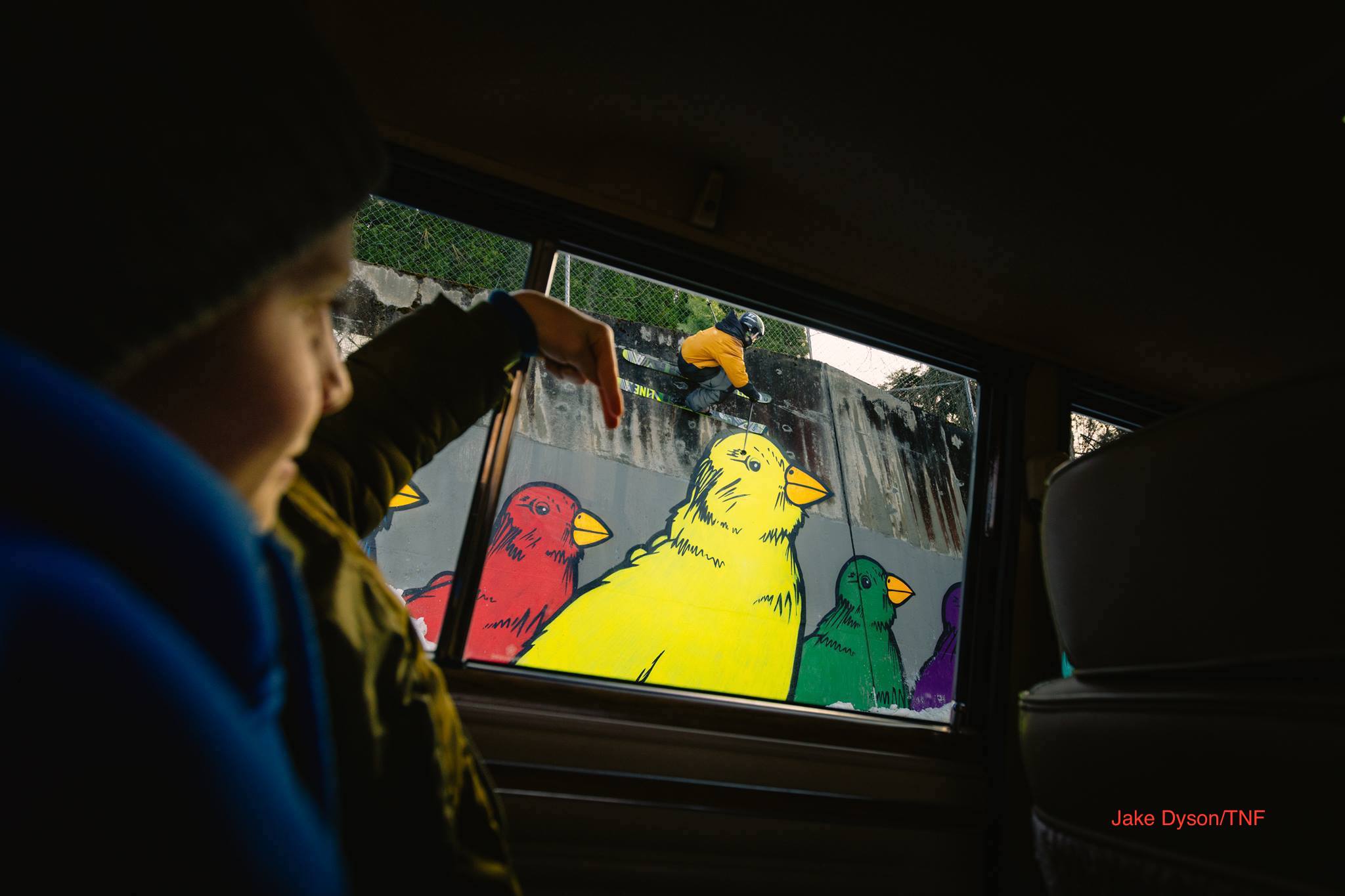
Once upon a time, the family of alpine skiers was a relatively tight-knit bunch of risk-takers regarded by the general public as a lunatic clan whose members seemed to spend half of each winter wearing a cast or sling, yet continued to ski, as if such injuries were mere inconveniences.
There was only one archetype of excellence, embodied in the racer. Everyone who wanted to be any good tried to emulate the technique of the fastest skiers. Perhaps no racer’s style had a more enduring impact than that of Stein Eriksen, a universally admired icon of athletic grace. While race technique no longer serves as the sole definition of excellence, the power and elegance of a Shiffrin or a Ligety still provides a compelling role model for a large percentage today’s more diverse ski family.
Skiing’s first family feud was a classic case of youthful rebellion, a generation of kids who rejected racing’s monotonous training and blind obedience to the clock. Freed of racing’s shackles, these unfettered athletes found new forms of competition and created new avatars of excellence. Hot-dog mogul skiing went from outlaw activity to Olympic event and early-epoch aerials and trick skiing (aka, ballet) morphed into the spectacular, man-made arenas of half-pipes and slopestyle courses.
[I’m compelled to interrupt this family history to observe that in the 1970’s if we so much as built an off-the-beaten-path kicker, a sno-cat would be dispatched to raze it. Now there’s hardly a ski resort in Christendom that doesn’t spend a princely sum to build extensive snow features – often with victory-or-death gap jumps – made expressly for those so inclined to hurl themselves into orbit. Don’t read me wrong, Dear Family Member; I’m not bitter, just very, very envious.]
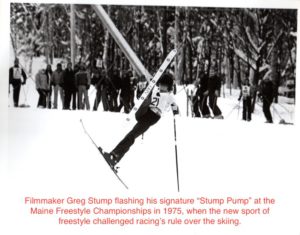
Once the freestyle movement successfully opened a new branch of the skiing family tree, every assumption of what constituted a ski and how best to use it was challenged to its core. A new cadre of revolutionaries emerged from the woods (since they weren’t allowed at resorts) wearing a single ski they called a snowboard. What began as a generational civil war has lost much of its bite as a new wave of snowboarding parents is now wearing skis to facilitate introducing their progeny to snowsports.
While skiing and snowboarding have influenced one another, they remain distinctively different activities. But the divide between traditional, on-slope alpine skiing and several of its other offspring is blurrier. Climbing has been part of alpine skiing since its inception (as skiing preceded lifts), but only recently has the climbing bug started to infiltrate the mainstream market. It seems everyone is suddenly interested in backcountry skiing, despite its perils and considerable cost of entry. The needs and objectives of the climbing skier are different enough from the resort skier that he or she requires an entirely different rig in order to do it seriously.
Today’s skiing family is a polyglot amalgam that embraces extremes such as skiing without snow (observe Candide Thovex slaying a hay field) or without a mountain (Tom Wallisch proves they’re optional), or running up the hill instead of sliding down it. Every variation on the theme of sliding has its own sub-culture, equipment, dress, accessories and rituals. Passionate devotees and defenders of their shared milieu, each eyes the other branches of the family with a hint of disregard and a dash of apprehension.

Tom Wallisch, seen here in a clip from Imagination, takes his tricks to town.
What all snow sliders should remember is that, like families and trees, we have common roots and shared values. As in all large families we have to learn to get along even when we’re not in the mood to do so. Despite our differences, we share the same space, which puts a premium on common courtesy.
The spirit of sharing is never more important than when there is little to share. Early in the season the Jones to ski runs hot, but the territory available for unbound self-expression is limited. The technician intent on symmetrical tracks, the ex-racer slashing through imaginary gates, the father shielding his snowplowing toddler, the park rat gunning it in reverse, the snowboarder focused on an upcoming kicker, the bored freerider straight-lining the groomage, we all have to be aware that we’re in this grand adventure together.
Whether we’re zigzagging or zipper lining, we’re responsible not just for ourselves but for those around us. When half the participants on a given slope are tootling along at 30+mph, civility matters.
When the ski community was small and relatively homogenous, all skiers felt a common bond, a realization that they were part of something special. That sensibility is still there, it just tends to be limited to a focused subculture rather than to snow sliding in all its manifestations.
As the world around us grows ever more divisive, let us celebrate what unites us as skiers. Skiing may not mean the same thing to all of us, but it’s special part of all of our lives.
Let me leave you with this apparently incongruous reflection. Last August I attended a celebration of life called Beloved, a gathering of some 2,500 like-minded souls in the remote Oregon woods. The sense of shared values, of hope for the human condition, wasn’t an affectation worn for one weekend then discarded, but a way of daily living of which the festival was but a manifestation. I believe the same communal feeling resides in the hearts of skiers everywhere. If you are a skier, you are my friend.
[Want to get in the spirit of skiing and learn a little ski history at the same time? Snag yourself a copy of Greg Stump’s Legend of Aahhh’s. If you haven’t seen the original Blizzard of Aahhhs, get that, too.]