
Can a ski have a soul?
Most theologians, as well as the murky dictates of common sense, would say no.
But skis do not build themselves. They are the product of human minds and hands and eyes. They are not plucked at random from the universe of possibilities, but are the result of a strict winnowing process that may begin with hundreds of options before being culled to a dozen finalists.
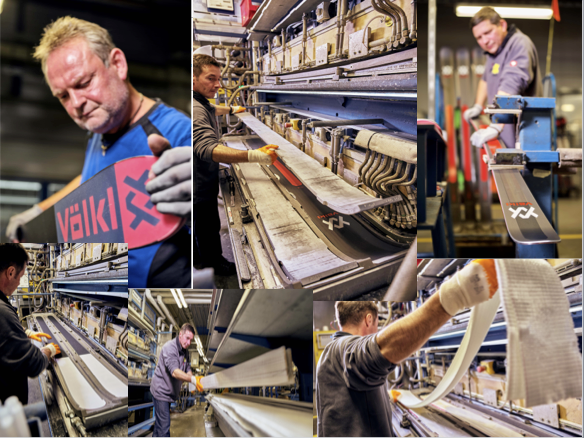
Look at the photos that accompany this Revelation. Each shows a stage in the creation of a new Mantra being built at Völkl. There’s an artisan at every station, someone who invests his or her energy to produce exactly the ski that began months ago as a fledgling idea.
All ski making, no matter how industrialized, requires the human touch.
The journey to the Mantra M5 has been a long one. It began with the creation of the first Mantra – unveiled in 2005/06 – so new it essentially created the All-Mountain West genre before there was such a genre. As a coterie of competitors coalesced around it, the Mantra continued to be the benchmark, the reference ski against which all new AMW models were measured.
Every few years since its debut, the Mantra has morphed in ways both subtle and bold. With each stage of its evolution, the behavioral bundle behind the name retained its essential trait: stability in all conditions. What has always made a Mantra a Mantra is its willingness to dive into any type of terrain and its determination to emerge victorious.
The latest iteration is the product of relentless focus on an ideal. It requires the collaboration of R&D engineers, on-snow testers, production supervisors, product managers and marketers to bring this vision to life. If you could feel the human energy in the final ski, it would vibrate at its own frequency.
At their most primal level, both skis and humans are made of sub-atomic vibrations. Like the mind and body, skis are vibration management systems, converting vibration into other forms of energy.
The Mantra M5 skis as if animated by its own life force. Its cambered baseline acts like an energy field that recoils when pressured, propelling the skier out of the turn with the gravitational thrust of a comet circling the sun. Skiers have always referred to this quality as “liveliness,” recognition that the skis beneath us are indeed alive.
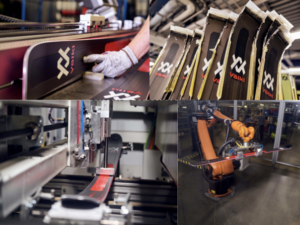
Ski making is complex ballet performed by man and machine.
For centuries, mankind has applied gender to inanimate objects, as anyone familiar with a non-English language can attest. We also have a habit of giving our favorite objects names and imbuing them with human traits such as loyalty and faithfulness.
All the human energy invested in things gives them power, including the power to touch us, charm us, amaze us. We want them to be not just like us, but to be like the best things in us.
Is it no wonder, then, that from time to time we fall in love with them? What could be greater testament to their ability to bond with us, to share with us some sense of spirit, something we often refer to as soul.
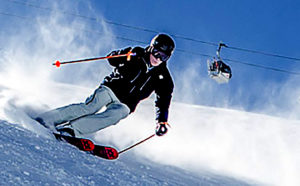
Your intrepid Editor samples the M5 in Sölden this fall.
By the time a fifth-generation Mantra is fully assembled, it will have been handled by dozens of people as it passes from station to station. The care that goes into its creation is special, but hardly unique when it comes to the craft of ski making. I’ve been to several ski-making facilities, large and small, and the passion that is invested in every ski is as bottomless as four feet of Wasatch white. It’s as if a few atoms of every ski maker’s soul trickles into the skis he or she is making at that moment, forever linking them together in the helix of life.
The skis’ new owner will be the final link in the chain, the loop that closes the circle and gives it purpose. Show your skis that you share the love by using them as often as you can.