
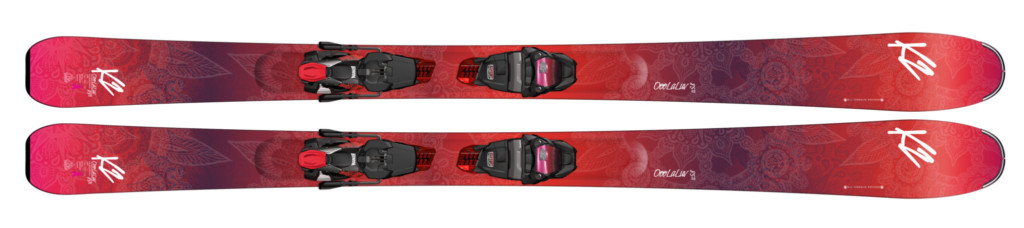
The relationship between the male-dominated universe of ski manufacturing and the women’s skis it has spawned over the years has been a one-sided affair. To say the attitude of the ski industry towards women-specific models was condescending would be admitting that the subject was thought of at all. The first “made-for-women” skis were aimed at low intermediates, since any woman worth taking on a ski trip could manage just fine on regular equipment. Most of the female skiers the ski designers knew raced on the World Cup. What did they need “women-specific” skis for?
K2 OoolaLuv
It took an American company with a less dismissive attitude, K2, to finally broaden their women’s offering to attract capable, even talented skiers. By the 21st century, every brand promoted some sort of women’s line-up, although to this day not all brands see the merits in making a full catalog of women’s models. Across the market, no one makes as many women’s models as they do unisex skis. The status quo isn’t likely to change.
The principal reason why there will never be as many women’s models as men’s is the same reason women’s skis found it hard to gain traction in the first place: ski designers know that the very best female skiers can tear the mountain down on a properly sized unisex ski. Take a look at the race market. How many “women’s” skis do you see? The more elite the talent, the less likely a “made-for” model is needed to help the pilot manage the ski.
One thing today’s ski maker doesn’t want to miss is a market opportunity, so for all but the race community they proffer at least one women’s-only ski in every realskiers genre but the peripheral categories of Powder and Carving. So what makes these skis “women’s” skis?
Modifying a Ski for Women
Skis are weight and pressure distribution devices. It appears to be part of Nature’s plan that women should be lighter than men, so women don’t have as much mass to displace along the ski’s surface. This rather mundane observation is relevant due to the market’s current infatuation with fatter and fatter skis.
Everyone seems to understand that the smaller female skier should use a shorter ski than a taller, heavier man; in the same vein, women don’t need as wide a ski to float them in fresh snow. While a 100mm ski underfoot might serve as an everyday ski for the average advanced male, it would be a powder-specific width for a woman with the same skill set.
In addition to being lighter weight, most women are also not as strong as men, so they can’t overpower a ski if it’s too stiff for them. So the primary characteristic of a women’s ski is a softer flex, which can be achieved by any number of means. Most of the flex-softening measures will also serve to lighten the ski, so the most tangible trait of any women’s ski is lighter weight.
There are only so many places a ski maker can trim fat; edges, bases and topskins all weigh the same. Metal laminates, the heaviest component, can be jettisoned, but there’s always a trade-off in composure at full throttle. All that’s left to put on a diet are the core and the heft of the fiberglass, so that’s where most of the effort goes. Some brands concoct composite foam cores, which are invariably lighter and more consistent than wood. Others thin the core profile and/or deploy lighter woods, which have the added cachet of being more renewable (think bamboo).
Once one has made a women’s ski lighter and softer, what’s left to do? Fiddle with sidecut and/or mounting position, that’s what. It has become accepted cant that women who aren’t built like men (i.e., some 95% of all women), should have their rumps raised and tilted forward so they’ll pressure the ski at the ball of the foot, just as men do. After ignoring this biomechanical fact for decades, the ski industry has now over-served womankind with every conceivable accommodation:
-
-
- Move the ski waist forward so women can get into the turn earlier
- Move the mounting mark forward so women can get pressure on the front of the ski.
- Raise the heel every chance you get:
- Start with a women’s boot with a high built-in ramp angle
- Add heel lifts under the insole inside the boot.
- Use a binding with a high ramp angle
- Raise the heel area on the ski or binding interface so the binding will tilt forward
-
It’s a wonder more women don’t dive right over their tips. We dare say that if this many changes were made to a man’s set-up, it would be unskiable. The majority of women who are over-corrected for supposed stance issues we suspect are likewise trapped on suboptimal equipment. The same male-oriented industry that once left the recreational female skier flailing helplessly in the back seat has now impaled her on the hood ornament.
Our opinion is that most accommodations for a woman’s anatomy should occur, as much as possible, with the boot. We prefer a neutral binding (toe and heel rest at the same height off the ski); if lateral or fore/aft angles need correction to address stance abnormalities, we prefer to see them addressed as close to the foundation as possible. In other words, either cant under the binding or cant the boot sole.
The issue of stance position isn’t limited to women. It’s an important and poorly understood technical aspect of the sport with too many variables to be addressed in this brief overview of the women’s ski market, to which we now return.
Finding the Right Women’s Ski
First, be sure you should be fishing in the “for women only” pond. If you ski with men who are fast and skilled and you have no trouble keeping up or even leading the parade, you very likely belong on an appropriately sized unisex model. For the rest of you, read on.
The Entry-Level Market
We don’t review models made for the first-time ski buyer (men or women), as the buying decision is usually driven by price and the models offered in this segment are largely interchangeable. The ski will be narrow underfoot with a wide tip and tail, probably with some mild rocker at the tip. It will almost invariably come with its own binding and attendant built-in binding interface on the ski. These are all the right properties for a low-skill-level skier. It doesn’t matter which brand you select. The only serious error you can make in model selection is getting a ski that’s too long for you, so err on the short side.
The Realskiers Categories
There are six realskiers’ categories – Carving, Frontside, All-Mountain East, All-Mountain West, Big Mountain and Powder – that apply equally well to women as they do to men, with this caveat: women don’t require as much surface area to float in powder as men do. This is why one doesn’t find many women-only skis in the Powder category; the selection is also limited in the slightly slimmer Big Mountain group.
By far the largest slice of the women’s market resides in the Frontside category, models ranging from 74mm to 84mm underfoot. These skis optimize performance on groomed slopes, but in their wider widths are suitable for exploration in off-piste terrain. As in all our categories, within the Frontside family are two distinct sub-groups: skis made for the lighter, less technical skier we call Finesse models, and skis made for the technically proficient, more energetic skier we dub Power models.
If you’re truly an all-terrain skier and want one pair of skis that does it all, you’re most likely to find your favorite ski in the All-Mountain East or All-Mountain West categories. The wider skis in the latter group will float better in new snow, while the narrower “East” models will have better behavior in bumps and on groomers. The candidates in the Big Mountain and Powder categories are not ideal as everyday companions but are real leg-savers on those wonderful days when the snow is deep.
Benediction
Before bidding adieu, allow us to leave you with this parting wisdom. Most of the women who ski infrequently – and your numbers are legion – do so because of some fundamental, persistent problem. You’d ski more if only your boots didn’t hurt or your fingers didn’t get cold or your skis were only more tractable. For whatever reason, you’ve accepted some nasty obstacle as intrinsic to the sport you otherwise enjoy. Maybe you’ve been renting equipment, in which case you’ve most likely experienced the worst the sport has to offer. God bless you for soldiering on.
You have found safe haven at realskiers. We know that whatever problem you’ve had – and we’ve heard all of them – there is an available solution. Without delving further into all the permutations of “things-that-keep-women-from-skiing-more-often,” here are a few things you can do to drastically improve your ski life.
- First, about your boots. They’re the usual suspects. Before you buy any ski, locate the best boot fitter you can find. We recommend the network of America’s Best Bootfitters. Treat him as you would a sommelier: tell him everything else you plan on ordering, then put yourself in his hands.
- Keep your skis tuned. This is a lot more important and oodles easier than you perhaps realize. However you do it, remember that your bases can’t be waxed often enough and your edges love a little polishing.
- Dress appropriately for the weather. In this day and age, there’s no reason you can’t stay relatively warm and dry. Winter clothing is like any other equipment: you just have to know what to get and you’ll be set.
Oh, and you might consider taking a lesson. Even Tiger Woods has a coach…
Did you notice anything in common about the bullet points above? They all lead back to a specialty ski dealer who has the tools, training and talent to help you. Trust us when we say you don’t want to go on this voyage of discovery alone. You need a reliable counselor. We’ll do our best here to help you find one.
We confess an ulterior motive to providing the best online resource for understanding women’s ski equipment: you make the mountains a more beautiful place to be, and that’s saying something.