
I’m an optimist by nature.
Try to keep this in mind as I air my misgivings about the future of American skiing.
As the thoughts I’m about to share were incubating, they started to coalesce around five points, all of which turned out to be more complex than I at first imagined. The signs of skiing’s demise as I first perceived them were:
- The end of snow. Water is certain to be in increasingly high demand for purposes other than recreation, which doesn’t bode well even for resorts with extensive snow-making operations.
- The end of the day pass. The price of a day pass is so high, the only purpose it serves is as a barrier to participation.
- Slope safety. Over-crowding on weekends and holidays puts too many skiers of mixed skills on the same slopes. Collisions are inevitable and often consequential.
- The closure of 100’s of small, feeder ski areas. Widespread participation requires widespread availability.
- The end of authenticity. Once upon a time, ski journalists did their homework. Now, every online publication – all we have anymore – shills for the equipment they review. No product is pitched without a way to buy it directly, without further ado – or informed advice.
Upon further review, I either mis-stated the nature of the problem or glossed over particulars that put a different spin on my perspective. Allow me to illuminate my serial foibles.
The end of snow. I identified the right issue with the right emphasis, but I failed to imagine a viable alternative. I underestimated the inventiveness of fixed-asset owners who won’t go down without a fight.
While it won’t be long before all resorts, regardless of altitude, will depend on snow-making – an eventuality they are well aware of – it’s possible to imagine a dystopia that results in a completely no-snow scenario. Should it come to that, resorts will resort to carpeting the hills. As you read this, artificial surfaces are already in use both indoors and out.
The end of the day pass. Boy, did I get this one wrong. Of course, I was right about day passes costing a lot more than they once did, a phenomenon I felt sent the wrong message to potential skiers. And I was right that higher prices discourage participation (duh), but I missed the main point: higher day pass prices are meant to limit casual participation, thereby reducing slope traffic that alienates the well-heeled customer the resort wants to cultivate. I thought it would be nice if the day pass rate went down; the reality is, given its profitability and continued popularity despite its inflated value, it’s far more likely day pass prices will go up.
If it sounds to you like we’re heading towards $200/day tickets that many potential skiers can’t afford, you’re right on the money. To put it another way, if you don’t earn $100,000 a year, you probably couldn’t afford to ski even if you had the time to do so, which you probably don’t.
Yet skiing participation is at an all-time high. Alterra, Epic and Indy Pass are all setting records for revenue. Resorts have zero incentive to discount day passes and two overriding reasons for raising them: limiting traffic at already bloated peak periods while raking in boatloads of dough.
Slope safety. As with my other conjectures, my worries about slope safety are well-founded, if somewhat misrepresented. In the mélange of skilled and unskilled skiers, it’s not the untrained, unsupervised and unpredictable beginners and intermediates who wreak havoc; rather, it’s the hell-bent-for-glory advanced skier who overtakes the initiates in his path. On groomed slopes especially, velocity can easily exceed the skier’s ability to manage it, and all it takes is one innocent meanderer in a dive-bomber’s path to cause a debilitating injury.
Nobody, regardless of skill level, likes to ski in a crowd. A great deal of disposable income takes care of the problem by leaving the riff-raff on the other side of gilded gates. If ski resort development has a future, it’s in the creation of ultra-exclusive hideaways where on-snow traffic won’t be a concern.
The closure of 100’s of small, feeder ski areas. Right idea, wrong decade. Yes, we’ve flushed 100’s of small ski areas out of the ski economy, but the damage was largely over and done with many seasons ago. What remains of small to mid-size resorts will most likely maintain their customer base (or, thanks to the Indy Pass, increase it), and maintain their snow coverage as long as they’ve invested in snow-making.
The end of authenticity. In keeping with my other “insights,” I was correct to note we’ve lost journalistic integrity as once practiced, but my disenchantment was too narrow in scope. We’re not just losing recognized expertise among those whose job it is to stay embedded in the sport and ahead of their readers, we’re losing a sense of the interconnectedness of all skiers.
We’ve broken into smaller and more focused sub-cultures that rarely communicate with each other. We don’t see the mountain we share the same way, and more and more of us are heading off into the backcountry, putting more distance, literally and metaphorically, between themselves and the in-resort crowd. We’re slowly but surely destroying the specialty shops that depend on ski sales to survive. If a ski is on sale online for $50 less than it sells in-store, you’d be dumb not to jump on the online deal, right? Soon specialty shops will be relegated to bootfitting and ski tuning, which only a handful may prove both willing and able to do.
Not so very long ago, we had a trade show that brought everyone together under one roof for an annual celebration of our communal commitment to the sport. Now we don’t even have that to comfort us as we plunge into a future with few consolations.
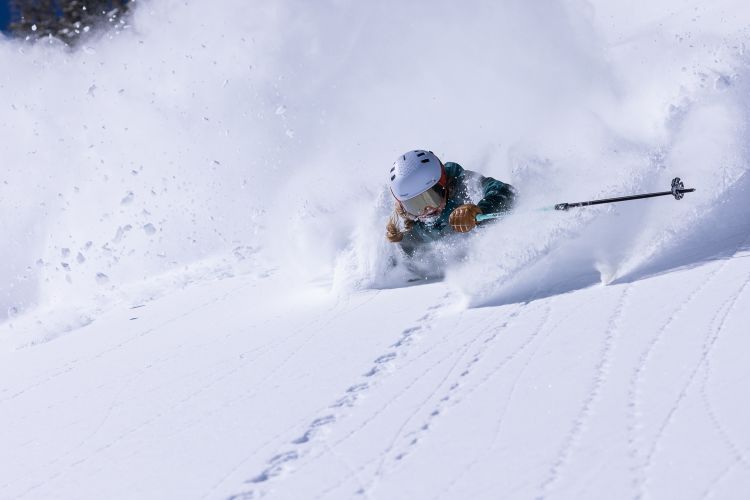
But I remain an optimist, forever dreaming of deep, silent snowfalls. My sunny suggestion for you, Dear Reader, is that you go skiing as early and as often as you can before you wake up to a world where the only surface left to ski is a synthetic carpet.

Related Articles
The Making of a Skier, Part IX: The ASTM, Carl Ettlinger and I
One of the many hats I wore as North American binding product manager for Salomon in the early 1980’s was that of delegate to the American Society for Testing and Materials (ASTM). I believe the first meeting of F8.14 – the sub-committee on ski safety – that I attended was in Pennsylvania. I was flying under the wings of Salomon’s seer of all standards and patents, Gilbert Delouche, and the binding product manager for the North American zone at that time (and my mentor), Joe Campisi.
I was a babe in the woods, but I soon caught on to the game under Delouche’s patience guidance. I recall a debate on the binding specification then being batted around in the technical committee chaired by Carl Ettlinger. Ettlinger wanted language that would require any release/retention setting of 10 or above to be “visually distinctive” from the rest of the scale.
In Memorium, Carl Ettlinger
Carl was a giant of a man whose outsized voice roiled every conversation like a burst dam and whose expansive vision reached across the mixed milieus of research, journalism, risk management and education. I knew him when he was at the peak of his powers, as he explained to me when I interviewed him for a “where are they now?” profile in Skiing History. He was able to conduct long-term research on injury patterns as well as analyze the particulars of the current binding market, turn around and package this knowledge into articles for Skiing and Skiing Trade News, followed up by a workshop tour that would bring enlightenment to the grassroots level. No one but Carl could have pulled this off, and Lord knows no one has had the requisite talent, energy and will power since.
But time and tide wait for no man, and Carl’s finely spun web of influence was eventually plucked apart. The loss of his pivotal positions in the press allowed him to slip from public view before we, the skiers of the world, realized we hadn’t taken the time to thank him.
We have the time to thank him now.
So thanks, Carl, for being first and foremost a teacher, for teaching is at the heart of the evangel’s mission.
Thanks for being so damn stubborn. Your insistence on improving skier safety wore through a wall of resistance as tough as Vermont marble.
Thanks for having a heart as big as that melon-sized head of yours. The fuel to your tireless mind was a caring heart that tried to embrace the world.
Thanks for all the stories once the Mount Gay flowed. Who knew we would have won the Vietnam War if only his superiors had listened? I can’t remember exactly how – he wasn’t the only one drinking Mount Gay – but I recall the light in his eyes as he relayed his twisted tales, taking us down successive rabbit-holes of digression that I lost track of at the seventh level.
That’s what I remember most vividly about my many interactions with Carl: his brain so teemed with thoughts he rushed to get them out in a verbal jailbreak that would travel around the cosmos until returning, many lost minutes later, to the subject that had inspired them. That was Carl: too many words for one sentence, too many tasks to tend to and all of it, every erg of his endless energy, devoted to a cause he never ceased to serve.
Fare thee well, Carl Ettlinger. The world misses you already for it will never see another quite like you, whose every moment seemed larger than life itself.
I raise my glass to you, old friend. Mount Gay, of course.
Jackson Hogen
June 23, 2020

Why This Buyer’s Guide?
Don’t read the 2021 Masterfit Buyer’s Guide in Partnership with Realskiers.com for its 62 ski reviews. I should know. I wrote or edited all of them.
Not that the ski reviews aren’t worth the read. But ski reviews on the web are as common as rice, while the Buyer’s Guide contains something no other publication, whether in digital, print or video format, can claim: the most respected, thorough and dependable boot reviews in the world.
This isn’t mere puffery. The Masterfit Boot Test is so well regarded by the supplier community that nearly every brand not only sends its following year’s line-up in four men’s sizes plus three for women, it also dispatches its top designers and/or product managers to a distant North American site for most of the test’s five-day duration.
