Ours is an era of unrivaled specialization in the ski department. On top of the already dizzying profusion of race models (that the public rarely sees) are fully populated genres that pop up every time the ski waist expands by a centimeter, not to mention a slew of specialty models for the pipe and park. The paralyzing proliferation of elite (read, expensive) model categories makes the average skier’s mission of locating the single ski that will do it all appear all the more elusive.
Allow me to cut through the fog. If the advanced skier means by “all-mountain ski” one that will hold on hard conditions yet provide adequate flotation in off-piste snow, there is only one genre of skis that delivers this magical combination in optimal balance (for the male skier) and that is the cluster that competes in the roughly 98mm-underfoot collection. While it is certainly true that any fatter ski will provide more flotation in powder – you can’t fake fat – said wider skis will also feel fatter when the powder is gone. If you don’t mind the sensation of a ski feeling fat, then jump up to a 108mm ride and have a nice day. But somewhere in the progression from 98mm to 108mm you will most likely cross a boundary where the ski will begin to feel fat, particularly in hard snow, and not just because the transition between turns is perforce of longer duration. It’s because, if you’re not careful, you can feel a strain in your knees as you tip from one high edge angle to another on skis over 100mm at the waist.
Having had the dubious privilege of skiing 22 fat skis on firm conditions during the 2012 SKI magazine powder ski test, I allege that once a ski is wider than the skier’s knee mass, the skier needs to be cautious how he or she tips the body into the turn or the knee may feel a strain pulling the fatty up on edge. A ski that is less than 100mm across underfoot doesn’t draw attention to its girth even when tossing it side to side at full tilt. Thus it provides the maximum flotation in a ski that still feels like a carver when priorities shift and edging on hard snow becomes the performance metric that defines excellence.
Just as all professional golfers who cash enormous checks owe their egregious wealth to the arrival of Tiger Woods, so all ski companies who currently feed of the 98-mm genre’s reputation for versatility owe their current profits in large part to the appearance nearly a decade ago of the Völkl Mantra. The Mantra is the sun around which all other models orbit, striving to own the position of “just like a Mantra,” only lighter or more forgiving or more grippy or some other spin off the acknowledged benchmark. The Mantra has held onto its market position despite assault from all sides, in large part because its swollen legion of loyal owners won’t ski on anything else. This despite the fact that the Mantra is not known for being forgiving or kind to the average muffin-shaped American. I suspect that at least half of all Mantra owners will never run their babies up into the fifth-gear range where they shine their brightest, but nothing seems to dim the skis’ popularity even if they’re run at tractor speeds.
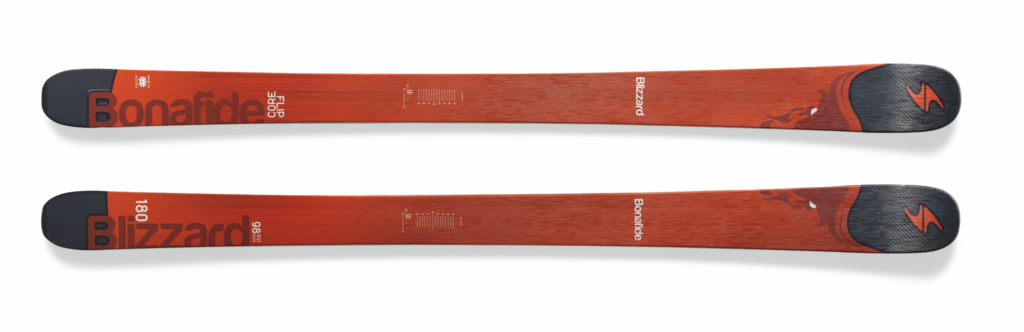
The best thing about the Mantra is that it has forced all other ski makers to put forth their very best efforts in this critical category. Rossi’s E98 remains the best ski in their line (in this humble ski tester’s opinion), the Hell and Back has enlightened a lot of skiers as to the good things happening at Nordica and Blizzard has ridden the all-star test performance of its Bonafide to new-found recognition and demand. There are even a couple of skis with pipe & park DNA, the new Armada ARV Ti and the sweet Line Prophet 98, with first-rate all-mountain properties on a 98-waisted chassis. The list of quality skis in the genre goes on, but you get the point: skiers now have a lot of choices among skis that can be accurately labeled as the ideal all-mountain tool.
– Jackson Hogen