

Today’s Revelation has been several weeks in the making. In the course of researching it, I’ve unearthed several disturbing trends that are tearing at the fabric of our sport:
- Some equipment suppliers are recklessly jamming their over-production into the market, providing more leverage for some of the retail sector’s worst actors.
- Skier visits are still strong (where there is snow), but so is skier discontent. Is the sport at risk of decline due to a surfeit of success? Is the resort experience getting better or worse?
- Vail Resorts is showing some chinks in its armor – sales of its Epic Pass declined this year for the first time – but it’s still a potent force for disruption. Its demo program threatens one of specialty retail’s last pillars of profitability. This analysis (by PeakRankings) of Vail Resorts’ annual report to its shareholders provides a master class in dissecting discontent: Is Vail Resorts’ Downfall Inevitable?
- The market for junior equipment is slumping. This is a dire problem: if we can’t convert a citizen into a skier by the age of 25, we’ve probably lost that person forever.
- Then there’s our most fundamental flaw: our over-heating planet is dismantling its snow-making machinery.
I’d like to know what you think of any or all of these developments!
You, my Dear Readers, are all passionate skiers who have no doubt spent some time pondering the primordial issues facing our sport. Share your thoughts, fears and dreams with the Realskiers’ community. If you send me your thoughts on these subjects, I’ll post them in a subsequent Revelation, with any luck inspiring an on-going dialog on the state of skiing in America. I look forward to hearing from you.
And now, this week’s ultra-relevant Revelation….
The popularity of alpine skiing in America has never greater than it is right now, as measured in skier days, one of the most reliable participation figures we have in winter sports. National Ski Areas Association data shows that 10.6 million skiers/snowboarders went through a ski lift scanner in 23/24 (the last season for which statistics are available), down from 11.6 million the year prior. NSAA stats project that 27% of the snow-siding public are snowboarders, shaving the skier population down to 7,290,000, which isn’t far off the estimates we used for the skier population back before we could easily count every skier visit (and there weren’t any snowboarders).
But the sunny skier/snowboarder-visit stats mask a serious clog in the retail pipeline that runs from suppliers’ factories to ski shop shelves. If you’ll bear with me, in the next few paragraphs I’ll explain how the U.S. market became overloaded with inventory despite record-breaking skier visits.
The Backstory
The seeds of the current disconnect between supply and demand were sown when the pandemic shuttered the sport in March of 2020. When the hammer fell, whatever orders for new gear that were in the mouth of the pipeline were annulled. Shipments of new skis and boots sat in limbo until it was announced that skiing could continue providing a few new restrictions were honored. Skiers were savvy enough to realize that restricted skiing was a lot better than none at all, and as a community we behaved well enough to be allowed to continue to feed our addiction. Which we did, in record numbers.
But abiding by new social distancing protocols proved to be far simpler than getting product moving from one side of the globe to the other. New skis sat in irons – along with everything else destined for U.S. dealer shelves – leaving retailers in a mad scramble to find gear to stock their stores. The one brand that came out of the pandemic lockdown better than they started was Rossignol, which was in the middle of a major line overhaul. Pre-pandemic, Rossi had opted to take on a two-years’ supply of its new models, which meant they were flush with fresh product while many of its competitors had only carry-over models or none at all.
The total number of skis flowing through the U.S. market, then as now, is a difficult figure to nail down. When all ski sales flowed through the retail channel it was easier to arrive at a viable total, but the specialty retail channel is only one of the major players in today’s supplier-to-user pipeline. The suppliers themselves have gotten into the game, unblushingly competing with the very retailers who helped build their brands. And there’s the growing community of online warehouses who occupy the banner of bottom-feeders that scrolls across the headline of any online ski search.
Gary Fleming, who heads the last remaining specialty channel buying group, Winter Sports Retailers, estimates the average annual flow of retail skis via the specialty channel before the pandemic was around 600,000. When the ski trade reconvened to take orders for the 2021/22 season, suppliers took advantage of the situation by playing up fears of further fractures in the supply chain to demand earlier, and of course larger, orders. Still stinging from the supply shortages of the pandemic’s first full season, dealers bumped their orders up to around 750,000 skis, which the overstimulated skier population eagerly consumed, triggering another sudden elevation in orders to around 900,000 the following year.
Adding Fuel to the Fire
On the product development front, the pandemic turbo-charged interest in what was already a growing segment: backcountry, non-lift-assisted skiing. Aside from selling gobs more highly specialized Alpine Touring (AT) skis, boots, bindings and accessories, the market created an even larger market for hybrid gear designed for both in-resort skiing and ex-resort hiking. This inventory fell into the “must-have” category for retailers, who still had to represent a full complement of traditional alpine equipment to satisfy their core constituency.
To put the issue of rampant product proliferation in perspective, Fleming points out that only a few seasons ago, suppliers served a population of 1.4 million ski buyers with only 200 models; now there are over 1200 alpine ski models available to a supply a skier population half that size.
Bear in mind, the alpine model families that were the only game in town just three seasons prior were still following through on their own new-product-development cycles. The 24/25 market was teed up to deliver a banner year for new ski model families aimed at the vital, all-mountain categories. Meanwhile the eastern U.S. – where most skiers live – was hit with back-to-back low-snow seasons, killing demand as supply continued to accumulate. It was to be a perfect storm that seemingly no one saw coming.
The Psychology of Over-Supply
To provide a little more context: the reason early order deadlines have become SOP is, of course, supply-chain related. Materials have to be sourced long before they can be made into the final product that will be shipped many months later. A certain baseline quantity has to be more or less assured. The person responsible for estimating that baseline is a brand manager, who in turn bases his/her estimate on what boots-on-the-ground affiliates and employees tell them they expect.
The fly in this ointment is that sales managers realize that no one ever got promoted for forecasting zero sales. This is particularly true when the product being forecast to fall flat is a new, freshly minted darling of the R&D department. The problem with forecasts is that inevitably they grow up to be skis (or whatever) that were presumably already sold and therefore are already en route. Imagine the shock at brand HQ when new product is trotted out and sales not only don’t go up, they decline. Dramatically.
When it turns out that the forecasted number was wildly optimistic, and an innovation-driven sales bump will not be forthcoming, the only effective remedy is snow, and lots of it. Preferably from the sky instead of a gun, but man-made snow is a major step up from bare earth. The need for snow to ride to the rescue is especially acute in the eastern U.S., where snow has been a stranger for most of the last two seasons. A third season of less-then-required precipitation in the most populous region in the country might induce a ski business retraction that would have been unimaginable four years ago, when the ski trade was firing on all cylinders.
More Tidings of Travails to Come
But praying for snow doesn’t solve over-supply; bottom-feeders do. Absorbing large quantities at low prices is the online warehouses’ contribution to the supply chain. When they weaponize their cost advantage, it’s the brick-and-mortar specialist who absorbs the hit. If you think you don’t need a ski specialty shop in your corner, just wait until it’s gone.
The retreat of U.S. ski sales to pre-pandemic levels doesn’t bode well for the sport because the American market’s high prices help sustain every brand’s worldwide operations. But behind the dwindling numbers for adult gear is an even more disturbing trend: the junior market is shrinking faster than a low-altitude glacier.
The junior market isn’t exactly a profit center for suppliers, but the major brands know they have to keep their financial ambitions in check or even a well-off family won’t be able to afford to ski. As things stand now, there’s an abundant junior rental/lease supply in or around any reasonably busy ski town, so product availability isn’t an issue.
Yet. But orders for junior gear at the wholesale level are expected to slump in the next sales cycle, an indication that we’re losing families both in the near term, because of skyrocketing costs for, well, everything; and in the long term, because it would appear that 1%’ers don’t replenish their ranks as rapidly as the middle class, a demographic the sport of lift-assisted alpine skiing has been squeezing out of the sport for years.
Market research suggests that we only have until age 25 to convert a non-skier into a believer. To capture this vital market the transition from non-skier to skier needs to be seamless; instead, it is infested with obstacles that quickly whittle the field down to the hardy lot willing to endure our rituals of indoctrination. The impending decline in junior equipment sales is a chilling indication that we are gradually eroding our future.

Related Articles
Fit the Whole Skier
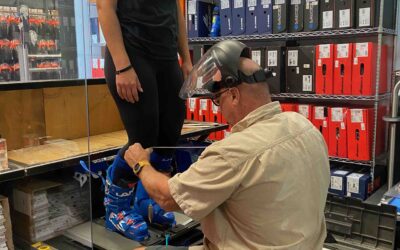
We bootfitters are naturally obsessed with feet, but the best bootfitters don’t just fit feet; they fit the whole skier. The “whole skier” includes more than just a quick survey of the lower leg and how it’s connected to the foot. It’s even more than all of the skier’s physical attributes, which include not only height and weight, but seated posture, stance, kinesthetic wiring, arch health and stiffness throughout the kinetic chain; the whole skier also includes his or her history with the sport and, most importantly, what sort of skier he or she wants to be.
One of the most obvious traits about almost all boot customers is his or her gender. (Please forgive me if I don’t overcomplicate what should be a simple point about body type.) The first step in a sales process that consists of winnowing all possible boots down to one is picking from the pile of unisex boots or the alternative world of women’s boots.
No-brainer, right? Not so fast. What if a particular woman were tall, with a long tibia and a tapered calf? Let’s add to her profile that she’s a good athlete with a background in dance. Up to now, she’s only been an occasional skier who rented her gear, but a new beau has persuaded her to take a deeper dive. She already has her season pass.
The Things We Do for Love, Part II
Dear Readers who regularly devour my weekly Revelations know that I have already written at length on the subject of Why Skiers Are Better than Everyone Else. Last Friday I was reminded of my timeless prose as I spent 45 minutes traversing a very short stretch of road that connects I-80 to Route 89, my proscribed path to Alpine Meadows. As I voluntarily descended into this automotive miasma, I could make out the dim form of the interstate traffic snaking down from the west, two dense strands of tightly linked vehicles stretching beyond the horizon.

Realskiers.com Trounces Field to Earn Second Stump-Bertoni Prize for Excellence
In a stunning upset that in retrospect appears inevitable, Realskiers.com has been awarded The Stump-Bertoni Prize for Excellence for the second year in a row.
For those cave-dwellers who snoozed through Realskiers.com’s first triumph in this gilded competition, permit me to bring you up to speed. Then as now, the battle for this cherished trophy (metaphorically speaking – the S-BP lacks sufficient funds for a memento commensurate with its prestige) was fierce, extending both of its eponymous founders to previously unknown limits.
The final ballot was determined by leg wrestling over Stump’s furious protest; he cogently argued that this sort of bias against the vertically challenged has no place in a free society. Bertoni imperiously overruled Stump’s evermore strident complaints, citing a lack of legible documentation, tardy submissions and a tendency to perspire copiously when provoked.
This year’s competition was no less fraught.
