


This week’s Revelation is an amalgam of important messages for any skiers looking for new skis and/or boots this year. Its recommendations are tilted in favor of the silver skier set, if only because one new product in particular is heaven-sent for this constituency. The Revelation you’re currently consuming will also provide some background for the subjects of the next two podcasts of Realskiers with Jackson Hogen, which are required listening for skiers of every stripe.
My guest on Realskiers with Jackson Hogen on Thanksgiving Day will be Jim Schaffner, the erstwhile owner of Start Haus (in Truckee, California), a renowned bootfitter and veteran instructor at Masterfit University. In addition to consulting with just about every boot brand in Christendom over his long career, he’s skied every boot of consequence for the last quarter-century. When Schaffner speaks, boot product managers listen.
So when Schaffner shared my assessment that the new Lange Shadow represents the most significant improvement in two-piece, overlap shell design since the invention of the plastic ski boot, you can be sure it’s the real deal. I won’t get into all the details about how the new Shadow pulls off this feat as that’s the primary subject of the podcast that follows Schaffner’s, with Thor Verdonk, who led the design team that created the Shadow. (The Verdonk interview is scheduled to post on November 30.)
But I will tell you why I think Shadow is so important, particularly for anyone old enough to have an AARP card. The net effect of the various changes embodied in the Shadow is its automatic amplification of the skier’s natural flexing action. Simply put, it takes less effort to translate the skier’s energy to the ski. The Shadow also augments the boot’s inherent rebound when pressure is released. This under-appreciated quality is what gives a new boot its youthful vitality, which is gradually drained with age. The Shadow design helps to retain this essential quality, even if its user’s energy reserves are likewise incrementally waning.
No matter how much I prattle on about the virtues of the Shadow’s shell and cuff design, it won’t prepare you for the shock of how comfortable it feels from the moment your foot slides in. The new Auxetic inner boot is a marvel in its own right, so comfortable from the get-go that experienced skiers are bound to be suspicious: how can a high-performance boot excel at energy transfer when the foot is surrounded by what feels like a room full of throw pillows?
Schaffner characterizes the central conundrum that the Shadow design solves as the successful separation of the functions/requirements of fit and performance. Bear in mind, Schaffner cut his product development teeth at Salomon during the entire life span of its legendary rear-entry design. The foundational problem that the Salomon rear-entries addressed was the separation of fit and function, so it shouldn’t surprise that Schaffner sees the Shadow through the same prism. Plus, I think Schaffner is right: the ethereal fit sensation of the Auxetic liner seems divorced from the responsiveness inherent in its cuff design. I realize Schaffner’s podcast posts on Thanksgiving Day, but just like turkey-day leftovers, it will still be good a day later.
Simplifying Ski Selection for Seniors
One of the too-numerous-to-mention-here benefits of Realskiers.com is identification of selected models as Silver Skier Selections. These are models that, in my estimation, are either inherently easier to steer with light pressure or possess such a broad performance envelope that their charms are accessible to lower-energy skiers as long as they’re sized down.
A few of my Dear Readers have kindly pointed out to me that I haven’t corralled all the Silver Skier Selections in one location, a deficiency I have yet to address. Mercifully, I have been spared the effort by SeniorsSkiing.com, whose publisher has done the necessary sorting. You can find a complete list of my 2024 Silver Skier Selections here.
Allow me to close this week’s Revelation with an appeal that feels particularly relevant this time of year. The holiday period is often characterized as a time of giving, and while you may feel like you have already given plenty, have you really? When you consider the extraordinary rewards bestowed on Realskiers.com members, is paying for a membership really enough? Deep down, you know you can do better. Well, I believe in you, Dear Readers, which is why I am appending a link to the Realskiers.com Tip Jar at the bottom of this missive.
Lest you imagine for a moment that the mavens at Realskiers.com are not worthy of your over-the-top largesse, I remind you that Realskiers.com not only won the inaugural Stump-Bertoni Prize for Excellence, it so out-classed the field that after winning its second Stump-Bertoni medallion the award was permanently retired.


Related Articles

The Five Stages of Ski Finish Awareness
Don’t let the title fool you. Although it sounds like it, this Revelation isn’t about the degree to which skiing is top of mind among Helsinki society. The purpose of this exposé is to shine a light on a subject about which almost all skiers are woefully uninformed, namely the condition of their skis’ bases and edges.
Just in case you don’t imagine this subject worthy of your attention, I hasten to point out that how well your skis are tuned and maintained isn’t just a factor, it is the factor that determines how well your skis perform. A properly tuned ski, regardless of brand or type, is a delight for skiers of any and all abilities while an untuned ski is such a detriment that even supreme skill cannot overcome its liabilities.
From Fallible to Foolproof and Back
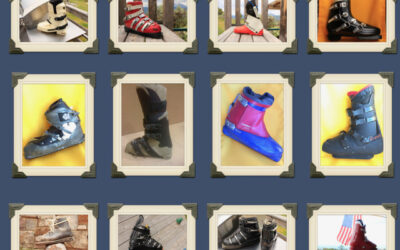
In the 1970’s, prior to the adoption of the first ski boot sole standard, boot makers were free to concoct any sort of sole they might imagine. Many skiers still used leather boots with laminated soles, even after the industry largely moved on to injected plastic, which enabled shapes and sole patterns leather couldn’t duplicate.
This incoherent jumble of boot designs showed no lack of imagination, but little consideration for how they might interact with a binding. Bindings were likewise free from any standards that might have limited the creativity of their designs, many of which were crafted specifically to reduce or eliminate the role of the boot.
The Road to Perdition
The road to hell is said to be paved with good intentions. In my experience, the friends and relatives of prospective boot buyers are a wellspring of wretched advice wrapped in bright ribbons of sincerity and concern.
(Let us pause a moment and prayerfully acknowledge the gratitude of bootfitters everywhere that the new, pandemic-driven bootfit protocol discourages the presence of a bootfit entourage composed of family, moral supporters and consiglieri.)
Back to the subject at hand, the particular nugget of advice I’m leery of is the customary admonition to avoid too stiff a boot as it will hurt, you’ll hate it eventually if you don’t detest it immediately, and it will inhibit your skills development. Get only as much boot as you need and no more, goes the conventional wisdom. Racers need stiff boots; you don’t.
