
Maybe it’s because I’ve spent what feels like several days in the clutches of AT&T customer service, a stretch of unrelieved aggravation that would roil the implacable calm of the Buddha, but the latest new product announcement to arrive in my mailbox ruffled my feathers. I realize my remarks are likely to be dismissed as the ravings of a 19th-century Luddite, which is almost accurate. Actually, my mindset more closely resembles that of an ancient Druid.
Those of my Dear Readers and Listeners who have read the odd chapter of Snowbird Secrets know that I believe skiing can open pathways of learning that are normally inaccessible. To achieve this level of cosmic connection with the mountain, the skier must be totally immersed in the experience. He or she must be present, so focused on the here and now that the separation between one’s movements and one’s essence disappears. Hold that thought while I return to the content of the press release that recently found its way to my desk.
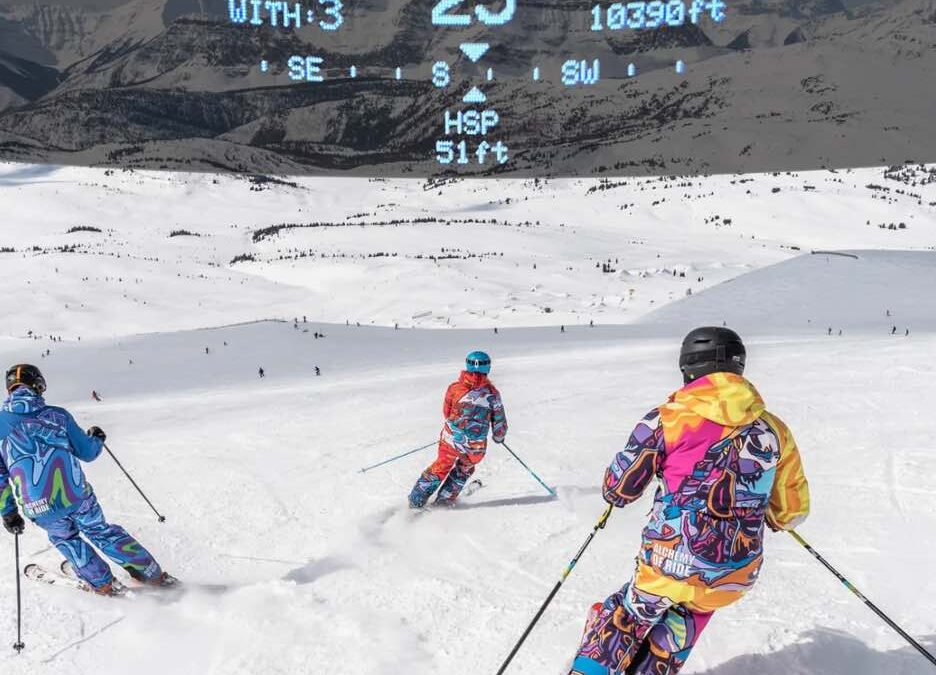
The latest appurtenance that all skiers will soon find indispensable is a new goggle named Rekkie that incorporates a display that will read your texts, answer your phone, keep tabs on all your friends, play your music and track your speed and vertical. All of this is right in front of your eyes, assaulting you with information and enticing you with distractions while you are supposedly engaged in the act of skiing.
I think my regular Dear Readers will recognize where I’m going with this tirade, but I’m not so sure those who sport these new goggles will be able to see where they’re going through the curtain of data dancing before them. It’s not just that this is all information you do not need to ski, nor even that some of it is likely to be wrong, but that it demands your attention be somewhere it shouldn’t be while you’re hurtling downhill on well-populated slopes.
Among the most celebrated of modern-day conceits is that people are capable of multi-tasking, despite the mountains of evidence that most people can’t handle tasks when taken one at a time, much less all at once. On the contrary, I find that many people are distracted all the time, usually by the digital devices in their hands or ears. With Rekkie goggles (and attendant app, of course), the art of distraction has been taken up a notch. The idea that some of the skiers around me may be more intent on the data floating around inside their goggles than they are with what is unfolding in front of them does not inspire confidence in my fellow man.
In the promotional literature, the number that looms largest in the skier’s field of vision is his or her speed, a figure that is almost certainly wrong. (See my Revelation of October 2, 2017, Deceptively Fast.) At least when a skier’s (inflated) speed was displayed on his or her phone, it wasn’t being dangled right before their eyes, daring them to go faster. I wouldn’t be at all surprised if it turned out to be the new goggles’ favorite feature.
How faithfully the goggles’ programming captures emails and text messages I have no idea, but their ready immediacy while I’m skiing sounds to me like a good way to ruin a ski day. I’m likewise not a fan of playing music while skiing, although I often start a song in my head just before I push off. (I’m particularly fond of Mixed Emotions, by the Stones.) It’s not that I don’t like music – I’m not that much of a curmudgeon – but I want to be able to hear my skis and all the other ambient sounds around me. I want to be able to hear the mountain channel the wind, and the soft crunch of compressing powder. Imported tunes muffle and distort the mountain’s own inimitable music.
The inspiration for this new accessory came to one of its creators when he became separated from others in his group; trying to reconnect ate up precious slope time, a sentiment I can definitely relate to. An app that tells you where everyone is sounds helpful, whether you’re trying to set up a rendezvous or avoid one. Of course, everyone you want to track needs to be outfitted with the same goggles and software, so connectivity comes at a fairly steep cost.
On that subject, a pair of Rekkie Smart Snow Goggles will run you $349.00 with the software/app package, or a mere $99 without. I’m not a goggle expert, but the un-smart version is priced well below most premium brands, which suggests the goggle may not be as sophisticated as its software. As I have no experience with the product, I’m in no position to judge its foundational qualities, but I hope its inventors didn’t attach all this technology to a so-so goggle. After all, a skier who is trying to track how the stock market is faring when he should be trying to dodge a sequoia he can’t quite make out, is not long for this world.

Related Articles

Road Tripping
Among the many dissatisfactions of this most unusual season is that travel beyond one’s local environs has been roundly discouraged. Don’t get me wrong: I’m grateful down to my socks that we’re allowed to ski locally, and my version of same is pretty sweet. Pardon the plug, but between Alpine Meadows, Squaw Valley and Mt. Rose I have a smorgasbord of savory choices.
But skiing close to home and skiing on the road are two different beasts. Nothing is the same, really, and therein lies a great deal of the road trip’s charms.
To shed light on my premise, allow me to pull back the veil on my favorite away game, an annual pilgrimage to Little Cottonwood Canyon. By the end of this brief travelogue you will probably hate me, so please fill your vessel of good will to the rim before proceeding.
It’s About Nothing
In the last week of January,2009 I was able to spend a few days skiing in Little Cottonwood Canyon, which is always cathartic for my ravaged soul. The conditions were all over the map, the mountains having experienced a long, hot spell followed by rain, grapple, wet snow and finally dry snow driven by winds that could flense an adult walrus in a few minutes. Couldn’t have been better.
I had been preparing for the trip for weeks, psychologically. Two back surgeries the previous winter had reduced my training regimen from semi-annual to non-existent. Scheduling conflicts such as work kept me from visiting the areas that abound at home near Lake Tahoe, so I had zero ski days on a body with more fat on it than a French duck. I had as much chance of surviving Snowbird and Alta as a rib roast in a piranha tank.
Fortunately, the Lord is merciful, anti-inflammatory drugs are powerful and there are techniques that allow one to block out pain. There are also many wonderful people in this world with which to ski, kind people who stand quietly by, pretending to be in awe of Nature, while my chest heaves so violently in its futile quest for oxygen that tiny lung particles break lose and make for the exits. One such person is Guru Dave Powers, a man whose passion for the sport hasn’t diminished after thousands of days of riding gravity down the infinitely variable slopes and crannies of Snowbird. The Goo knows this hill, and in knowing it well knows so much more.
The Making of a Skier, Chapter XII: Putting Words into the Mouth of God & Other Mid-Life Adventures
When I was cut adrift by Head on June 13, 2001, my once glowing prospects dimmed considerably. The date is etched in memory because I hosted a small soirée that evening in honor of my darling wife’s 50th birthday. One of the attendees was Paul Hochman, who would play several roles in my life as I wandered in the wilderness of unemployment during what were supposed to be my peak earning years.
During the gaping hole in my career that spanned 2001-2011, I would eventually spend every cent of my inheritance, plus most of what I’d saved from earlier bouts with gainful employment, just keeping the household afloat. Despite a river of red ink, my resume would suggest that I was not only commercially active during this epoch, but had my hand in all sorts of ventures.
