
Maybe it’s because I’ve spent what feels like several days in the clutches of AT&T customer service, a stretch of unrelieved aggravation that would roil the implacable calm of the Buddha, but the latest new product announcement to arrive in my mailbox ruffled my feathers. I realize my remarks are likely to be dismissed as the ravings of a 19th-century Luddite, which is almost accurate. Actually, my mindset more closely resembles that of an ancient Druid.
Those of my Dear Readers and Listeners who have read the odd chapter of Snowbird Secrets know that I believe skiing can open pathways of learning that are normally inaccessible. To achieve this level of cosmic connection with the mountain, the skier must be totally immersed in the experience. He or she must be present, so focused on the here and now that the separation between one’s movements and one’s essence disappears. Hold that thought while I return to the content of the press release that recently found its way to my desk.
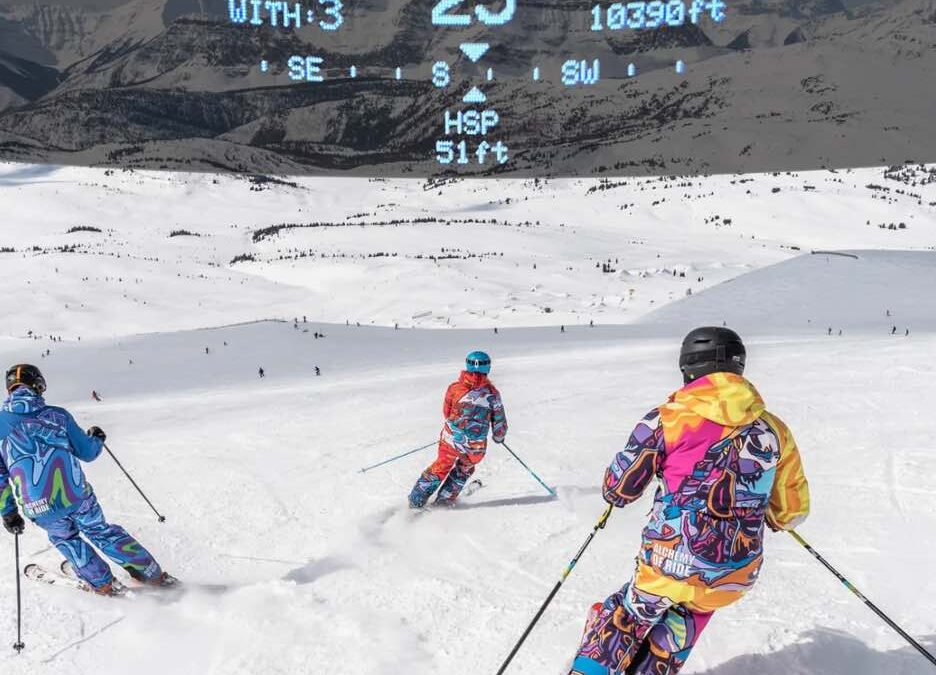
The latest appurtenance that all skiers will soon find indispensable is a new goggle named Rekkie that incorporates a display that will read your texts, answer your phone, keep tabs on all your friends, play your music and track your speed and vertical. All of this is right in front of your eyes, assaulting you with information and enticing you with distractions while you are supposedly engaged in the act of skiing.
I think my regular Dear Readers will recognize where I’m going with this tirade, but I’m not so sure those who sport these new goggles will be able to see where they’re going through the curtain of data dancing before them. It’s not just that this is all information you do not need to ski, nor even that some of it is likely to be wrong, but that it demands your attention be somewhere it shouldn’t be while you’re hurtling downhill on well-populated slopes.
Among the most celebrated of modern-day conceits is that people are capable of multi-tasking, despite the mountains of evidence that most people can’t handle tasks when taken one at a time, much less all at once. On the contrary, I find that many people are distracted all the time, usually by the digital devices in their hands or ears. With Rekkie goggles (and attendant app, of course), the art of distraction has been taken up a notch. The idea that some of the skiers around me may be more intent on the data floating around inside their goggles than they are with what is unfolding in front of them does not inspire confidence in my fellow man.
In the promotional literature, the number that looms largest in the skier’s field of vision is his or her speed, a figure that is almost certainly wrong. (See my Revelation of October 2, 2017, Deceptively Fast.) At least when a skier’s (inflated) speed was displayed on his or her phone, it wasn’t being dangled right before their eyes, daring them to go faster. I wouldn’t be at all surprised if it turned out to be the new goggles’ favorite feature.
How faithfully the goggles’ programming captures emails and text messages I have no idea, but their ready immediacy while I’m skiing sounds to me like a good way to ruin a ski day. I’m likewise not a fan of playing music while skiing, although I often start a song in my head just before I push off. (I’m particularly fond of Mixed Emotions, by the Stones.) It’s not that I don’t like music – I’m not that much of a curmudgeon – but I want to be able to hear my skis and all the other ambient sounds around me. I want to be able to hear the mountain channel the wind, and the soft crunch of compressing powder. Imported tunes muffle and distort the mountain’s own inimitable music.
The inspiration for this new accessory came to one of its creators when he became separated from others in his group; trying to reconnect ate up precious slope time, a sentiment I can definitely relate to. An app that tells you where everyone is sounds helpful, whether you’re trying to set up a rendezvous or avoid one. Of course, everyone you want to track needs to be outfitted with the same goggles and software, so connectivity comes at a fairly steep cost.
On that subject, a pair of Rekkie Smart Snow Goggles will run you $349.00 with the software/app package, or a mere $99 without. I’m not a goggle expert, but the un-smart version is priced well below most premium brands, which suggests the goggle may not be as sophisticated as its software. As I have no experience with the product, I’m in no position to judge its foundational qualities, but I hope its inventors didn’t attach all this technology to a so-so goggle. After all, a skier who is trying to track how the stock market is faring when he should be trying to dodge a sequoia he can’t quite make out, is not long for this world.

Related Articles
The Making of a Skier, Chapter XI: Desperate Measures
When Head humanely, if rather brusquely, terminated my tenure in 2001, the ski business in the U.S. was already facing stiff headwinds, a brewing storm that would turn into a full-on debacle when 9/11 disrupted all commerce. I became unemployed just in time for the job market to implode.
I don’t handle inactivity well. I started writing a very long, very dreadful novel, composed a handful of scripts for Warren Miller – and later, Jeremy Bloom – to recite and scribbled batches of brochure copy and white papers for industries as diverse as accounting software, instrumented football helmets that registered concussions and risk assessment based on location.
The pickings were slim, but they wouldn’t have amounted to anything at all were it not for a little help from my friends. Andy Bigford, who I’d worked with at Snow Country, hired me for the Warren Miller gig. A college chum kindly engaged me to write white papers on accounting fraud. But it was Dave Bertoni, an erstwhile colleague from Salomon days, who joined me in creating Desperate Measures: A Training Method for Selling Technical Products at Retail.
Reader Comments on Why Ski Sales Have Shrunk
In this week’s Revelation, I posted my top ten (twelve, actually) reasons why skis sales have shrunk, along with the musings of two Dear Readers on the subject. Note that the topic’s focus was ski sales at retail, not skier or skier/rider participation rates, subjects that are certainly related but just as certainly not the same.
Below are verbatim reader responses culled in the last 48 hours. I’ve corrected the odd typo, but otherwise left these contributions intact.
My thanks to all who took the time to tell their tales. – J
Top Reasons U.S. Ski Sales Have Shrunk
[As I wrapped up an earlier Revelation, I proposed to my beloved readership that they share their list of the top ten reasons U.S. ski sales have shrunk. I elicited only two written responses, so I’ll reproduce both here in their entirety, along with my musings on the subject. Consider these submissions tinder to light a fire under you, Dear Reader, to submit a list of your own.]
From Rick Pasturczak
1. Snowboarding-
I’ve noticed most snowboarders are 12 to 20 years old and once they become an adult, almost all stop. While I noticed most skiers continue on.
2. High school and college sports-
Schools now require practicing sports during Christmas and spring breaks taking away opportunities to hit the slopes and family vacations to the mountains. I’ve been told by many parents the coaches forbid them to ski.
3. Travel costs-
Lodging, airfare, ground transportation, and lift tickets.
4. Video games
5. Cost of lessons make it expensive to improve.
6. Confusing selection of equipment
7. Magazines and movies showing extreme skiing
8. Cruising. We need some resorts to be all inclusive.
9. Baggy pants. Bring back stretch pants and sex appeal.
10. Last, we need mother nature to be more consistent with snow.
