
If Bloomberg Business doled out financial advice as transparently idiotic and unresearched as its ski gear advice, Bloomberg – and all its clients- would be bankrupt.
Dear Readers:
The following bit of tripe was recently re-published by Apple News after first appearing in the pages of Bloomberg’s online publication. It consists of unreadable drivel from end to end, and certainly isn’t worth paying to peek behind the Apple News paywall to investigate, so I’ve copied the text, verbatim, in this week’s Revelation, and I’ll also recite it as we visit its few paltry paragraphs of twaddle in the companion podcast. My commentary runs alongside the original in red.
If you detect a tone of irritation mingled with impatience in my voice, it’s because this sort of crap gets under my skin. I don’t offer financial advice; I wish Bloomberg would stay out of my lane and resist the urge to comment on ski equipment that its writers clearly do not understand.
I’m sharing it with you because:
- While most “writers” whose efforts at English appear mainly in online pubs are incompetent hacks, this is a particularly glaring example of lazy composition that reveals a contempt for its readership that sets a low bar lower still.
- The pseudo-journalist who composed this piece and the dimwit editor who assigned it richly deserve to be flogged in a public forum, a service I’m more than happy to provide.
- Finally, I wish to entertain as well as edify my Dear Readers and Dear Listeners. I hope you enjoy this pensée as much as I enjoyed deconstructing the original article’s serial inanities.
Here’s the link to the original article: https://www.bloomberg.com/news/articles/2024-10-17/new-skis-boots-to-improve-technique-confidence-nordica-rossignol-volkl?embedded-checkout=true.
Pursuits ■ October 17, 2024, 5:51 AM EDT
The Bloomberg article is titled,
These New Skis and Boots Can Instantly Improve Your Technique and Confidence
Manufacturers have hit the sweet spot with ski gear to get you back to black.
By Jen Murphy
The author begins her assault on her readers’ intelligence in the title, then doubles down in her first sentence, citing stats that are transparently untrue. For openers, no piece of equipment can instantly improve anyone’s technique just by purchasing it. A properly selected and fitted boot can make skills advancement more attainable, but it won’t automatically do anything for you. In any case, the two boots this article references are designed specifically to be more convenient and would not generally be regarded as performance models. We’ll return to this subject later. Let’s get to the first sentence, as it’s a paradigm of poor research and unsubstantiated claims.
Almost half of the 13 million Americans who skied last season either were first-timers or hadn’t been in a while, and manufacturers are responding with gear that instantly (and effortlessly!) improves technique.
Wow. There are no credible statistics to support the claim that 13,000,000 Americans went skiing at an alpine ski resort last year, or any other year in your or my lifetime. Not even close. The highest (arguably) plausible number is around 10,000,000, which would already be an all-time high.
As for 6,500,000 beginners or recently returned former skiers, not only is this figure hopelessly wrong, it flies in the face of current trends, which suggest a decline in the never-ever category. How the author can even pretend to know such an untracked statistic is beyond me. Not to mention that the skis and boots she cites aren’t aimed at entry-level skiers. A stellar achievement in the annals of disinformation. But our Dear Author isn’t done yet…
Manufacturers do not “respond” to trends that emerged in the prior season; the R&D cycle doesn’t take 3 months; it’s closer to 3 to 4 years. Not to beat a dead horse, but new skis and boots do not confer advanced ability. Skiing is a sport, not some mindless activity, and it takes skills development to improve.
These pieces of equipment may not take you from zero to hero overnight, but they just might help you turn squares into diamonds.
This attempt at error correction doesn’t mitigate the follies to follow: two of the three recommended skis are unapologetically aimed at advanced to expert pilots, while the two boots, as noted, are designed to ease entry/exit, not facilitate rapid skills development. Onto the skis!
Nordica Enforcer 99: The new 99 has all the top-end performance DNA of its predecessors but adds a versatility boost. A sharper rise in the tip gives it more stability across all conditions—from groomers and powder to bumped-up glades and ice—while its overall shape allows the ski to change the arc of a turn with just the slightest bit of pressure from your shins.
Congratulations, Dear Author, you almost made it two full sentences before missing the point. Yes, the new Enforcer 99 has increased its tip radius, but this is a less significant development than the change in tail rocker profile, which releases the turn smoothly across a range of snow conditions. The remark about “pressure from your shins” has little to do with changing turn radius, which is more a function of how the sidecut meets the snow: the higher the edge angle, the tighter the turn radius. This is the first hint our Dear Author not only hasn’t ever skied the skis under review, it suggests that she has little to no ski experience of any kind.
A new pulse core (the underfoot layer of rubber) dampens the ski so you can blow through choppy terrain without punishing your legs. It’s a combination of power and finesse that makes this the Goldilocks of all-mountain, all-condition skis.
Finally, a snippet of brochure copy our Dear Author almost understood. The Energy 2 Ti Pulse Core (it’s a trade term, hence capitalized) indeed places an abbreviated layer of elastomer underfoot, between the top sheet of Titanal and the vertically laminated wood core. It helps with shock absorption, so she got that right, but it’s only one ingredient in the shock-muffling recipe. (The Titanal laminates do the heavy lifting.) At least our Dear Author is right on the main point: the Enforcer 99 is a great ski, probably more than the neophyte she cites in the opening paragraph needs, but let’s be optimistic that the relative newcomer can grow into it in the fullness of time.
Rossignol Arcade 84: For anyone who’s had to deal with hardpack on low-snow years, here’s a solution for incredible edge and grip. [Hmm, I think you intended to say “edge grip,” but it’s clear that ski design argot is all new to you.] Rossignol built this ski with a poplar wood core and full-length sidewalls to provide remarkable stability and precision whether you’re navigating crud or corduroy and the odd powder day, too. It also has the right blend of stiffness and snappy responsiveness to provide a short and easy-to-control turn radius. Confidence, elevated.
The use of poplar is hardly noteworthy, as it’s the most common wood in use today, and full-length sidewalls, while nice enough, are hardly worth writing home about. The rest of the copy is routine PR blather.
Völkl Mantra M7: Whether you want to glide from blue to black or from groomers to off-piste, the Mantra M7 has a four-dimensional sidecut design that lets you link turns more smoothly and takes less effort to control at lower speeds. Think of it like paddle-shifting on a steering wheel: You get the performance of a sports car without the complexity and skill necessary to operate a clutch. The result is a ski that helps aspiring chargers unlock their potential without feeling overpowered.
Yikes! “Four-dimensional sidecut?” Are you trying to suggest the M7 helps the skier travel through time as well as space? Of course, you’re trying to reference Völkl’s 4-Radius Sidecut, but the virtues of this feature obviously flew over your whipped-cream-filled cranium, or you wouldn’t suggest it has anything whatsoever to do with saving effort at lower speeds. The unique virtues of the Mantra M7 are patently inaccessible to the lower skill skier this article pretends to address.
Boot Camp
Rossignol Vizion: The most exhausting part of your ski day can often be wrestling your boots. No longer. A rear-entry design lets you slip the boots on and off, hands-free, like a slipper. Usually this type of design requires a less sturdy, two-buckle construction that prioritizes comfort over performance. The Vizion, by contrast, maintains the four-buckle design of a performance boot, but with hidden snaps under the top buckles that release the heel for a Cinderella fit you can glide right into. That means power and precision on the slopes—and après readiness with a quick flick of the double buckle.
Lord have mercy. The Vizion is NOT a rear-entry design – that’s kinda the whole point. It has the architecture of a four-buckle overlap with the convenient entry/exit normally associated with a rear-entry. It is a welcome addition to the pantheon of current ski boot designs and should attract interest from skiers whose low-skill seasons are well in their rear-view mirrors. The one thing the Vizion doesn’t guarantee is a “Cinderella fit;” achieving this eminently desirable goal is between the skier and his/her bootfitter. If it’s over-sized – as entry-level and intermediate boots often are – it’s skiing virtues will be masked forever.
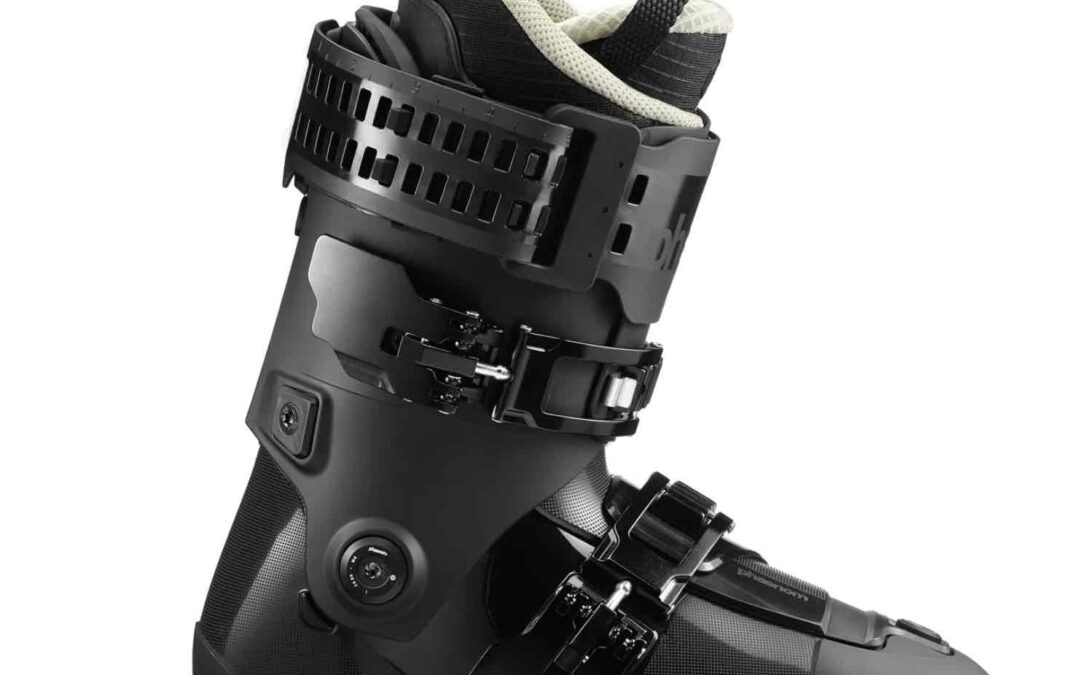
Phaenom FS 01 120: What’s got two buckles, a spacious inner and still lets you shred like a pro? This boot. After four years of development and a soft launch last season, B Corp-certified Phaenom is rolling out a disruptive design that’s aimed at expert freeskiers but is equally good for intermediate, all-mountain shredders. It rethinks everything from the liner—which you remove and lace up before stepping into the plastic shell—to the oversize power strap that goes across your shin, which in this case works like a third buckle to provide shock absorption and exceptional flex control. The toe box is wider without sacrificing heel hold. And in a nod toward sustainability, every element, from buckles to screws, is repairable and recyclable.
This review had the potential to be very interesting if only our Dear Author had any idea what she was writing about. (Note that she never explains “B Corp-certified,” no doubt because she hasn’t the faintest idea what it means.) Simply put, the Phaenom is the next generation of the much-derided Apex, which combined a snowboard boot with a rigid exoskeleton to create a semblance of a ski boot. By appearances – which is all we have to go by, as there’s zero chance our Dear Author ever skied it – the Phaenom is a complete, ground-up overhaul that ditches the exoskeleton while preserving a roomy fit environment. I doubt it will be “disruptive,” because this is a terrible year to be introducing a new concept; dealers aren’t in a risk-taking mood at the moment. But it may well be a big improvement over its antecedent. We’ll have to wait until we talk with someone who’s actually skied it…
By this point in the narrative, some of Dear Readers and Dear Listeners may suspect that the swill bucket I’ve just examined is the product of AI, but I very much doubt it. AI is already much, much better than this, and wouldn’t have made some of the rudimentary mistakes this article is littered with. Why Bloomberg News would drag its name through the mud just to fill space in one of its online issues is beyond me. If any of you would care to speculate on the subject, I’d be happy to entertain your suggestions.

Related Articles

The Making of a Skier, Part IX: The ASTM, Carl Ettlinger and I
One of the many hats I wore as North American binding product manager for Salomon in the early 1980’s was that of delegate to the American Society for Testing and Materials (ASTM). I believe the first meeting of F8.14 – the sub-committee on ski safety – that I attended was in Pennsylvania. I was flying under the wings of Salomon’s seer of all standards and patents, Gilbert Delouche, and the binding product manager for the North American zone at that time (and my mentor), Joe Campisi.
I was a babe in the woods, but I soon caught on to the game under Delouche’s patience guidance. I recall a debate on the binding specification then being batted around in the technical committee chaired by Carl Ettlinger. Ettlinger wanted language that would require any release/retention setting of 10 or above to be “visually distinctive” from the rest of the scale.
In Memorium, Carl Ettlinger
Carl was a giant of a man whose outsized voice roiled every conversation like a burst dam and whose expansive vision reached across the mixed milieus of research, journalism, risk management and education. I knew him when he was at the peak of his powers, as he explained to me when I interviewed him for a “where are they now?” profile in Skiing History. He was able to conduct long-term research on injury patterns as well as analyze the particulars of the current binding market, turn around and package this knowledge into articles for Skiing and Skiing Trade News, followed up by a workshop tour that would bring enlightenment to the grassroots level. No one but Carl could have pulled this off, and Lord knows no one has had the requisite talent, energy and will power since.
But time and tide wait for no man, and Carl’s finely spun web of influence was eventually plucked apart. The loss of his pivotal positions in the press allowed him to slip from public view before we, the skiers of the world, realized we hadn’t taken the time to thank him.
We have the time to thank him now.
So thanks, Carl, for being first and foremost a teacher, for teaching is at the heart of the evangel’s mission.
Thanks for being so damn stubborn. Your insistence on improving skier safety wore through a wall of resistance as tough as Vermont marble.
Thanks for having a heart as big as that melon-sized head of yours. The fuel to your tireless mind was a caring heart that tried to embrace the world.
Thanks for all the stories once the Mount Gay flowed. Who knew we would have won the Vietnam War if only his superiors had listened? I can’t remember exactly how – he wasn’t the only one drinking Mount Gay – but I recall the light in his eyes as he relayed his twisted tales, taking us down successive rabbit-holes of digression that I lost track of at the seventh level.
That’s what I remember most vividly about my many interactions with Carl: his brain so teemed with thoughts he rushed to get them out in a verbal jailbreak that would travel around the cosmos until returning, many lost minutes later, to the subject that had inspired them. That was Carl: too many words for one sentence, too many tasks to tend to and all of it, every erg of his endless energy, devoted to a cause he never ceased to serve.
Fare thee well, Carl Ettlinger. The world misses you already for it will never see another quite like you, whose every moment seemed larger than life itself.
I raise my glass to you, old friend. Mount Gay, of course.
Jackson Hogen
June 23, 2020

Why This Buyer’s Guide?
Don’t read the 2021 Masterfit Buyer’s Guide in Partnership with Realskiers.com for its 62 ski reviews. I should know. I wrote or edited all of them.
Not that the ski reviews aren’t worth the read. But ski reviews on the web are as common as rice, while the Buyer’s Guide contains something no other publication, whether in digital, print or video format, can claim: the most respected, thorough and dependable boot reviews in the world.
This isn’t mere puffery. The Masterfit Boot Test is so well regarded by the supplier community that nearly every brand not only sends its following year’s line-up in four men’s sizes plus three for women, it also dispatches its top designers and/or product managers to a distant North American site for most of the test’s five-day duration.
