
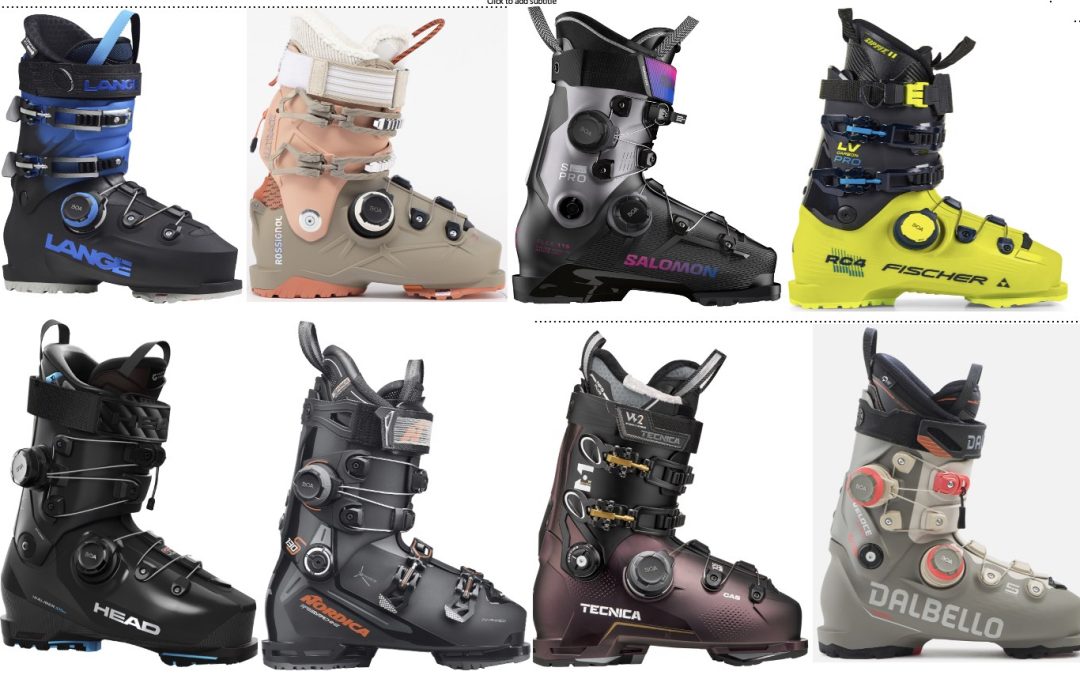
A scant three seasons ago, there wasn’t a single alpine boot adorned with the now-familiar BOA® dial. As the 2026 season commences, there isn’t an alpine boot brand that doesn’t deploy a BOA® cable retention system in at least one product across a broad swath of its non-Race boot collection.
If you detect a note a of modest amazement at the swiftness of this development, it’s because integrating the BOA system into a hard plastic shell isn’t a self-evident proposition. Sure, the BOA device had already become ubiquitous among snowboard boots (and other forms of athletic footwear), but the alpine ski boot presents a very tricky fit environment. For BOA® to work, the alpine boot maker would have to turn over the development reins, essentially anointing BOA as a co-creator of its own product line.
K2 was one of the first boot brands to enthusiastically embrace BOA®, extending its reach throughout its collection. K2’s enthusiasm for BOA® goes all the way back to the fit system’s origins: when BOA debuted in 2001, its first incarnation was on a K2 snowboard boot, a brand alliance that has remained strong, establishing an ethos of co-branding that remains part of BOA’s brand identity.
One of the benefits of early adoption was the confirmation that BOA® worked best when it was integrated into the design, rather than jerry-rigged onto an existing chassis. K2’s new Cortex model is a low-volume, double-BOA® affair built around the BOA® concept from day one. As with any low-volume, two-piece construction, getting the Concept on and off is a bit of an ordeal, particularly for the flexibility-challenged members of the senior population, but a better fit and more accurate steering should off-set this minor drawback. The point I’m trying to make is that BOA isn’t just a part of the K2 Concept’s design; BOA® is the design, as interpreted by K2.
For an impactful impression of just how pervasive the BOA® fit system is today, this single page from the BOA® web site – https://www.boafit.com/en-us/products/ski – captures the range of adoption that is already in place. Bear in mind the models displayed on this page are only a fraction of the BOA-equipped models that have already fully infiltrated the American market.
In its first-generation collaborations with its alpine boot partners, BOA began with uniform parts and accessible anchor points. As second-generation models roll into production, every aspect of the closure and retention systems will be optimized brand by brand, model by model.
Extending BOA’s Reach into Racing
While the four-buckle overlap shell design is in full retreat across all recreational genres, it still dominates in the category that has always embraced it: Race. The apparent BOA/Buckle divide would just be one more example of how deep and wide the chasm has become that separates the recreational skier from the race community. In concert with some of its alpine boot partners, BOA has already been testing the race-worthiness of its design for several seasons. What if a boot manufacturer could concoct a BOA®-equipped boot that beat buckles at their own game? In other words, what if a BOA® boot were faster?
Before traditionalists get their wool undies in a knot, consider this: The BOA® boot has the potential for a longer travel with more progressive resistance, while the classic overlap has a relatively short absorption phase before hitting a wall the racer can leverage to steer. Perhaps a fresh combination of stance, fit and flex will one day prove to be faster. BOA® continues to work diligently with elite athletes to create a BOA® race design that provides the desired functionality without the extreme pressure and tightness to which racers are accustomed.
If BOA® has already hit upon a new paradigm that meets the needs of the World Cup racer, I suspect we would have heard about it. Part of the problem BOA faces with race boots that isn’t an issue with a recreational product is that their plastic is much stiffer and not so easily influenced by the contortions of a cable. Also, a race fit not only has to be exceptionally precise, it also needs to be consistent from the start gate to the finish line. Aside from the obvious differences in how a BOA-equipped race boot might feel, if it can’t mimic the sustained solidity and concomitant energy-transfer properties of a 4-buckle race boot, it will likely remain an R&D project until it does.
The separation of fit qualities and flex properties that the BOA® design makes possible remind me of the benefit/advantage arguments for the legendary Salomon rear-entry models, the SX90 and SX91. For starters, both used a patented, adjustable internal cable to secure the foot, although the Salomon cable path went over the instep, rather than wrapping the forefoot. Speed skiers of the day gravitated to the Salomons because they were transparently more aerodynamic and fit and flex were functionally differentiated. These qualities should be just as useful today as they were then.
BOA’s ambitions appear boundless. Aside from its total domination of the snowboard and alpine boot markets, BOA has permeated golf shoes, competitive cycling, outdoor activities and even work boots (in partnership with K2 and Vans). The messaging is consistent across all ventures: better fit contributes to better performance.
Life Without BOA®
The ubiquity of BOA’s infiltration of the alpine boot market makes it hard to imagine a future without it, but there are a few current examples of where boot designs can innovate without adding a pudgy dial to their silhouette. While Tecnica offers a BOA-equipped option to its Mach1 MV and HV versions, its new Mach1 LV 130 improved its fit environment the old-fashioned way: it reshaped the shell and redesigned the cuff/shell interface at the spine to create a smoother, more elastic travel in a shell preformed to match the boney prominences of the skinny, low-volume foot.
Arguably the most brilliant re-design of the classic, 4-buckle overlap design of the last 30 years is Lange’s Shadow series; its unique flex behavior derives from the reimagining of its cuff-to-spine interface, and its proprietary inner boot material doesn’t need a cable tourniquet to feel close-fitting. In the ease-of-operation department, Rossignol’s Vizion series is easier to don and doff than a BOA-powered boot, an attribute that only grows more alluring as we toddle towards life’s sunset.
On balance, I’d say the across-the-board adoption of BOA® by the world’s boot makers is a mixed blessing. By focusing on fit around the forefoot, it distracts from job one, which is securing the heel and supporting the arch. Because it’s so simple and feels so effective, it mitigates the importance of the bootfitter in model, shell and size selection. Simplifying matters for the unqualified bootfitter should not be the primary objective of boot design. What the BOA® design promises is a foolproof fit, but in practice it can lead to over-sizing the BOA® cable can’t compensate for.
Another problem stemming from BOA’s ubiquity is how its omnipresence dilutes the differentiation among the various brands who have labored for decades to refine the properties that give their product families their essential character. As long as BOA® retains its dominant position, its near-universal adoption will mask the fundamental differences that make one boot brand fit and perform differently from its competitors.
Looked at from a sunnier perspective, the consumer’s willingness to try a new concept that costs a little more but delivers a tangible benefit in return is a positive development for skiers of all stripes and the specialty shops who serve them. But I’m always a little leery of any new technology that gives consumers the impression they can fit themselves, which inevitably facilitates shopping for ski boots online. Removing a veteran bootfitter from the boot-buying experience is perhaps the biggest single mistake a skier can make. What skiers should be looking for are customization features that improve both comfort and control, with the collaboration of a skilled technician who can put all the pieces together.
But love it or fear it, no matter how one perceives its merits, BOA® has indisputably set the standard that all future boots will have to meet or exceed to be successful.

Related Articles

My IT Angel has Ascended
A chasm has opened inside me, of the sort that can never be re-filled. Brian Frias passed away last Friday, February 20, doing what he loved, skiing with the daughter he cherished. He was taken...
Odds and Ends
Last Thursday, I skied for the first time since recovering from lumbar fusion surgery. I use the term “recovering,” as that’s the blanket term for whatever time it takes to restore the functionality...
The Beginning of the End
Last Thursday, I skied for the first time since recovering from lumbar fusion surgery. I use the term “recovering,” as that’s the blanket term for whatever time it takes to restore the functionality...
