
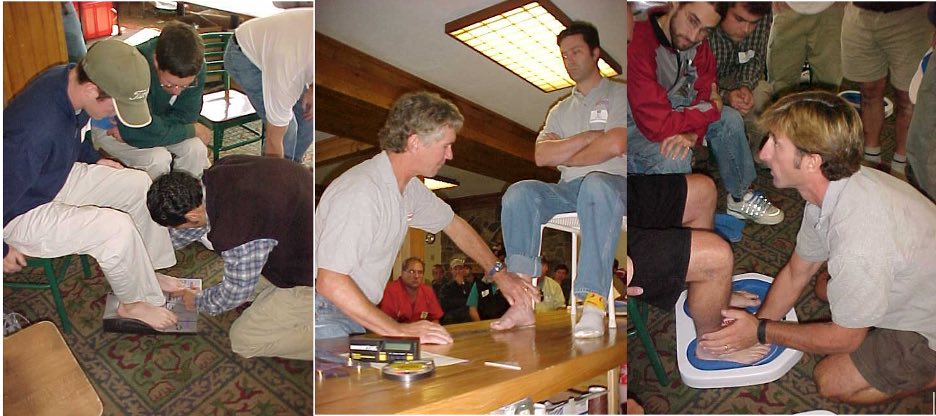

My central message this week is so primordial, so foundational, that it applies to every skier and every shop that hopes to serve them: boots matter most. Anyone remotely interested in skiing safely and comfortably should spend the time and resources to be properly fit. Nothing else you can do, buy or rent can overcome the handicaps imposed by bad boot selection and/or shoddy bootfitting.
As an industry, we try to get this message across by focusing the rental bootfitting experience on speed instead of accuracy. (This isn’t anyone’s fault; custom fitting and mass rental don’t happily co-exist.) Rental boots also tend to be relatively soft-flexing, which, married to an indifferent fit, puts a limit on the skier’s skills development, to put it mildly. On the bright side, anyone who survives the rental-boot baptism-by-fire will be gobsmacked to discover that skiing is much, much easier in boots that actually fit them.
Despite what appears to be an industry-wide effort to drum out the middle class, there are still deals to be had in the gear market. Prominently displayed on any Google search for ski gear will be a legion of buying mistakes that are only a keyboard-tap away from being yours. 2023 skis that are still in the wrapper are priced as if they had the shelf life of a petunia.
I’d love to live in a world where shoppers would think first of their local specialty shop when shopping for bargains, but the point here is about where it’s relatively safe to economize and where it is not. The street value of a used ski is a fraction of what it was when new, so it’s worth it to keep your eye out for ski swaps and local ski team fund raisers where you can find a concentration of previously owned skis.
The reason for saving serious cash on skis is so you can invest more in your boots. To put it succinctly, better boots ski better. All adult boots include in their name a number that indicates their relative stiffness in forward flex; the higher the number, the stiffer the boot; the stiffer the boot, the more it costs. Roughly speaking, each step up in flex index costs another $100 at retail.
Move closer to the screen, please, so you’ll be more focused on what I’m about to say: do NOT buy the wrong boot in order to save $100. Flex isn’t all that changes as you climb the product hierarchy from a 70-flex beginner boot to a 130-flex performance boot. The inner boot, the Velcro strap, the buckles, the shell and/or cuff material, all improve as flex resistance increases.
Once you’ve made the wise decision to get the best boot you can bend on the bench, you need to invest in a couple more items that aren’t baked into the cost of the boot. First, you need ski socks, the thinner the better. There are no cheapo substitutes for a properly designed ski sock. Second, and even more important for your comfort and skills development, is a custom insole. In this instance, I would rather you economize with a decent, off-the-rack insole that matches your arch rather than go without any underfoot support at all. (The shim that comes with most models serves as a placeholder for the upgraded insole you’re going to use. Most stock insoles are as supportive as a cocktail napkin.)
Spend the time to find the best bootfitter you can. Resources include shops listed on Jackson’s List and America’s Best Bootfitters. Next time you ski, ask whomever you’re sharing the lift with where they recommend you go. Ask often enough, and a pattern will usually emerge before your ski day is done.
A couple of concluding caveats for all potential boot buyers:
- Many specialty shops are understaffed due to a pucker-tight job market. To improve your chances of ending up with the best bootfitter, make an appointment. Then keep the appointment.
- If all goes as you had hoped it would, don’t forget to tip your bootfitter. It will make you feel better, and can’t hurt your standing in the afterlife.
Retail’s Last Recourse
If you’re a specialty ski retailer today, you feel under assault from all sides. While operating costs keep climbing, the avenues for making an honest buck are dwindling. More and more skiers who self-assess as advanced or expert are choosing to rent a demo ski, particularly when flying to their destination, rather than buy a new one. The big, profitable boom in backcountry skiing has most likely passed its peak and will probably settle back into the niche role it’s played for most of its existence.
Most distressing of all, every ski brand the specialty retail channel has championed into prominence is now a direct competitor. Some are fairly subtle in how they contrive to siphon off the online customer before they can cross a brick-and-mortar threshold, while others are as subtle as a kick in the nuts. The erosion of ski sales at retail is self-evident to anyone paying attention to the numbers.
The point I’m straining to make is that the American ski consumer isn’t at all skittish about buying an expensive ski online, should he or she elect to own at all. That genie is not going back into the bottle, which portends a shrinking ski rack at your local shop. Once skiers figure out that any huckster can sell a ski, the reasons for patronizing a ski shop become increasingly nebulous.
But it takes more than a smooth line of patter to sell a ski boot. The skills great bootfitting require are as evident as the talents required to sell a ski are vaporous. For ski equipment retail sales and service to survive, whoever is charged with fitting boots better be at the top of his or her game, or the game itself will be over.
Which brings me to the call-to-arms conclusion of this Revelation: if you’re a specialty retailer, you can’t afford to send ill-equipped rookies to the front lines: your bootfitters are your life line, and they need to be first rate.
The fastest, most efficient and most effective way to convert an eager novitiate into a conscious competent is attendance at Masterfit University, which will again be conducting classes at three U.S. locations this fall. I don’t have the vocal range to sing its praises highly enough. The training is hands-on, with instructors who are also active bootfitters at the top of their game. The associated instruction manual is atlas-thick and not a page is wasted on fluff. It’s worth the price of admission all by itself.
But even the best manuals have a way of gathering dust in a pile of their brethren, while the animated education delivered by the MFU faculty continues to resonate long after the circus has moved on. Considering all the challenges facing specialty shops, sending a contingent of bootfitters to MFU is the best way of ensuring that your store will maintain the high standards needed to attract and retain today’s fickle customer.
If you’re looking for Realskiers’ Boot Brand Profiles and their attendant links to America’s Best Bootfitters’ reviews, your patience is about to be rewarded. They should post later this week.

Related Articles
Reader Comments on Why Ski Sales Have Shrunk
In this week’s Revelation, I posted my top ten (twelve, actually) reasons why skis sales have shrunk, along with the musings of two Dear Readers on the subject. Note that the topic’s focus was ski sales at retail, not skier or skier/rider participation rates, subjects that are certainly related but just as certainly not the same.
Below are verbatim reader responses culled in the last 48 hours. I’ve corrected the odd typo, but otherwise left these contributions intact.
My thanks to all who took the time to tell their tales. – J
Top Reasons U.S. Ski Sales Have Shrunk
[As I wrapped up an earlier Revelation, I proposed to my beloved readership that they share their list of the top ten reasons U.S. ski sales have shrunk. I elicited only two written responses, so I’ll reproduce both here in their entirety, along with my musings on the subject. Consider these submissions tinder to light a fire under you, Dear Reader, to submit a list of your own.]
From Rick Pasturczak
1. Snowboarding-
I’ve noticed most snowboarders are 12 to 20 years old and once they become an adult, almost all stop. While I noticed most skiers continue on.
2. High school and college sports-
Schools now require practicing sports during Christmas and spring breaks taking away opportunities to hit the slopes and family vacations to the mountains. I’ve been told by many parents the coaches forbid them to ski.
3. Travel costs-
Lodging, airfare, ground transportation, and lift tickets.
4. Video games
5. Cost of lessons make it expensive to improve.
6. Confusing selection of equipment
7. Magazines and movies showing extreme skiing
8. Cruising. We need some resorts to be all inclusive.
9. Baggy pants. Bring back stretch pants and sex appeal.
10. Last, we need mother nature to be more consistent with snow.
The Making of a Skier, Part X: The Mechanics & Managers Workshop Tour
When I left Salomon in the spring of 1987, my motivations could be distilled into three principal components:
• The parent company declared it was moving its Reno-based North American HQ back from whence it came. Neither I nor my family had the slightest desire to return to New England.
• I felt I was spending more energy battling factions within my own company than I was out-flanking our competition. I’d worked more or less without a break since June of 1978. My thin veneer of patience cracked.
• I wanted to write screenplays. Not that I had demonstrated any talent for creative writing or had any training in the field. I’d written reams of technical swill, brochure copy, training manuals and memos which created the illusion that I could at least write something, so why not screenplays?
Note that none of these factors involves finding a new job. At the time, I didn’t want to resume wearing the shackles of employment as they would interfere with my ludicrous screenwriting ambitions. Then the stock market went into a tailspin in October, crippling what little equity I’d managed to accrue on my minimalist salary. Oops.
