

It’s been a rough first half of the ski season. The 24/25 season began with a whimper, not a bang, when most major ski brands belatedly realized their sales targets were unattainable. Unsold skis were clogging the supplier-to-retailer pipeline; even shiny new models with technology worth talking about couldn’t maintain the sales momentum of the post-pandemic market. Over the course of the past few months, the wholesale backlog has been shifted from the supplier community to its constituent retailers, with an unhealthy slice off-loaded to online mega-stores.
Oversupply inevitably leads to price concessions, a boon to budget-squeezed skiers seeking the best bargain. Suffice it to say, online ski shoppers will be well served this spring. The dark side of a discount-driven market is the deep dent it puts in resources that might otherwise been invested in R&D. Unless the ski maker thinks it has a market-changing home run in the wings, there’s little incentive to innovate on a grand scale.
If one’s market research were limited to brand-sponsored communications such as catalogs, one could be forgiven for thinking that new technologies were emerging every season. Most freshly minted model families, regardless of brand, do indeed possess a nugget of newness, but no matter how their components are made, assembled and finished, almost all contemporary skis are made from the same stuff.
I’m not suggesting there’s no value to the adaptations and enhancements provided by each new generation of models, only that the majority of contemporary, high-volume manufacturers are aiming at the same targets, often with the same ammunition. For example, in the image-setting All-Mountain West genre, every single model on the American market has a vertically laminated wood core (usually poplar, oftentimes mingled with one or two other woods) and a double-rockered baseline with tapered tips and tails. They nonetheless manage to ski differently from one brand to the next because of how all the ingredients are assembled. Everything that goes into a ski – and everything that gets left out as skis descend the price pyramid – matters, so it doesn’t take much alteration to get a palpable change in how a given ski design performs.
While truly innovative constructions are rare, and new materials rarer still, the mainstream ski brands nonetheless usually find a way to refresh their collections on a regular cycle. Despite the recent dip in U.S. ski sales, most major brands still managed to re-engineer at least two important alpine model families over a relatively short, two-season span. (This analysis doesn’t take into account new product introductions in the over-served Alpine Touring market, which has several subsets of its own.)
Looking Ahead
What does all this arid posturing about the state of the alpine ski market in America have to do with you, Dear Reader?
First and foremost, this capsule synopsis strongly suggests that the end of this season will be a buyer’s market for alpine skis. With all the new models introduced to the ski market over the past two sell-in seasons (2024/25 and 2025/2026), there’s bound to be an abundance of marked-down models as the current ski season staggers to the finish line. The online merchants who depend on steep discounts to move their bloated inventory will inevitably dangle some attractive offers in order to keep their enterprises afloat. But before you succumb to the temptation to buy your new skis online, at least give your favorite specialty shop the chance to match the offer.
By next fall, a measure of price stability will return to the ski market as virtually every supplier of note will institute both a Manufacturer Suggested Retail Price (MSRP) and a Minimum Advertised Price (MAP) as a means of limiting the scope of dealer discounting over the course of the selling season. In principle, the supplier maintains MSRP on its direct-to-consumer sales until a pivotal point in the season – say, December 1 – when it will adopt MAP as the norm. As the ski season winds down, discounting descends into a free-for-all in a scramble to convert inventory into cash. The instituting – or in some cases, the re-instituting – of MAP pricing brightens the retail landscape a bit for specialty retailers who fight a constant battle with online warehouses for the ski consumer’s dollar.
While industry-wide enforcement of MAP policies would help level the retail playing field, it won’t constrain how the supplier community manipulates its own pricing policies when the time comes to shed excess inventory. To pick a notorious example, K2 continues to thumb its nose at the dealers who once built their brand into a dominant market position. It will be awhile before K2 scales such sales heights again.
One trend we’re happy to see accelerating is the gradual market shift towards narrower skis, a trait we touted at the beginning of the season (Your Next Ski Should Be a Frontside Model). No doubt about it, the short-radius carving tool is making a comeback on our shores. (It’s always been a strong category in Europe). While the market for skis over 100mm underfoot isn’t going away, its influence is waning.
The shift to more slender skis has prompted a revival of a sub-genre that had all but disappeared on this side of the pond, the short-radius carving ski. Joining the returning Atomic Q 9.8 and Redster X9, Fischer The Curv GT 80, Head Supershape e-Magnum, Kästle MX74, Stöckli Montero AS and Völkl Peregrine 82 are the Nordica Multipista DC, a re-vamped Rossignol Forza 70o+Ti, and four new models from Blizzard, comprised of two re-imagined Thunderbird R15’s and a new system ski, Stormbird, in two iterations.
Standing out from this crowded field of sublime, snaky carvers is a fresh take on the slalom-radius, non-race, on-piste charger, the new Addikt 66 and 76 from Salomon. The distinctive notch in their tails suggests that something different is happening here, a promise fulfilled by a unique Titanal laminate that Salomon fuses with a patch of flexy polymer to create a ski that is super-supportive without dulling its energy off the edge. The imagination at work in the design of the Addikt chassis is a reassuring sign that the era of innovation that Salomon helped kick-start with its monocoque shell design back in 1989 still has the ability to surprise us in 2025.
A Bit About Boots
The current state of the alpine boot market can be summed up in three letters: B – O – A. This dial-driven, internal retention system that began as way to hold the forefoot without fumbling with buckles or distorting the shell, has now spread to most of the recreational boot market. It has also migrated to many upper cuffs, which is where its cable system is probably most useful and effective.
Checking in on My Long-Suffering Spine
It is with a deep and abiding gratitude that I acknowledge all the get-well wishes I’ve received from so many of my Dear Readers and Listeners. My lumbar fusion transpired without incident on November 11; I was declared fit for (mild) physical therapy on Valentine’s Day; I begin PT March 4. I won’t bore you with the litany of afflictions now being tended to by another squadron of surgeons and physicians as none of them will inhibit my ability to ski. I’ll have access to next year’s new skis right up to the end of the current season, so if I can ski, I’ll be able to test and report on every significant 2026 model worthy of your consideration.

Related Articles
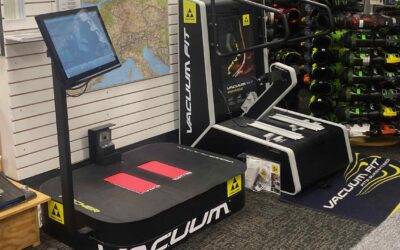
U.S. Shops with 3-D Scanning Capability
Far West Footloose Sports, Mammoth Lakes, CA (BootDoc) California Ski Company, Berkley CA (Fischer) Gravity Sports, Mt. Bachelor, OR (Pulse) Start Haus, Truckee, CA (Pulse) Sports Creel, Spokane, WA...

Is 3D Imaging a Fad or the Future?
Any serious attempt at bootfitting begins with an assessment of the customer’s feet and lower legs. This appraisal can be as superficial as measuring each foot for length or as detailed as a complete skier profile accompanied by a few basic biomechanical evaluations.
Better bootfitters gather further information from a litany of details that lie outside the scope of the usual foot-measuring device, such as a Brannock. The veteran bootfitter watches how the customer walks, sits and assumes a skiing position, for starters. The savvy fitter can even spot limb-length differences and redistribute pressure around the foot in places no measuring stick can quantify.
If this sounds like a pretty sophisticated skill set, well, it is. Yet many, if not most, prospective boot buyers approach the bootfitting exercise with the same enthusiasm they usually reserve for a root canal. Suspicions are often confirmed when the first boot proffered seems crazily short. Even the most knowledgeable fitter is obliged to re-establish his/her credibility just to move the bootfit process pass square one.

Of Podcasts, Archives & Revelations
According to my tight-knit circle of advisors, idolaters, sycophants and astrologers, I was made for this medium.
Of course, any garden-variety sycophant will whisper words of inspirational twaddle, but the faint note of sincerity I detect in the smarm-storm of platitudes meant to buck me up has proven sufficient to spur me to action. I quickly acquired a very professional looking microphone and a pop filter to knock down my fierce sibilants. To preserve my objectivity, I opted not to take any lessons, follow any tutorials or otherwise prepare myself for this venture. By the powers vested in me as the Pontiff of Powder, I declare myself to be, now and forever after, a podcaster.
I’ll give you a moment to recover.
