
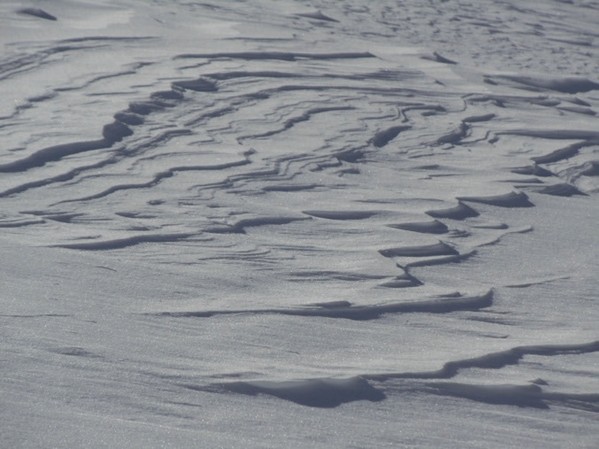
Mineral Basin, on the backside of Snowbird, is a bowl so large if it were any bigger it would be a lake. When storms move into this corner of Little Cottonwood Canyon, visibility collapses to a range so dense it should serve as the optical equivalent of Absolute Zero on the Kelvin scale. Normally when conditions devolve to this degree, the Patrol closes the basin, but every so often the border remains open when only those gifted with inner sight can make out the terrain.
So let’s begin the lesson with the premise that you can’t see anything, and what you think you can see is probably a mirage. Now let’s make it interesting. The surface underfoot is wind-crust, formed by the current storm-in-residence that is wrapping up its engagement with hammering winds worthy of a Norse god. The crust varies from gossamer to glacial, and there isn’t the slightest visual clue about which you are about to encounter. Because of surface winds, when the rare glimpse of the earth’s topsheet is possible, it appears to be buckling and cracking underfoot like the last moments of Mordor.
Of course, you could curl into a fetal ball and beg for redemption and immediate transport to another, less formidable world. In our experience, this rarely works. If you have a dear friend who works part-time as a crash-test dummy, send him first. This simplifies matters immensely. All you, Dear Follower, have to do is focus on the dummy’s feet [no pejorative undertones intended]. The feet will tell you all you need to know about the world in front of you. You move as they move. You put away the computer, Luke, and follow the flow of the feet. Remember, you are the lucky one.
In front of you, the master has no feet to follow. He can’t even see dimly through the darkness because for one thing, the darkness is solid white. It is more impenetrable than any fog. How does he ski this terrain that can’t be seen?
Because the master knows the secret of being light. He also knows the mountain, so he knows the first turn may be so wind-battered it could be bone-jarring, yet just at the top of the second turn the antenna-tips of his skis tell him he has transitioned to windcrust, so he shifts his weight to his arches and concentrates. What the master feels is the full length of his ski, every little millimeter, and he asks every little micrometer to hold up his weight, like a colony of ants holding a statue aloft. He feels the entire surface and only when it is free of the crumbling crust does he shift subtly in the saddle and send the arc of his run back across the hill.
When you are light, you make no sudden movements. You are a stalking feline, keenly aware of every clue your senses afford where clues are hard to come by. Your success depends on picking up the slightest cues and moving in concert with them. You rise and sink with the pulse of gravity, waiting for weightlessness to facilitate your shift from to towards fro.
You can’t force windcrust to like you. If you try to beat it into submission it will taunt your efforts and leave you upside down. Like a confident lover, the top of the turn must be decisive but never forceful. The weight shift is a matter of judgment and timing, all triggered by an intimate, tip-to-tail connection with the buckling terrain.
Why would anyone do this? Shouldn’t they be having cocoa in the Fork Lift instead? Because the mountain isn’t just one thing, it’s all the things it’s capable of; and to not know this mountain, this complete mountain, is to leave some of yourself behind. There is ineffable magic in floating through a world that has disappeared, feeling comfort in the slice of your skis through snow that is entirely of the moment, gone a millisecond later. Whether you lead or follow, you also are tethered to your companion, responsible for him or her, for in this world the pair of you are utterly alone.
The primary reason for heading down the gut of Mineral Basin in a whiteout is because on that particular day it offers the best snow with the least competition for its charms. While the first 20 turns may be exercises in centering and sensibility, on the 21st turn a shaft of light may break through the grayscape and the fragile surface may turn to fluff just as you crest the next fall line. Then the world and all that is in it is yours.
This may pass for scant wisdom in the pantheon of advice, but when you can’t see it’s critical to shift focus to your other senses. Smell won’t do you much good unless the master in the lead is allergic to soap or wearing a garland of garlic, and sound only tells you what’s happening now, not what’s about to transpire. Only a febrile sensitivity to your ski tips tells the tale of the next instant, and each instant consists of spreading your pressure evenly along the ski. We don’t care if your ski is rockered, early-rise or bent like a pretzel, try to feel the energy of the snow along every centimeter. Feel the feedback. Float with the flow. Don’t resist the force of gravity, channel it. Don’t fight the snow, feather it.
To foster the idea of being light, it may be helpful for neophytes to carry their hands a little higher, if only so they are a little taller, a little more extended, particularly at the top of the turn. Even the skilled skier can benefit from a manual cue from the uphill hand to get light at the moment of direction change. As with a symphonic conductor, hands can provide a rhythmic indicator for the rest of the ensemble to follow. High is a light tone and low is a heavy beat. To stay light, you can’t get too low.
The most amazing aspect of skiing a Mineral Basin whiteout is how it internalizes the entire experience. There is only you, wind and white slashed with sluices of gray. You have to discover your inner self, if only to not be so alone. If you stop, you may lose all sense of which way is down, a form of mountain Purgatory. Momentum, quiet, purposeful momentum, is your friend. Be cool. Feel the surface, down to the crunch of wind-brittle snow cracking under the edge. Concentrate on the moment, for there truly is nothing else.
You emerge from runs like this with an altered sense of what you’re capable of. For most of the run, there was no world, yet you moved through this opaque, hostile medium and made it. When you are light, you find the clean connection to the snow that allows you to relax – even when the air is a blank, roaring vortex of churning chaos and the ground metamorphoses below your feet – and you’ll want to do it again.

Related Articles
Reader Comments on Why Ski Sales Have Shrunk
In this week’s Revelation, I posted my top ten (twelve, actually) reasons why skis sales have shrunk, along with the musings of two Dear Readers on the subject. Note that the topic’s focus was ski sales at retail, not skier or skier/rider participation rates, subjects that are certainly related but just as certainly not the same.
Below are verbatim reader responses culled in the last 48 hours. I’ve corrected the odd typo, but otherwise left these contributions intact.
My thanks to all who took the time to tell their tales. – J
Top Reasons U.S. Ski Sales Have Shrunk
[As I wrapped up an earlier Revelation, I proposed to my beloved readership that they share their list of the top ten reasons U.S. ski sales have shrunk. I elicited only two written responses, so I’ll reproduce both here in their entirety, along with my musings on the subject. Consider these submissions tinder to light a fire under you, Dear Reader, to submit a list of your own.]
From Rick Pasturczak
1. Snowboarding-
I’ve noticed most snowboarders are 12 to 20 years old and once they become an adult, almost all stop. While I noticed most skiers continue on.
2. High school and college sports-
Schools now require practicing sports during Christmas and spring breaks taking away opportunities to hit the slopes and family vacations to the mountains. I’ve been told by many parents the coaches forbid them to ski.
3. Travel costs-
Lodging, airfare, ground transportation, and lift tickets.
4. Video games
5. Cost of lessons make it expensive to improve.
6. Confusing selection of equipment
7. Magazines and movies showing extreme skiing
8. Cruising. We need some resorts to be all inclusive.
9. Baggy pants. Bring back stretch pants and sex appeal.
10. Last, we need mother nature to be more consistent with snow.
The Making of a Skier, Part X: The Mechanics & Managers Workshop Tour
When I left Salomon in the spring of 1987, my motivations could be distilled into three principal components:
• The parent company declared it was moving its Reno-based North American HQ back from whence it came. Neither I nor my family had the slightest desire to return to New England.
• I felt I was spending more energy battling factions within my own company than I was out-flanking our competition. I’d worked more or less without a break since June of 1978. My thin veneer of patience cracked.
• I wanted to write screenplays. Not that I had demonstrated any talent for creative writing or had any training in the field. I’d written reams of technical swill, brochure copy, training manuals and memos which created the illusion that I could at least write something, so why not screenplays?
Note that none of these factors involves finding a new job. At the time, I didn’t want to resume wearing the shackles of employment as they would interfere with my ludicrous screenwriting ambitions. Then the stock market went into a tailspin in October, crippling what little equity I’d managed to accrue on my minimalist salary. Oops.
