
On a day when we all pause to remember the people, events and things in our lives for which we are deeply grateful, I offer this meditation, On Gratitude, Chapter 19 of Snowbird Secrets.
“It’s more, I’d say, not so much a word as kind of a state of consciousness that I try to get into and it has to do with a – I’m not trying to sound too weird – it’s tuning into the earth and her spirit. I ask the earth a lot if it’s safe to go over here or go over there, things like that. The things that guide me are these vibrations that I feel, these frequencies of light that go through my body. I’ve had plenty of experiences that justify this. I’ve been in really weird situations and been told not to go there [by the earth], and sure enough, I shouldn’t have.”
– Scot Schmidt in Greg Stump’s The Legend of Aahhhs
When someone has learned to listen to light, it’s wise to listen to him. Pay close attention to these words from the man who redefined the boundaries of freeskiing, a transcendent talent who introduced the term “extreme” into the sporting lexicon. He taught himself how to clear his mind so he could pick up vibrations from the mountain, vibrations he experienced as light coursing through him, which would tell him if and where it was safe to proceed. It speaks volumes about his character that he arrived at this understanding solely through communion with the earth. It’s also highly instructive that after thousands of runs – 90% of which all skiers couldn’t even contemplate without injury – Scot Schmidt has never been hurt.
This absence of debilitating accidents is not a coincidence. Scot Schmidt has remained injury-free because he is always humble before the mountain, because he asks its permission to go. When he drops in some perilous chute, he succeeds not just because he has visualized what he must do, but because in a sense he has already done it: the idea is already whole and complete, awaiting only his actions to manifest it. He moves as instructed by the light. How amazing and perfect is that?
The chances of anyone learning to ski like Scot Schmidt are virtually nil – no one has managed the feat in the 25 years since his skiing was first put on exhibit before a slack-jawed public. But everyone can learn to think like him. Everyone can learn humility before the mountain.

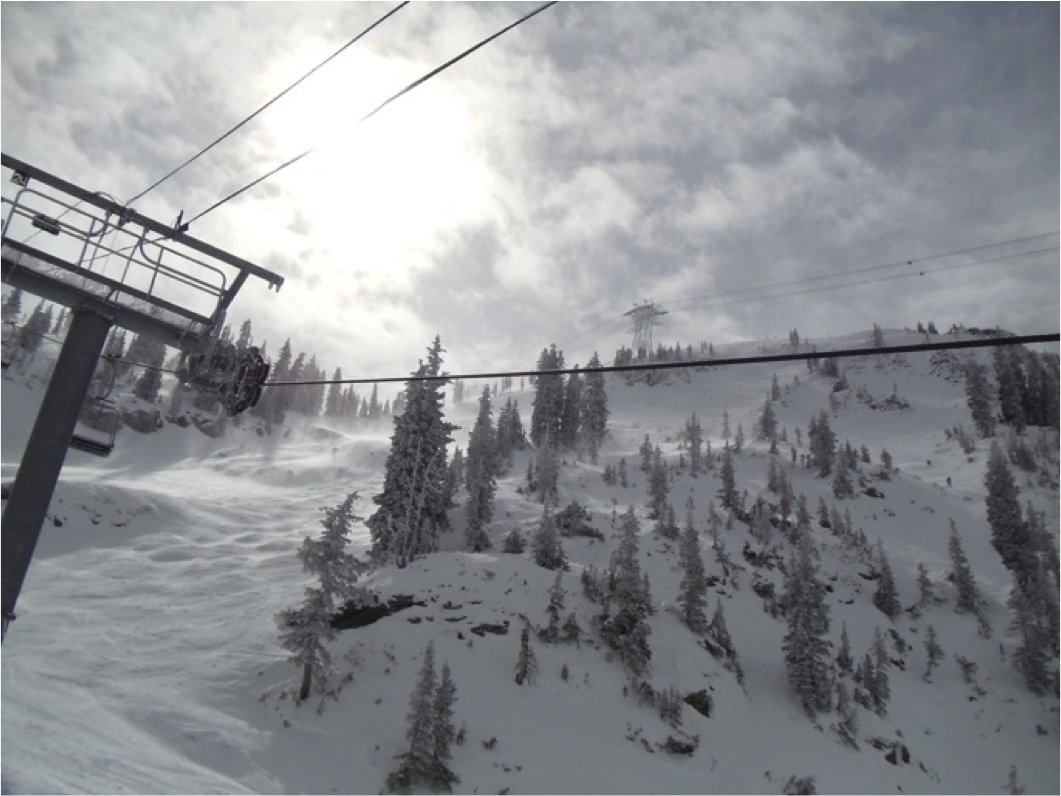
Silver Fox Cliffs, Snowbird, UT
Nowhere is this more important than at Snowbird, where if you don’t approach the mountain with the appropriate measure of humility, the mountain will be more than happy to supply some. Take your eye off the ball here by celebrating your brilliance prematurely and humility will be the next course served.
A corollary to humility is respect, the implicit acknowledgement that we share the planet with others and owe our brethren a dollop of deference. Respect is commonly demonstrated by displaying good manners, and the first article of appropriate behavior is expressing gratitude. Yet how many times a day do we benefit from the grace of this mountain without remembering to say, “Thank you?” Regrettably, it’s far more likely to overhear boasts in the tram line such as, “Did you see the way I stomped that line?” To which we say, first of all, big deal. Secondly, where is the respect, the humility or the gratitude in this attitude? All these attributes require the ability to consider the needs and desires of others as of at least equal value as one’s own, a sentiment expressed in pubic places as courtesy. Yet our national “me-first” obsession has made manners as obsolete as alchemy.
Let us share another secret from a couple of lifetimes devoted to skiing: all the very greatest skiers are like Schmidt. They are humble, respectful and courteous. Again, not an accident. The proud, the loud and the rude will never achieve communion with the mountain and will never understand why they are here. But here they are, and so we, along with the mountain, must teach them the rules of behavior. This isn’t an option. We all have to actively remind people of how to behave because, simply put, lives are at stake.
The two most likely ways to meet one’s end on the mountain are via avalanche or collision. While there are obscure exceptions, such sad events are usually the result of a failure to show proper respect, either to the mountain or to fellow citizens. We can’t hurtle downhill side by side at 40 mph if we don’t bring an attitude of sharing to the slopes. If all we are listening to is the noise in our heads, not only will we never achieve communion with the mountain, we’ll be a menace to mankind.
If you took the counsel of curmudgeons, you’d blame kids today. But gratitude and courtesy aren’t generational attributes: the elderly can be obnoxious and the young can be contemplative and kind. Take the case of Oakley White-Allen, a 33-year old who began exploring this mountain five years ago. One recent winter there dawned a day when the snow was especially heinous. On the front face, a few paltry inches of low-density dust barely disguised a 40o skating rink, cleverly constructed by the rains that had deluged the peak two days prior. One false move and you’d punch through the irregular crust, turning your shin into the impromptu prow of an icebreaker. Humility was the norm on Upper Silver Fox, where arrhythmic bumps were barely disguised by this 3-layer dip from hell. The run had become an unskiable morass of hideosity from top to bottom.
Then along comes Oakley. He doesn’t tiptoe in to get a sense of the snowpack, he launches. He motors through the upper moguls as if they were a mirage, then just before he reaches the trees that punctuate the lower cliff bands, he throws it in reverse without shedding a shred of speed. Now scorching the hill switch, Oakley aims for the tallest pile of rock and – bing! – tosses an insouciant off-axis air, landing backwards and sailing into Chips Flats as if he hadn’t a care in the world.
Asked later how he managed to slay that line in conditions no one else could even hack their way through, Oakley replied, “I asked for the mountain’s permission.”
You won’t ski like Oakley just by asking the mountain’s permission, but you’ll never ski anything like your best if you don’t. Remember, the mountain knows you’re here; it feels you in its stream. The mountain appreciates manners even if you don’t. Remember to say “please” and “thank you” and the mountain will return gifts of miraculous value.
Lenny Johnson, 81, who has skied Snowbird for the last 22 years and is thankful for every one of them, experienced just such a miraculous gift. It happened on the same run, Silver Fox, where we just described Oakley’s exploits. Picking his way down through a wind-swept snowstorm, Lenny momentarily came to rest by a hollow the wind had carved out of the slope. For some reason, he paused and looked in the hollow and there, shivering with cold, was a tiny, pink-nosed mouse. The mouse made no move to run, but kept its quivering gaze fixed on Lenny. In their shared moment the world was reduced to the two of them, and a connection was forged. Lenny knew that he could have been that mouse, and suddenly he felt what it was like to be isolated, terrified and so very dependent.
So he reached down to the mouse, who made no effort to move away. Lenny slid his cupped palm under the minuscule creature and scooped it up. It remained calm in his custody as he traversed skier’s right across the hill to a small copse of evergreens where he found a nook where he could deposit the mouse. There was never any question of doing otherwise, for to deny the mouse its chance for survival he’d have to exchange his own capacity for compassion. For some reason, the mountain connected Lenny and that mouse on a frequency – like Schmidt’s frequency – that normally resides outside the range of human detection. Maybe Lenny needed a metaphysical reminder meant just for him, but for whatever reason that moment of connection remains a resonant chord in Lenny’s soul that will vibrate forever.
What is the source of such serendipity and synchronicity? Lenny appeared because the mouse needed him. The mouse appeared to Lenny for the reciprocal reason. We know how Lenny found his way to the mouse. But how did the mouse ever find this intersection with Lenny? How does any bite-sized mouse navigate across Silver Fox in the dead of winter during a blazing snowstorm? It should have been swept to Provo. Yet it was there for Lenny to find and save, so Lenny could be found and saved.
Lenny is fond of saying, “I can never give back all this mountain has given me. I can never thank it enough.” And so he has thanked it every day, honoring those gifts it has bestowed on him. Should we really be so surprised the mountain sent a Lenny a mouse to say, “You’re welcome?”