
Why You Should Buy From People Who Know What They’re Doing And Have Your Best Interests at Heart
Everyone wants a deal. So here’s the deal: every authorized dealer in the US signs a Dealer Agreement that obliges him or her to observe certain price levels over the course of the all-to-brief ski season. If this sounds like restraint of trade, please remember that if there were no price constraints of any kind the ski market would fizzle to nothingness like a poorly tied balloon. The net effect of the price limitations, known as MAP pricing, for Minimum Advertised Price, is to set a new de facto market price below the MSRP, or Manufacturers Recommended Retail Price. For many shops, the implementation of a system meant to maintain the minimum margins able to support a storefront has simply established a lower bar across the board. The engine behind this great equalization is the same one you’re deploying now, the Internet. In an age of instant price comparison, all specialty retailers not inside a resort bubble have to match the prices, not just of the shop down the street, but of every shop, physical and digital, in America.
One of the many implications of this reality is that if you find a price on a web site for a current product that’s a meaningful amount below the MAP price, something isn’t kosher. Proceed as you wish, but when it’s time to assemble a binding on your new acquisitions, you’re telling the dealer to whom you grant this privilege that you don’t think their counsel and services are worth $20 on a $700 purchase. Bear in mind that most specialty dealers will mount, test and/or tune whatever new babies you pull off their rack for something less than the listed price for these services. Skis coming from other sources requiring the same treatment won’t get the same price breaks. While from your perspective the total invested might seem to amount to the same whether you bought locally or at a distance, you’ll be the only one who sees it that way.
If you’re buying last year’s product, searching by price makes sense, as everyone has a different level of inventory and attendant anxiety about its eventual liquidation. But for this year’s goodies, if you’re getting some super-deal on the product, either the vendor is a shady operator or some other shenanigans are at work.
While the tenor of this editorial portrays the slighted specialty retailer as the big loser in the age of the Internet search, the bigger loser is most likely the consumer making the online purchase. Where do we get the temerity to make such an allegation? Because we’ve seen you in the process of gathering your research as you “showcase shop” specialty retailers before you slink away to buy somewhere else. When interviewed on the shop floor, many of you reveal a remarkable inability to judge the quality of the information you’ve dug up online; you apply equal weight to disciplined methodologies and forums of personal opinion from knuckleheads. If you do buy online based on your own judgment, you tend to select the wrong stuff. We know, because you bring it to us to assemble it. Others of you use the Internet to “narrow” your search down to 20 skis, which is ludicrous on so many levels. Let’s explore just a couple.
If you end up with a long list of skis you want to try before buying, chances are excellent you’ve selected a hodgepodge of skis. Get serious about the terrain you actually ski and the terrain you want to access: if you do this with any sort of self-perception, you won’t find yourself picking skis from 3 different realskiers categories; at most you’ll narrow your field of options down two genres, such as Carving and All-Mountain East. Within each genre we clearly identify two types of skiers/shoppers: Finesse skiers who prize ease of use and accessibility to new terrain, and Power skiers who want to take full advantage of their technical mastery. No matter which side of this divide you land on, you can further winnow your choices by filtering your first cut of candidates according to this rough measure of prowess and aggression.
If you’re fishing in the right category (e.g., Big Mountain or All-Mountain West), and you’ve made your Power/Finesse self-assessment, the heavy lifting is behind you. Now you just have to pick (approximately) the right length – which can vary by category – and your chances for error drop dramatically because if you pick any ski from this site’s 2014 collection from the right category in the right length, it will work for you.
Naturally we wouldn’t go to all the trouble to test, score and describe every model on realskiers if we didn’t think small nuances in behavior were important. But the simple truth is that any new ski that is well prepared will make you happier than whatever you’ve got now. It’s equally true that a highly proficient skier can make any tool work in just about any condition. Nonetheless, we dig deep into the details because we know that for many of you, you’re not just picking a ski, you’re embarking on a long-term relationship. We try to capture the feeling of what each ride is like so you can feel if the fit sounds right for you. It’s very much like dating: we’re describing some very attractive potential mates, any one of which you may fall deeply in love with, but it’s best if you only commit to one. To extend the analogy, if you date forever looking for perfection, you may fall in love several times but in the end you’ll spend a lot of time alone.
Given how long it’s likely you’ll own your new skis, it only makes sense to second-guess your own counsel and seek the professional wisdom of a marriage counselor, otherwise known as a specialty ski retailer. If this retailer resides in the high-rent district at the base of the ski area, expect very knowledgeable personnel and higher-than-Internet pricing. If the retailer is urban or suburban, you’ll usually pay the same price you find on the Internet, only you’ll have a real person to help you with the details.
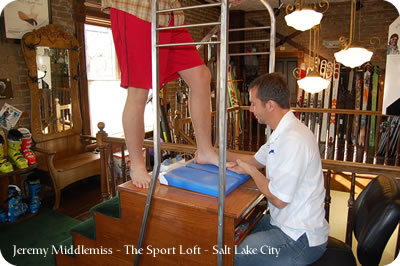
Trust us when we say you’ll need help with the details. First of all, a real live dealer is going to see your boots when it comes time to mount your new treasures. Chances are, your boots – whether you love them or hate them – are a disaster. We conservatively estimate that half of all skiers aren’t even in the right size shell, much less the optimal boot. Spending $1,000 on a new ski-binding set-up – not to mention all the other costs of a ski vacation – without inspecting whatever you have on your feet as a guidance system, is folly incarnate. To cut to the chase, skis and boots ought to match each other functionally: you can’t run a racecar with bald tires and an engine that fires on 3 cylinders. You need the intervention of a specialty retailer more than you realize.
Speaking of boots, if you’re thinking of buying your next ski boots online, stop. Do all the research you want – realskiers would be a good place to begin – but do not imagine for one second that you can find and fit the right boot online. In the interests of saving time – yours and ours – we don’t know any better way to stop you from buying a ski boot online other than to say it is tantamount to idiocy.
To summarize:
- Pricing for current product is at virtual parity across all legitimate channels to market.
- If you do your research on realskiers, there is very little chance of going wrong.
- You should visit one of the specialty shops recommended on realskiers for all your skiing needs. Like symbiotic relationships in nature, you need them and they need you,
- The longer you spend looking for a ski, the more winter you waste in the process.
- If you are buying ski boots online, first seek psychiatric help.
- Life’s short. Get yourself some new equipment, go skiing, and it will at least feel like it’s all been worthwhile.
– Jackson Hogen