
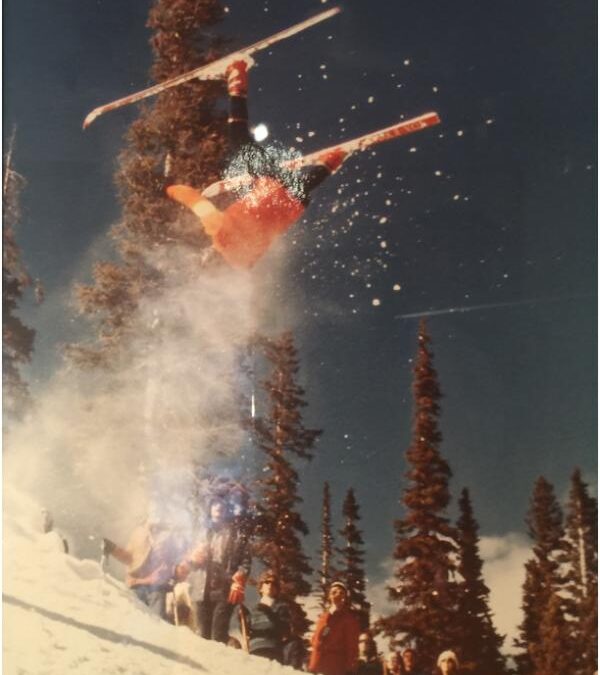

As we grow older, events of the misty past take on a warm, pastel glow that suffuses our memories with a charm that seems notably lacking in the present. Part of our sanity- preservation wiring gives us the ability to edit our past so the best moments loom large and the soul-scarring bits are de-emphasized, if not suppressed in their entirety.
While I refuse to wade into the fetid swamp that is the current state of discourse in our tragically divided society, there’s no denying it hasn’t helped lighten the national mood, regardless of where one lies on the political spectrum. Against this backdrop, nostalgia has a lot to recommend it. For all the solace that skiing still provides, our appreciation for its current incarnation is further eroded by the looming menaces of climate change, increasing income inequality and the absorption of the ski economy by a monied class that could care less about the quality of the experience for the average Joe.
Before I work myself into a full lather, let’s dial it back and consider some of the quainter aspects of my skiing youth. Back when I was growing up simultaneously in suburban New York and rural Vermont, ski areas (we didn’t call them “resorts”) would promote themselves on the radio by reciting their current conditions. A breathless DJ would rattle off the state of the snowpack in a slew of regional mountains, every cited statistic an exercise in over-stimulated imagination. A typical entry might be, “At Ever-Snow Mountain, six inches of packed powder with three inches of fresh snow!” Let us enumerate the gross misrepresentations therein:
- There aren’t 6 inches of snow depth anywhere on Ever-Snow Mt. Most of its acreage is pocked with dirt smears and glistening patches of “fast-grass.”
- “Packed powder” manages a double lie in only two words. Whatever the snow surface consists of, it didn’t begin life as “powder,” and it isn’t so much “packed” as congealed after umpteen freeze-and-thaw cycles.
- “Three inches of fresh snow” is a flight of pure fantasy, conceived of by a marketing minion determined to out-fib the competition.
With the amount of information available to today’s powder-chaser, such deceptions are impossible to pull off. Resorts are still capable of over-stating their other purported amenities, but the amount of natural snow that’s on the ground is no longer a pliable statistic.
One of the factors that has inhibited skiing’s popularity across the generations is that it’s quite dangerous. That’s still true, albeit not as true as it used to be. As the former General Secretary of the ASTM Committee on Snow Skiing, I know that skiing today is roughly a zillion times safer than it was 60 years ago. Thanks to the surge in interest in backcountry skiing, which has created lots of new opportunities to create incompatible ski/binding/boot systems, skiers can still break their legs, but for the most part, spiral fractures of the tibia – the lower-leg cast was once a meme for the avid skier – are now relatively rare. The knee was, is and shall remain vulnerable to twisting forces the binding can’t detect, but on the whole, skiing has never been safer.
One reason skiing is safer today is that binding technology has evolved so that virtually any alpine binding on the market will function predictably and reliably when used with a compatible alpine boot. But when we think about advances in ski equipment technology, bindings aren’t top of mind, as this precious space is occupied by the more visible changes in ski design and more palpable improvements in boot construction. The wholesale adoption of deep-sidecut carving skis made carving a turn so easy, it’s arrival on the ski scene took only a couple of seasons to completely eradicate the long, skinny, almost shapeless skis they replaced.
Arriving on the scene right behind shaped skis were a host of fat skis, forever altering the way ski product lines were segmented. The embrace of the fat-ski movement enabled ski makers to multiply the number expensive skis they marketed while they quietly euthanized the horde of package skis that once made up the bulk of the skis sold in this country. (Note that almost all major brands still make an entry-level, system ski (i.e., sold with a binding), but they used to make one for every important chain retailer.)
Anyone who has ever suffered in an ill-fitting pair of boots should say a prayer for all the boot manufacturers who have gradually introduced narrow, medium, wide and extra-wide models into a product line that at one time offered only one last shape, take it or leave it. While it’s still possible to end up in a boot that falls shy of a perfect fit, there’s no doubt that the boot buyer has more custom-fitting options than what was available even 15 years ago, let alone 60.
One of the clearest differentiators between skiing sixty ago and now is the change in the snow surface we ski on. In my view, the omnipresence of immaculate grooming has been both boon and bane. Who doesn’t like cruising along on a satin-smooth surface at speeds that make your lips flap like an astronaut’s in a cyclotron? But a life constrained to groomers strikes me as an impoverished one. Perhaps it’s because I was first lured away from the race course by moguls’ siren call, but I still find bumps a more satisfying surface for displaying a full range of flight and feelings. When I had the legs and lungs, there was no greater joy than stringing together a suite of acrobatic airs – mule kick! twister! backscratcher! spread eagle! – through moguls the size of igloos.
Now the few bump fields left to us are hacked to ribbons by boarders who couldn’t hew to a zipper line for love nor money. (Not that today’s average skier fares much better.) The situation isn’t helped by the fact that learning to ski moguls well is hard, and hard on the body. (My two laminectomies on L4/L5 were probably necessitated by the chronic abuse of fall-line mogul skiing.) Creative expression in the moguls was at the heart of the original freestyle movement and laid the groundwork for today’s stunning Slopestyle event. More than just missing moguls as they once were, I miss the ability to ski them as I once did.
One unalloyed benefit of today’s ski world versus that of yesteryear is the proliferation of the high-speed quad and six-pack. When you plop down in a fixed grip chair today, you feel like you’ve visibly aged by the time you reach the summit. On a mountain covered in detachable lifts, you can ski 20 runs a day, no worries. In the land of the fixed-grip double, a more realistic goal would be to read 20 Russian novels.
But even high-speed uphill transportation won’t move you if you can’t get to it. Last season, the western U.S. was buried under ungodly amounts of snow that nobody could get to. As a group, skiers don’t handle deferred gratification well. Backcountry skiers learn to accept it as a condition of playing the game, but the in-resort practitioner has no such built-in capacity. Even with designated parking spots, which one might hope would limit visitation to a number the resort could reasonably absorb, access roads remained clogged for hours, both coming and going. The road congestion along the route to many iconic resorts put a dent in the fun factor for thousands of skiers who embarked on a powder morning that never materialized.
A problem roughly analogous to skiers who can’t get to the slopes is the problem of resort workers who can’t live close to the ski town where they work. At the same time that skyrocketing costs are squeezing the middle class out of the sport, the gentrification of resort communities is driving those who serve them further and further “down valley.” Ski towns feel less and less like organic communities and more like country clubs with a rotating membership.
I realize I’m starting to sound like a latter-day Yogi Berra: “Skiing is so popular, no one wants to go anymore.” Ski areas (in general) realize that they’ve got a congestion problem, which is why there are more chairlifts of every ilk on order with suppliers right now than at any time in skiing’s history. Perhaps road traffic and slope congestion issues will abate as new infrastructure comes online. Meanwhile, it’s hard not to be wistful for an irrecoverable past when skiing was a sport for the lunatic fringe.
We now live in an era dominated by the Internet, a scourge that has wiped out hundreds of specialty ski shops, replacing them with web sites that offer great deals and very little else. All web sites pretend to be super-informative, naturally, but behind a façade of service they really don’t care what you buy as long as you buy from them. The network of specialty retailers we have left can’t guarantee foolproof solutions to everyone’s equipment needs, but in today’s crazy retail environment, they’re still the best friends a skier has.
Looking around the corner, we only have a partial view of what Artificial Intelligence will bring to the party, but what we can see so far is terrifying.
I hate to cast a light on all these thorny aspects of today’s ski world without offering the solace of some sort of solution. It’s all but impossible to recreate the idyllic aspects of a ski culture that exists only in our memories. But we can rediscover the feeling of freedom and flight that inhabited our souls when we began our journey as skiers.
All we have to do is go skiing. That’s where we’ll rediscover the joy that drew us to this sport in the first place. It’s also how we can replace the turmoil of the world around us with an internal calm created in the space between us and the next turn.

Related Articles
It’s About Nothing
In the last week of January,2009 I was able to spend a few days skiing in Little Cottonwood Canyon, which is always cathartic for my ravaged soul. The conditions were all over the map, the mountains having experienced a long, hot spell followed by rain, grapple, wet snow and finally dry snow driven by winds that could flense an adult walrus in a few minutes. Couldn’t have been better.
I had been preparing for the trip for weeks, psychologically. Two back surgeries the previous winter had reduced my training regimen from semi-annual to non-existent. Scheduling conflicts such as work kept me from visiting the areas that abound at home near Lake Tahoe, so I had zero ski days on a body with more fat on it than a French duck. I had as much chance of surviving Snowbird and Alta as a rib roast in a piranha tank.
Fortunately, the Lord is merciful, anti-inflammatory drugs are powerful and there are techniques that allow one to block out pain. There are also many wonderful people in this world with which to ski, kind people who stand quietly by, pretending to be in awe of Nature, while my chest heaves so violently in its futile quest for oxygen that tiny lung particles break lose and make for the exits. One such person is Guru Dave Powers, a man whose passion for the sport hasn’t diminished after thousands of days of riding gravity down the infinitely variable slopes and crannies of Snowbird. The Goo knows this hill, and in knowing it well knows so much more.

The Making of a Skier, Chapter XII: Putting Words into the Mouth of God & Other Mid-Life Adventures
When I was cut adrift by Head on June 13, 2001, my once glowing prospects dimmed considerably. The date is etched in memory because I hosted a small soirée that evening in honor of my darling wife’s 50th birthday. One of the attendees was Paul Hochman, who would play several roles in my life as I wandered in the wilderness of unemployment during what were supposed to be my peak earning years.
During the gaping hole in my career that spanned 2001-2011, I would eventually spend every cent of my inheritance, plus most of what I’d saved from earlier bouts with gainful employment, just keeping the household afloat. Despite a river of red ink, my resume would suggest that I was not only commercially active during this epoch, but had my hand in all sorts of ventures.

Fit the Whole Skier
We bootfitters are naturally obsessed with feet, but the best bootfitters don’t just fit feet; they fit the whole skier. The “whole skier” includes more than just a quick survey of the lower leg and how it’s connected to the foot. It’s even more than all of the skier’s physical attributes, which include not only height and weight, but seated posture, stance, kinesthetic wiring, arch health and stiffness throughout the kinetic chain; the whole skier also includes his or her history with the sport and, most importantly, what sort of skier he or she wants to be.
One of the most obvious traits about almost all boot customers is his or her gender. (Please forgive me if I don’t overcomplicate what should be a simple point about body type.) The first step in a sales process that consists of winnowing all possible boots down to one is picking from the pile of unisex boots or the alternative world of women’s boots.
No-brainer, right? Not so fast. What if a particular woman were tall, with a long tibia and a tapered calf? Let’s add to her profile that she’s a good athlete with a background in dance. Up to now, she’s only been an occasional skier who rented her gear, but a new beau has persuaded her to take a deeper dive. She already has her season pass.
