
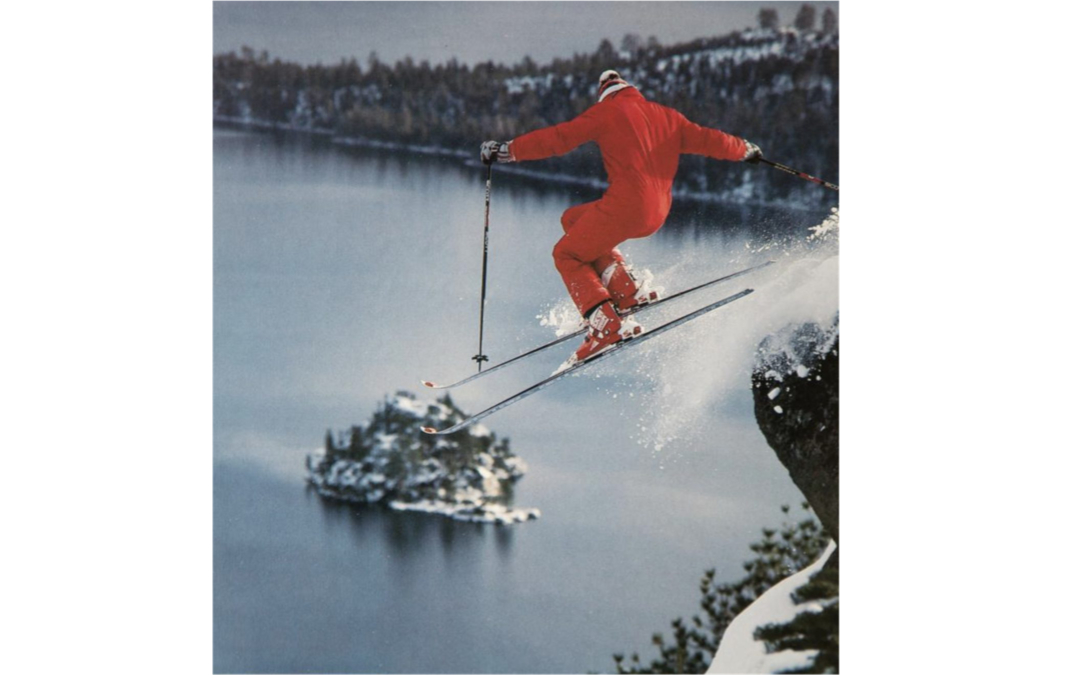
Larry Prosor didn’t just document the birth of extreme skiing in America, he ignited it.
The spark was lit by a nine-page barrage of eye-popping images lovingly displayed in the pages of Powder magazine, titled Ski to Die. If the editors at Powder had never seen a series of shots like these, it was because a rare confluence of events had to align to make them possible. First there had to be a multi-generational talent, Scot Schmidt, who saw lines through boulder-strewn cliffs that no one had ever dreamed of skiing.
Equally important was a documentarian with the skiing chops to tuck into the precarious positions needed to get the perfect perspective. The special sauce that took the Prosor/Schmidt collaboration to the next level was Prosor’s technical proficiency in service to an artist’s eye for composition.
Prosor’s deep roots in the nascent freeride culture in and around Palisades Tahoe inevitably connected with another cutting-edge snowsport, snowboarding. As related by Tom Burt, one of the first wave of snowboard pioneers, “Larry shot the athletes that were setting trends at the time. Larry shot all aspects of the mountain lifestyle, and when snowboarding started taking hold in the 80’s, he shot that, too, shooting legends like Craig Kelly, Tom Sims and Terry Kidwell, all now in the Hall of Fame.”
Prosor’s preeminent role in popularizing a sport just finding its footing made an indelible impression on its early practitioners. “His portfolio boasts an impressive array of captivating images that have not only showcased the thrill and beauty of snowboarding, but have helped shape the visual identity of the sport,” notes Cathy White, the first manager of (and only mother to) a certain Shaun White, who Prosor first shot as a nine-year old prodigy. “Larry has worked tirelessly to promote the sport, support its athletes and inspire a new generation of snowboarders. His passion, dedication and expertise have earned him the admiration and respect of the entire snowboarding community.”
Today’s media-saturated culture is so choked with video and film, we often overlook the impact that still pictures have on our lives. Shots like Prosor’s image of Scot Schmidt, clad in a bright red onesie – taken when Schmidt was so anonymous, he had yet to sign with a sponsor – invite the viewer into the frame, where they, too, can pause in mid-air over Emerald Bay, forever weightless, anticipating the plunge into snow that, in our dreams, is forever untracked.
What you just read was my nomination pitch to the U.S. Ski & Snowboard Hall of Fame for Larry Prosor, who, if elected, would be the first still photographer ever elected to the Hall. The roster of subjects who flew past Prosor’s lens is a Hall of Fame unto itself, with 17 august members. Here’s what a few of them had to say about Larry’s influence on a pioneering generation of skiers and riders.
Working with Larry came at a pivotal moment in both of our lives and careers. Our ability to read each other’s minds on which line to focus on and what mark to hit was special. Any miscommunication had the potential to be lethal for either one of us. We put a lot of trust in each other; we had to, for we often had just one chance to nail it, and getting the shot in the can is what Larry did best. He inspired a generation of skiers with his iconic images that are now forever burned into our collective ski minds. These images are a huge part of American ski history and Larry was one of the first to gamble his life and career on a pursuit that was unproven and certainly out-of-the box at the time. Together, Larry and I helped change the arc of skiing history. The passage of time has proven that these were risks worth taking, validating Larry Prosor’s contributions as a true pioneer in the action sports photography world, creating a body of work that is anything but conventional. – Scot Schmidt
Over the years since Doug’s passing, I browse through Larry’s priceless collection of photos from those memorable days , bringing those moments to life. Larry wasn’t just a photographer—he was a friend enjoying mountain adventures with us. That’s what made him unique as a professional photographer. Larry captured the moments with such authenticity, never in the way, but always present. Larry was the unsung hero, always there but never in the spotlight, sharing the adventure through his lens and preserving the spirit of those unforgettable moments for skiers to enjoy and be inspired by. – Emily Coombs
As a skier lucky enough to work with Larry in this era, Larry was the perfect combination of gifted photographer, talented skier and laid-back California surfer to meld seamlessly into the emerging extreme ski and snowboard universe. We athletes were making it all up as we went. Everything was new, Larry gently supported, facilitated and rolled with it while capturing it on film. Larry was the photographer all the athletes wanted to work with. His images were the best and always published. – Rob DesLauriers
With a career span since the beginning of our sport, Larry has established himself as one of the most respected and accomplished sports photographers in our industry. His portfolio boasts an impressive array of captivating images that have not only showcased the thrill and beauty of snowboarding but have also helped shape the visual identity of the sport. Larry’s impact on snowboarding extends beyond his stunning photographs. He has worked tirelessly to promote the sport, support its athletes, and inspire new generations of snowboarders. His passion, dedication, and expertise has earned him the admiration and respect of the entire snowboarding community. – Cathy White
If you’d like to read more about Prosor’s HOF-worthy career, this article by Melissa Siig in the March 11, 2022 issue of Moonshine Ink does a fine job of capturing what makes Prosor’s work so special: https://www.moonshineink.com/sports/the-photographer-who-changed-skiing/.

Related Articles
From Fallible to Foolproof and Back
In the 1970’s, prior to the adoption of the first ski boot sole standard, boot makers were free to concoct any sort of sole they might imagine. Many skiers still used leather boots with laminated soles, even after the industry largely moved on to injected plastic, which enabled shapes and sole patterns leather couldn’t duplicate.
This incoherent jumble of boot designs showed no lack of imagination, but little consideration for how they might interact with a binding. Bindings were likewise free from any standards that might have limited the creativity of their designs, many of which were crafted specifically to reduce or eliminate the role of the boot.
The Road to Perdition
The road to hell is said to be paved with good intentions. In my experience, the friends and relatives of prospective boot buyers are a wellspring of wretched advice wrapped in bright ribbons of sincerity and concern.
(Let us pause a moment and prayerfully acknowledge the gratitude of bootfitters everywhere that the new, pandemic-driven bootfit protocol discourages the presence of a bootfit entourage composed of family, moral supporters and consiglieri.)
Back to the subject at hand, the particular nugget of advice I’m leery of is the customary admonition to avoid too stiff a boot as it will hurt, you’ll hate it eventually if you don’t detest it immediately, and it will inhibit your skills development. Get only as much boot as you need and no more, goes the conventional wisdom. Racers need stiff boots; you don’t.
The Making of a Skier, Part IX: The ASTM, Carl Ettlinger and I
One of the many hats I wore as North American binding product manager for Salomon in the early 1980’s was that of delegate to the American Society for Testing and Materials (ASTM). I believe the first meeting of F8.14 – the sub-committee on ski safety – that I attended was in Pennsylvania. I was flying under the wings of Salomon’s seer of all standards and patents, Gilbert Delouche, and the binding product manager for the North American zone at that time (and my mentor), Joe Campisi.
I was a babe in the woods, but I soon caught on to the game under Delouche’s patience guidance. I recall a debate on the binding specification then being batted around in the technical committee chaired by Carl Ettlinger. Ettlinger wanted language that would require any release/retention setting of 10 or above to be “visually distinctive” from the rest of the scale.
