Prospective modern-day ski buyers do assiduous research, checking every online advice purveyor for clues in its reviews that will identify his or her personal best-of-all-possible worlds. They interview friends, instructors and a random coterie of lift-mates they interrogate while riding up on the gondola.
They might even follow the carefully crafted methodology on Realskiers.com to guide them to a rational selection. But whether the buying moment transpires on the floor of a specialty shop or is about to be executed with the jab of a finger on the Enter key, one final decision must be made, a decision that can suddenly derail the purchase from the fast track.
How can anyone go wrong getting a Bonafide? All that’s left to screw up is the size…
What size to get?
There is every reason to pause and reflect on the subject. In skis as in footwear, business suits or hats, sizing matters. Let’s revisit why.
First of all, what is it that a ski does, primordially? It displaces weight, namely yours. (You can ski in just your boots, but you won’t get far.) So the question becomes, how long a ski do I need to displace my weight sufficiently? The answer to this is simple: any ski worthy of the name will be long enough to enable sliding over groomed snow. The secondary issue now shifts to the foreground: how much will added length improve stability, particularly at higher speeds, and at what sacrifice to maneuverability?
Aye, there’s the rub. Longer skis are intrinsically more stable at speed and provide a more substantial platform behind you should you lose balance rearward. But longer skis also require more material, particularly if the ski is quite wide. More important than the extra mass is the likely judgment by the ski maker that the intended user will be proportionately larger than the skier using a smaller size, so it’s made beefier and harder to bend under moderate pressure.
If you can’t bend a ski, you’re no longer skiing; you’re strapped to a pair of slender toboggans. Bon voyage! See you at the clinic!
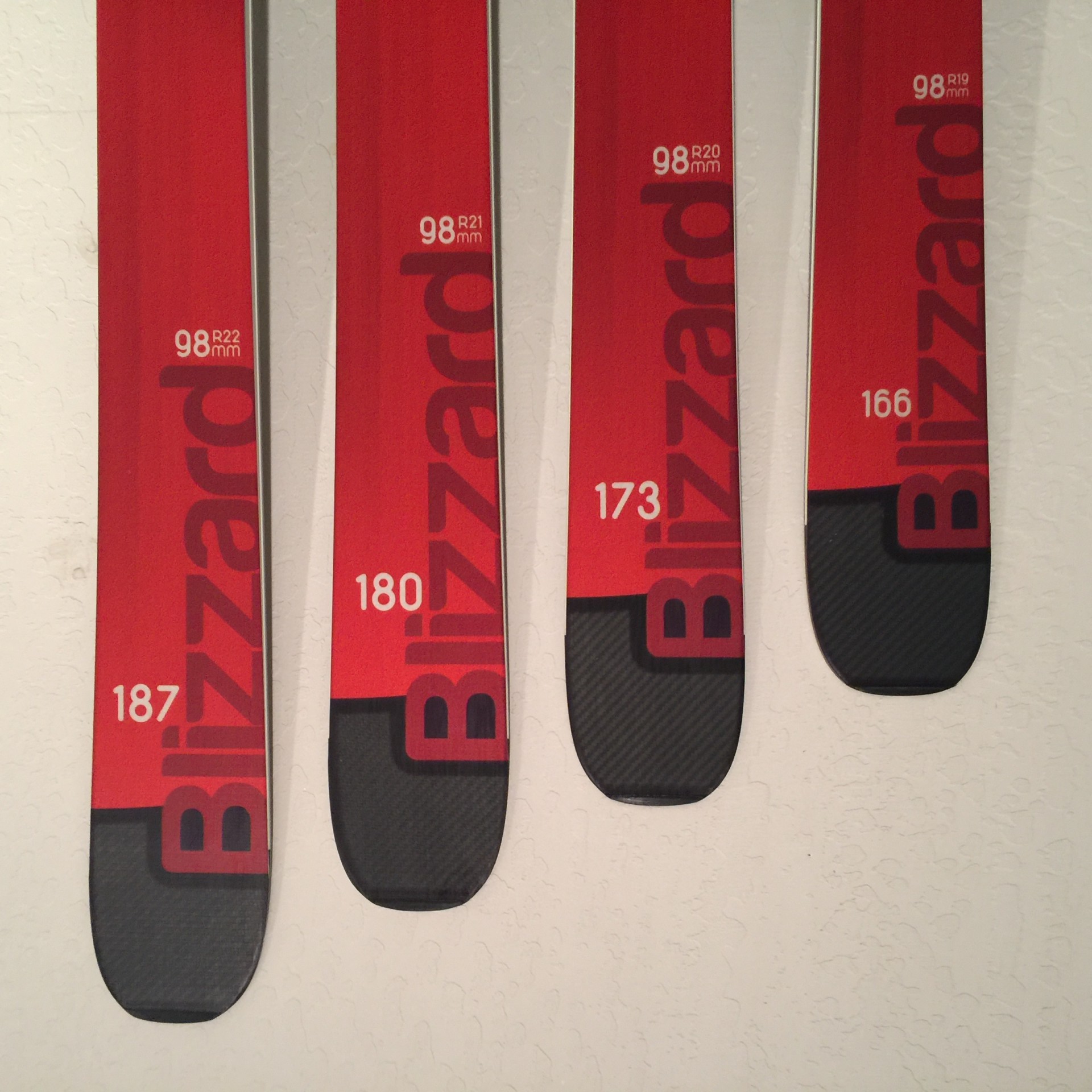
Exacerbating the issue of length selection is the relative paucity of choice. Once upon a time, a ski maker produced a new size every 5cm, and for some race skis, at even smaller increments. Now the split between sizes is more likely to be 7cm or more and the choice limited to 4 sizes or fewer.
Now that we all agree size selection is important, what guidelines should one follow to ensure a happy result? Back to basics: while height is not irrelevant, all a ski really knows about you is your weight. In simplest terms, the bigger you are, the more ski you need beneath you.
But there’s one more wrinkle before we issue sizing edicts. What category of ski are we talking about? The standard length for a World Cup slalom ski is 165cm, regardless of the (adult male) racer’s size. If we take this as a baseline, narrow-waisted skis that mimic race ski design (at Realskiers.com we call these Technical models) should also be skied short, the better to exploit their carving capabilities.
Once we move away from the racing domain and into recreational pursuits, skis get wider and lengths should – unbound from FIS restrictions on ski length and course setting – grow longer. A little longer beam underfoot makes balancing easier, particularly at high velocity. More importantly, today’s rockered skis shorten the amount of edge contact available, so one needs to add a few cms just to make up for the amount of running length surrendered to a warped baseline.
The world of off-piste skis (All-Mountain West, Big Mountain and Powder genres) has become such a hodge-podge that picking the optimal length requires detailed knowledge of any model’s construction, flex pattern and baseline. Two guidelines to observe: go too short and you lose rear support, which you’re going to rely on at some point; go too long and you’re on a freight train with no local stops.
There’s another reason to hew towards the middle of the size range when buying wider skis: not all models scale precisely. Sometimes there are material changes between sizes, but even when there are no apparent reasons two sizes should ski so differently they may feel more unalike than expected. Point being: when in doubt, medium-sized people should choose the reference length, which won’t be the shortest or longest.
Are there exceptions? Sure. The reason most skis come in a variety of sizes is because the options are necessary. Tiny people need smaller skis. (One of the worst crimes in humanity is putting a child on too long a ski.) Larger people (aka, all of humanity over 200 pounds) need a longer weight-displacement unit.
If I’ve managed to make a muddle of what was, before reading this monograph, a fairly simple decision, take solace in the fact that there are able counselors at conscientious specialty shops who have mastered the skill of sizing. I submit you to their care.
Last week I labored under the impression that the Hot Gear Bag would find its way back to market. I was wrong. But help is on the way in the form of the Transpack heated bag. It boasts the same essential features plus the ETL stamp of approval, an assurance it’s unlikely to melt your insoles or set your locker on fire.