
There are few things in skiing that work quite as well as being early. Every powder addict in the world knows the advantage of being early to the lift line or on the first tram, for these are the only ways to assure first tracks. While there’s no denying the allure of uncut powder pastures, being early has more to recommend it than just untrammeled lines. The mountain is all but empty, stripped clean of the clatter, clutter and yammering that will populate it in a few hours. The engines that will soon sweep the public uphill lie still. The snow underfoot is colder and squeaks louder when you walk on it. The fraternity of the early begins to gather as another ski day rustles to life.
There are two best-possible scenarios for being early at the Bird. The red-carpet route consists of early trams, three of which may ascend before the 9:00 AM cable car opens its doors to the masses. Gaining passage on early trams is reserved for those who can afford the heady tariff, which keeps the exclusivity high and the body count low. Standing on the top of Hidden Peak at the first glow of dawn is worth the price of admission, particularly if someone else is paying. It may be foot-stomping, arm-swinging cold, but the tingling anticipation of the special run to come warms from the inside.
The alternate ideal for being early entails another form of exclusivity, albeit a more democratic one. It’s known as “inter-lodge,” shorthand for “due to avalanche danger you can’t leave your building [any building] until further notice.” This divides the world into two unequal parts: those who will be skiing moments after inter-lodge is lifted, and those who will be barricaded below the canyon waiting for the road to open. When inter-lodge is in effect, no early tram travelers can poach the Bird’s abundant powder fields, giving everyone first shot at face shots. There is no better time in the world to be early.
There is another way to be early, and it doesn’t require the resources of a pasha or serendipitous housing. This opportunity to be early comes with every turn and is open to all. Yet precious few skiers avail themselves of it, content to drift aimlessly side to side, all the while convinced that because their skis are pointing somewhat east one moment and almost west a few beats later, they must have mastered the art of carving.
The single biggest differentiator between the advanced skier and the true expert is the latter’s ability to get to the next turn early. There are several components to being early, each of which moves in concert with the others. The upper body must continue its constant projection down the hill and into the turn, the existential lean of faith that is a prerequisite for performance skiing. The uphill hand cues a shift in weight to the ski below it by reaching for the fall line. And the uphill ski begins to tilt on edge early, at the top of the arc, supporting your hurtling mass as it navigates gravity’s stream.
The essence of getting to the turn early pertains at all slope angles and in every condition, but its clarity shines most brilliantly on freshly crafted corduroy with some samba to its rhythm.
The business of getting to the turn early has been somewhat compromised with the advent of rocker. While the essentials of body position don’t change, the ski’s ability to find snow at the top of the turn may be diminished by anywhere from a little to where did it go? The key is to apply the early edge angle and pressure regardless and let the ski design make the most of it. Some rockered skis will hook up from the tip almost as if there were no early rise in the ski forebody, while others will have their loose shovels bounce around like ferrets on meth when they don’t have any soft snow to press against.
While it is always advantageous to be early when riding firm snow, it is even more helpful if the aim is to achieve a high edge angle without any lateral slide. As anyone who observes their fellow man on the slopes can attest, there is more than one way to tip a ski on edge, but there aren’t a lot of good ways to get it on edge at the very top of the turn, so that between the two skis that form your carving foundation, you never leave contact with the snow. Getting to the uphill ski’s edge early sets the tone for the rest of the turn. It requires commitment and sensitivity and some comfort with speed. The return on this investment is total security on edge, allowing the pilot to set his or her line according to the degree of edge angle applied, feathering the arc without smearing it, the way Vermeer manipulated his brush when simulating the sheen of a pearl.
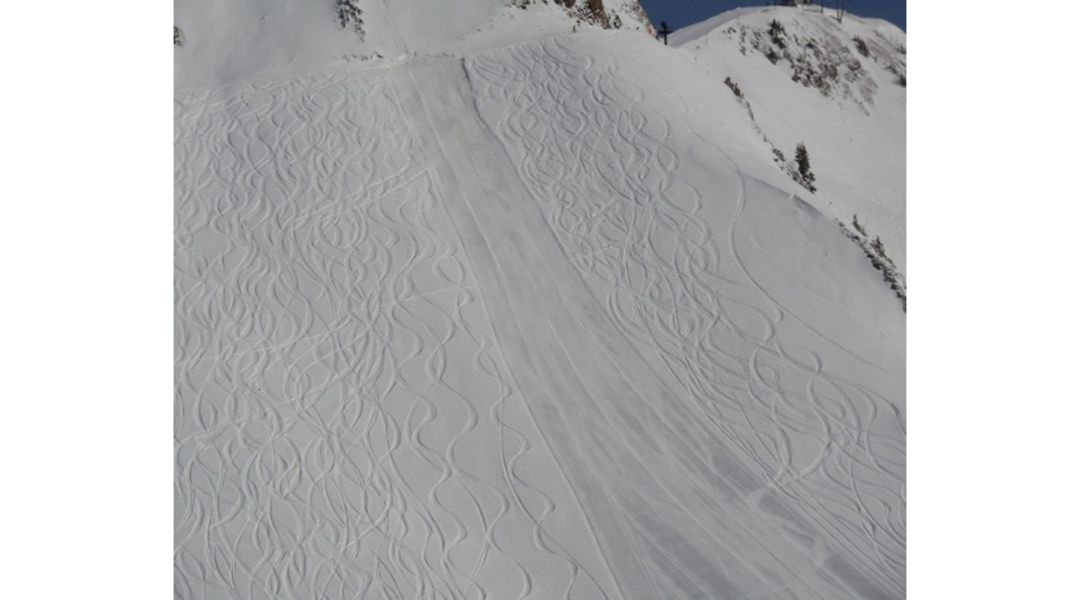
When you’re motoring along at 40mph, every turn may contain an element of surprise. Like presents on Christmas, you don’t know what you’re going to find at the bottom of the turn until you remove the wrapping at the top. If you set the edge early, you always get the present you want. For a lesson in being early, head off the top of Hidden Peak down the Path to Paradise, which feeds into Mineral Basin. The smooth acceleration of the cat-track gradually builds the energy you will momentarily unleash into White Diamonds Downhill. As you pass the gun mounted along the edge of the traverse’s only tight corner, White Diamonds Downhill will be your next left, groomed ballroom smooth top to bottom, but with an abrupt transition that can only be cannily managed by being early.
As you crest the run, roll your uphill ski on edge and tip your upper body into the fall line. Stand hard on the ski to resist the sudden surge in force generated by the slope’s steep pitch, but don’t stand on it long. At the peak of the load, step to your uphill ski; the move to the new ski is inseparable from the step off the old, as integrated and uncomplicated as walking. The commitment to the uphill ski is accompanied by leaning the upper body down the pitch, ahead of your skis. It’s at the top of the turn, when one has the sense of falling into it, that you can feel the flow of the hill, inviting you to mesh your movements with it. As you move early to the uphill ski it becomes the platform from which you direct the rest of you into the flow. The ski will load naturally as you shift weight and apply pressure to it, storing the power that will shoot you out the bottom of the arc and into the next. Step, tip, load and release. The more force applied when loading the ski, the lighter the feeling when the load is released. The pressure-and-release feels like an organic pulse, as natural and rhythmic as breathing.
As the pitch starts to transition into a giant, roundhouse left, you let your ponies run, adding an extra dollop of speed to pull a few more fractions of g force through the compression, luxuriating in the belly of an elongated arc. As you round the corner, you confront a slope that falls sharply away to your right, another opportunity to set up early so when you hit the crest you are already in the heart of your first turn. This pitch transitions into the immense rollers that dominate the bottom of this side of Mineral Basin. Here the instinct for being early translates into matching the roll of the hill with your roll onto the edge, always striving to make that moment come as early as possible. More than a matter of mere mechanics, being early is a mindset, a willingness to seek the cadence of the mountain, a recognition that gravity’s stream is always running, and the comprehension that once we visualize its flow it’s our sacred duty to enter it.
Don’t forget to pick up your own copy of Snowbird Secrets, available on Amazon.

Related Articles
Fit the Whole Skier
We bootfitters are naturally obsessed with feet, but the best bootfitters don’t just fit feet; they fit the whole skier. The “whole skier” includes more than just a quick survey of the lower leg and how it’s connected to the foot. It’s even more than all of the skier’s physical attributes, which include not only height and weight, but seated posture, stance, kinesthetic wiring, arch health and stiffness throughout the kinetic chain; the whole skier also includes his or her history with the sport and, most importantly, what sort of skier he or she wants to be.
One of the most obvious traits about almost all boot customers is his or her gender. (Please forgive me if I don’t overcomplicate what should be a simple point about body type.) The first step in a sales process that consists of winnowing all possible boots down to one is picking from the pile of unisex boots or the alternative world of women’s boots.
No-brainer, right? Not so fast. What if a particular woman were tall, with a long tibia and a tapered calf? Let’s add to her profile that she’s a good athlete with a background in dance. Up to now, she’s only been an occasional skier who rented her gear, but a new beau has persuaded her to take a deeper dive. She already has her season pass.
The Things We Do for Love, Part II
Dear Readers who regularly devour my weekly Revelations know that I have already written at length on the subject of Why Skiers Are Better than Everyone Else. Last Friday I was reminded of my timeless prose as I spent 45 minutes traversing a very short stretch of road that connects I-80 to Route 89, my proscribed path to Alpine Meadows. As I voluntarily descended into this automotive miasma, I could make out the dim form of the interstate traffic snaking down from the west, two dense strands of tightly linked vehicles stretching beyond the horizon.

Realskiers.com Trounces Field to Earn Second Stump-Bertoni Prize for Excellence
In a stunning upset that in retrospect appears inevitable, Realskiers.com has been awarded The Stump-Bertoni Prize for Excellence for the second year in a row.
For those cave-dwellers who snoozed through Realskiers.com’s first triumph in this gilded competition, permit me to bring you up to speed. Then as now, the battle for this cherished trophy (metaphorically speaking – the S-BP lacks sufficient funds for a memento commensurate with its prestige) was fierce, extending both of its eponymous founders to previously unknown limits.
The final ballot was determined by leg wrestling over Stump’s furious protest; he cogently argued that this sort of bias against the vertically challenged has no place in a free society. Bertoni imperiously overruled Stump’s evermore strident complaints, citing a lack of legible documentation, tardy submissions and a tendency to perspire copiously when provoked.
This year’s competition was no less fraught.
