
There are few things in skiing that work quite as well as being early. Every powder addict in the world knows the advantage of being early to the lift line or on the first tram, for these are the only ways to assure first tracks. While there’s no denying the allure of uncut powder pastures, being early has more to recommend it than just untrammeled lines. The mountain is all but empty, stripped clean of the clatter, clutter and yammering that will populate it in a few hours. The engines that will soon sweep the public uphill lie still. The snow underfoot is colder and squeaks louder when you walk on it. The fraternity of the early begins to gather as another ski day rustles to life.
There are two best-possible scenarios for being early at the Bird. The red-carpet route consists of early trams, three of which may ascend before the 9:00 AM cable car opens its doors to the masses. Gaining passage on early trams is reserved for those who can afford the heady tariff, which keeps the exclusivity high and the body count low. Standing on the top of Hidden Peak at the first glow of dawn is worth the price of admission, particularly if someone else is paying. It may be foot-stomping, arm-swinging cold, but the tingling anticipation of the special run to come warms from the inside.
The alternate ideal for being early entails another form of exclusivity, albeit a more democratic one. It’s known as “inter-lodge,” shorthand for “due to avalanche danger you can’t leave your building [any building] until further notice.” This divides the world into two unequal parts: those who will be skiing moments after inter-lodge is lifted, and those who will be barricaded below the canyon waiting for the road to open. When inter-lodge is in effect, no early tram travelers can poach the Bird’s abundant powder fields, giving everyone first shot at face shots. There is no better time in the world to be early.
There is another way to be early, and it doesn’t require the resources of a pasha or serendipitous housing. This opportunity to be early comes with every turn and is open to all. Yet precious few skiers avail themselves of it, content to drift aimlessly side to side, all the while convinced that because their skis are pointing somewhat east one moment and almost west a few beats later, they must have mastered the art of carving.
The single biggest differentiator between the advanced skier and the true expert is the latter’s ability to get to the next turn early. There are several components to being early, each of which moves in concert with the others. The upper body must continue its constant projection down the hill and into the turn, the existential lean of faith that is a prerequisite for performance skiing. The uphill hand cues a shift in weight to the ski below it by reaching for the fall line. And the uphill ski begins to tilt on edge early, at the top of the arc, supporting your hurtling mass as it navigates gravity’s stream.
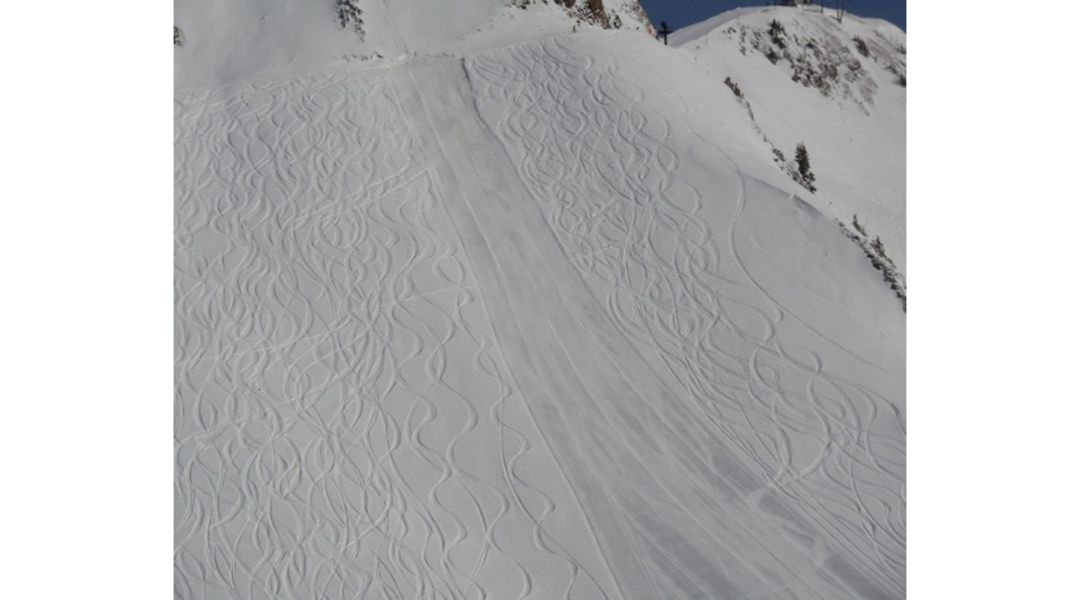
The essence of getting to the turn early pertains at all slope angles and in every condition, but its clarity shines most brilliantly on freshly crafted corduroy with some samba to its rhythm.
The business of getting to the turn early has been somewhat compromised with the advent of rocker. While the essentials of body position don’t change, the ski’s ability to find snow at the top of the turn may be diminished by anywhere from a little to where did it go? The key is to apply the early edge angle and pressure regardless and let the ski design make the most of it. Some rockered skis will hook up from the tip almost as if there were no early rise in the ski forebody, while others will have their loose shovels bounce around like ferrets on meth when they don’t have any soft snow to press against.
While it is always advantageous to be early when riding firm snow, it is even more helpful if the aim is to achieve a high edge angle without any lateral slide. As anyone who observes their fellow man on the slopes can attest, there is more than one way to tip a ski on edge, but there aren’t a lot of good ways to get it on edge at the very top of the turn, so that between the two skis that form your carving foundation, you never leave contact with the snow. Getting to the uphill ski’s edge early sets the tone for the rest of the turn. It requires commitment and sensitivity and some comfort with speed. The return on this investment is total security on edge, allowing the pilot to set his or her line according to the degree of edge angle applied, feathering the arc without smearing it, the way Vermeer manipulated his brush when simulating the sheen of a pearl.
When you’re motoring along at 40mph, every turn may contain an element of surprise. Like presents on Christmas, you don’t know what you’re going to find at the bottom of the turn until you remove the wrapping at the top. If you set the edge early, you always get the present you want. For a lesson in being early, head off the top of Hidden Peak down the Path to Paradise, which feeds into Mineral Basin. The smooth acceleration of the cat-track gradually builds the energy you will momentarily unleash into White Diamonds Downhill. As you pass the gun mounted along the edge of the traverse’s only tight corner, White Diamonds Downhill will be your next left, groomed ballroom smooth top to bottom, but with an abrupt transition that can only be cannily managed by being early.
As you crest the run, roll your uphill ski on edge and tip your upper body into the fall line. Stand hard on the ski to resist the sudden surge in force generated by the slope’s steep pitch, but don’t stand on it long. At the peak of the load, step to your uphill ski; the move to the new ski is inseparable from the step off the old, as integrated and uncomplicated as walking. The commitment to the uphill ski is accompanied by leaning the upper body down the pitch, ahead of your skis. It’s at the top of the turn, when one has the sense of falling into it, that you can feel the flow of the hill, inviting you to mesh your movements with it. As you move early to the uphill ski it becomes the platform from which you direct the rest of you into the flow. The ski will load naturally as you shift weight and apply pressure to it, storing the power that will shoot you out the bottom of the arc and into the next. Step, tip, load and release. The more force applied when loading the ski, the lighter the feeling when the load is released. The pressure-and-release feels like an organic pulse, as natural and rhythmic as breathing.
As the pitch starts to transition into a giant, roundhouse left, you let your ponies run, adding an extra dollop of speed to pull a few more fractions of g force through the compression, luxuriating in the belly of an elongated arc. As you round the corner, you confront a slope that falls sharply away to your right, another opportunity to set up early so when you hit the crest you are already in the heart of your first turn. This pitch transitions into the immense rollers that dominate the bottom of this side of Mineral Basin. Here the instinct for being early translates into matching the roll of the hill with your roll onto the edge, always striving to make that moment come as early as possible. More than a matter of mere mechanics, being early is a mindset, a willingness to seek the cadence of the mountain, a recognition that gravity’s stream is always running, and the comprehension that once we visualize its flow it’s our sacred duty to enter it.
Don’t forget to pick up your own copy of Snowbird Secrets, available on Amazon.

Related Articles
The Making of a Skier, Part IX: The ASTM, Carl Ettlinger and I
One of the many hats I wore as North American binding product manager for Salomon in the early 1980’s was that of delegate to the American Society for Testing and Materials (ASTM). I believe the first meeting of F8.14 – the sub-committee on ski safety – that I attended was in Pennsylvania. I was flying under the wings of Salomon’s seer of all standards and patents, Gilbert Delouche, and the binding product manager for the North American zone at that time (and my mentor), Joe Campisi.
I was a babe in the woods, but I soon caught on to the game under Delouche’s patience guidance. I recall a debate on the binding specification then being batted around in the technical committee chaired by Carl Ettlinger. Ettlinger wanted language that would require any release/retention setting of 10 or above to be “visually distinctive” from the rest of the scale.
In Memorium, Carl Ettlinger
Carl was a giant of a man whose outsized voice roiled every conversation like a burst dam and whose expansive vision reached across the mixed milieus of research, journalism, risk management and education. I knew him when he was at the peak of his powers, as he explained to me when I interviewed him for a “where are they now?” profile in Skiing History. He was able to conduct long-term research on injury patterns as well as analyze the particulars of the current binding market, turn around and package this knowledge into articles for Skiing and Skiing Trade News, followed up by a workshop tour that would bring enlightenment to the grassroots level. No one but Carl could have pulled this off, and Lord knows no one has had the requisite talent, energy and will power since.
But time and tide wait for no man, and Carl’s finely spun web of influence was eventually plucked apart. The loss of his pivotal positions in the press allowed him to slip from public view before we, the skiers of the world, realized we hadn’t taken the time to thank him.
We have the time to thank him now.
So thanks, Carl, for being first and foremost a teacher, for teaching is at the heart of the evangel’s mission.
Thanks for being so damn stubborn. Your insistence on improving skier safety wore through a wall of resistance as tough as Vermont marble.
Thanks for having a heart as big as that melon-sized head of yours. The fuel to your tireless mind was a caring heart that tried to embrace the world.
Thanks for all the stories once the Mount Gay flowed. Who knew we would have won the Vietnam War if only his superiors had listened? I can’t remember exactly how – he wasn’t the only one drinking Mount Gay – but I recall the light in his eyes as he relayed his twisted tales, taking us down successive rabbit-holes of digression that I lost track of at the seventh level.
That’s what I remember most vividly about my many interactions with Carl: his brain so teemed with thoughts he rushed to get them out in a verbal jailbreak that would travel around the cosmos until returning, many lost minutes later, to the subject that had inspired them. That was Carl: too many words for one sentence, too many tasks to tend to and all of it, every erg of his endless energy, devoted to a cause he never ceased to serve.
Fare thee well, Carl Ettlinger. The world misses you already for it will never see another quite like you, whose every moment seemed larger than life itself.
I raise my glass to you, old friend. Mount Gay, of course.
Jackson Hogen
June 23, 2020
Why This Buyer’s Guide?
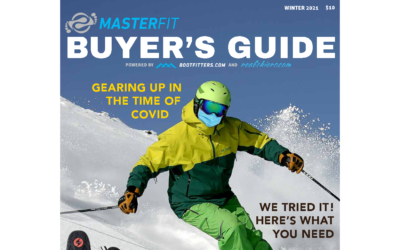
Don’t read the 2021 Masterfit Buyer’s Guide in Partnership with Realskiers.com for its 62 ski reviews. I should know. I wrote or edited all of them.
Not that the ski reviews aren’t worth the read. But ski reviews on the web are as common as rice, while the Buyer’s Guide contains something no other publication, whether in digital, print or video format, can claim: the most respected, thorough and dependable boot reviews in the world.
This isn’t mere puffery. The Masterfit Boot Test is so well regarded by the supplier community that nearly every brand not only sends its following year’s line-up in four men’s sizes plus three for women, it also dispatches its top designers and/or product managers to a distant North American site for most of the test’s five-day duration.
