
Twenty-five years ago, even astute ski industry insiders wouldn’t have predicted that tiny Swiss brand Stöckli would one day be the darling of the specialty retail channel. Then as now, Stöckli’s deepest roots are in the race community, and its ski line reflects this heritage. I recall several years of testing for SKI magazine when seemingly every Stöckli was perfectly designed and tuned to win a Super G.
A toe-hold in FIS-level speed events isn’t normally a springboard to broad-based market success, and Stöckli’s ascension to the ranks of the most popular ski brands was neither swift nor smooth. At one point, sales via the normal retail channel grew so grim the U.S. distributor gave up on brick-and-mortar shops and tried to live off the growing Internet channel. The complete reversal of this catastrophic policy laid the groundwork for Stöckli’s current market momentum.
Another cornerstone of Stöckli’s present-day popularity is its top-of-the-market pricing. Once specialty shops realized that their best customers would spend more – a lot more, like $500 more – for Stöckli quality, the sales of the Swiss skis soared. In a shrinking market, the ability to charge more per transaction is the only way to preserve viability, so Stöckli evolved into the right brand at the right time. The exquisite on-snow performance of its growing collection of non-race skis validated the premium pricing and lent the brand an aura of luxury and prestige, a heady mix that also happens to drive the success of the Swiss high-end watch trade, which can’t have escaped Stöckli’s notice.
From the perspective of the insular U.S. retail market, it seems like Stöckli has assumed an unassailable position at the pinnacle of the pricing pyramid. (To give you an idea of the prices we’re talking about, the Montero AR sells for $1489 flat, $1829 with a matching binding. Race skis – still a large chunk of its collection – cost more.) But just as Rolex isn’t the only premium Swiss watch brand, Stöckli is similarly surrounded by elite competition. All the models I’ve corralled for this roundup of luxury brands teeter at the top of the market, dangling the allure of conspicuous exclusivity for the one-percenters who don’t want to be mistaken for hoi polloi.
Van Deer https://vandeer-redbull-sports.com/en

Van Deer H Power 78 ($1599)
Of all the Stöckli challengers, Austrian-made, Marcel Hirscher designed, Red Bull funded Van Deer seems best positioned to challenge the Swiss for preeminence in the ultra-exclusive genre. The construction of a new factory in Scheffau, Austria gives Van Deer a decided advantage over the field, as whoever builds the most recent, up-to-date facility can take advantage of the latest technology. The ultimate validation for any European ski maker is success on the World Cup circuit, where Van Deer athletes are already mounting podia in technical events. Availability in the U.S. is limited to a handful of specialty shops with a history of race-level service.
Stereo https://www.stereoskis.com/selectskis/

Piste Carve FC ($1400)
Norway-based Stereo is all but invisible on the American market, but it’s singing from the same hymnal as Van Deer and is a likely candidate to enter the U.S. soon. The focus is on top-quality components and eco-friendly production in their Swedish factory. Headlining the operation is Norwegian superstar Kjetil Andre Aamodt, charged with the assignment to deliver World Cup level performance. All indications are the race-bred models are first rate, but it’s questionable whether America will ever embrace high-speed carving as practiced in Europe.
Bomber https://bomberski.com/
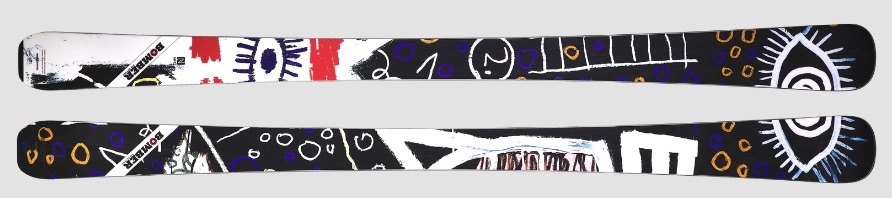 Basquiat Third Eye 78 ($2250)
Remember the brand Bode Miller embraced after he quit the World Cup and ended his long association with Head? It was Italian luxury brand Bomber, who continues to sell its high-end wares out of its Madison Ave. storefront. If you want to be sure fellow skiers notice that you’ve dropped over $2K on your skis, Bomber has an entire artists’ series, including the Basquiat Third Eye 78 ($2250). If you really want to make a statement, Bomber also offers a matching helmet and pole, for a look that in all probability will be all yours.
Dynamic https://dynamic.ski/en/
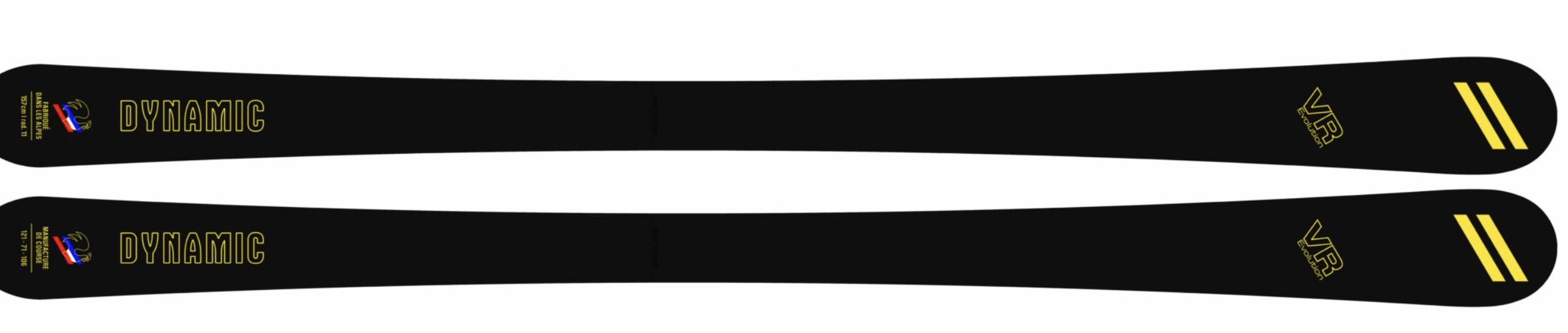
Dynamic VR Evolution (1150€)
For nostalgia buffs, the return of the Dynamic VR17 rekindles memories of a time when racing was the only game in town and Dynamic enjoyed a reputation as one of the great skis of its era. Actually, the 2025 VR Evolution (1150€) is a better ski, with a modern construction and superior quality control (the original was a bit iffy in this department). Well regarded in Europe, the new Dynamic has yet to dip its toes into American waters.
Volant https://www.atomic.com/en-us/shop/shared/volant.html

Volant 9000 ($3000)
Volant presents another nostalgia play, but time travel via Volant is strictly first class as the top model in the 3-model Volant family will set you back $3000. Volant began as an all-American brand (designed by Bucky Kashiwa, marketed by brother Hank), but in the current alpine ski market its natural constituency is among Europe’s carving cult. The story of Volant’s rise, fall and resurrection teaches many lessons, not the least of which is “timing is everything.” The brand’s death spiral was triggered by a bold decision to sell direct via the Internet. The retailer revolt was swift and its results fatal. How times have changed.
DPS https://www.dpsskis.com/collections/skis

DPS Pisteworks 79 ($1995)
America is home to dozens of small-batch brands that will never challenge Stöckli’s market penetration, and at least one legitimate rival for the affections of the well-heeled, Salt Lake City based DPS. There’s no better place for a brand whose first two initials stand for “Deep Powder” than the foot of the Wasatch range, and DPS will continue to focus on what it does best, but it may get its biggest boost in skier awareness by introducing the groomer-oriented Pisteworks collection, spearheaded by the apotheosis of the carved turn, Ted Ligety.
Wagner Custom Skis https://www.wagnerskis.com/pages/wagner-custom-skis
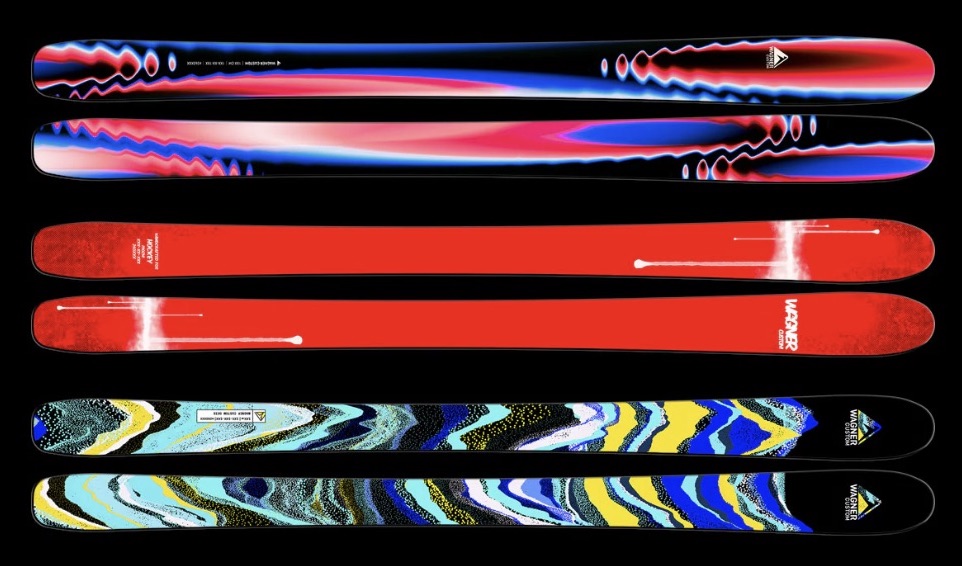
A sampling of the design options in the standard Wagner offering. ($2095)
I’m reasonably certain Pete Wagner isn’t interested in selling as many skis as Stöckli, but price-wise his bespoke designs are in the same stratospheric orbit. The basic design is all classic, quality components ($2095), with upgrades like Titanal laminates available in $400 and $800 packages. Cosmetics likewise have a stock offering and a slew of options like wood veneers and design-your-own top sheets. They may not enjoy a race pedigree like Van Deer, but Wagner customers tend to be addicted to their impeccable ride.
Epilog
This quick tour d’horizon of the luxury ski market is by no means comprehensive. I’ve left out well-regarded Blossom from Italy; exotic designs from Zai in Switzerland; eco-conscious Ferreol from Canada; custom cosmetics from Foil; killer carvers on steroids from Head-owned Indigo; Crosson, where Bode Miller had a cup of coffee between Bomber and Peak; the fashionable flair of Black Crows, the tiny Swiss Alpenstille and Canadian-made J Skis that has attracted a cadre of fanatical followers.
If that sounds like a soup-to-nuts round-up, it’s not. Not by a long shot.
I don’t know exactly how many small ski brands there are in the world, but I do know a well-respected ski industry maven who has tried to amass a comprehensive list. His current total sits at… (pause for effect)… 231. And counting.

Related Articles

In Memorium, Carl Ettlinger
Carl was a giant of a man whose outsized voice roiled every conversation like a burst dam and whose expansive vision reached across the mixed milieus of research, journalism, risk management and education. I knew him when he was at the peak of his powers, as he explained to me when I interviewed him for a “where are they now?” profile in Skiing History. He was able to conduct long-term research on injury patterns as well as analyze the particulars of the current binding market, turn around and package this knowledge into articles for Skiing and Skiing Trade News, followed up by a workshop tour that would bring enlightenment to the grassroots level. No one but Carl could have pulled this off, and Lord knows no one has had the requisite talent, energy and will power since.
But time and tide wait for no man, and Carl’s finely spun web of influence was eventually plucked apart. The loss of his pivotal positions in the press allowed him to slip from public view before we, the skiers of the world, realized we hadn’t taken the time to thank him.
We have the time to thank him now.
So thanks, Carl, for being first and foremost a teacher, for teaching is at the heart of the evangel’s mission.
Thanks for being so damn stubborn. Your insistence on improving skier safety wore through a wall of resistance as tough as Vermont marble.
Thanks for having a heart as big as that melon-sized head of yours. The fuel to your tireless mind was a caring heart that tried to embrace the world.
Thanks for all the stories once the Mount Gay flowed. Who knew we would have won the Vietnam War if only his superiors had listened? I can’t remember exactly how – he wasn’t the only one drinking Mount Gay – but I recall the light in his eyes as he relayed his twisted tales, taking us down successive rabbit-holes of digression that I lost track of at the seventh level.
That’s what I remember most vividly about my many interactions with Carl: his brain so teemed with thoughts he rushed to get them out in a verbal jailbreak that would travel around the cosmos until returning, many lost minutes later, to the subject that had inspired them. That was Carl: too many words for one sentence, too many tasks to tend to and all of it, every erg of his endless energy, devoted to a cause he never ceased to serve.
Fare thee well, Carl Ettlinger. The world misses you already for it will never see another quite like you, whose every moment seemed larger than life itself.
I raise my glass to you, old friend. Mount Gay, of course.
Jackson Hogen
June 23, 2020

Why This Buyer’s Guide?
Don’t read the 2021 Masterfit Buyer’s Guide in Partnership with Realskiers.com for its 62 ski reviews. I should know. I wrote or edited all of them.
Not that the ski reviews aren’t worth the read. But ski reviews on the web are as common as rice, while the Buyer’s Guide contains something no other publication, whether in digital, print or video format, can claim: the most respected, thorough and dependable boot reviews in the world.
This isn’t mere puffery. The Masterfit Boot Test is so well regarded by the supplier community that nearly every brand not only sends its following year’s line-up in four men’s sizes plus three for women, it also dispatches its top designers and/or product managers to a distant North American site for most of the test’s five-day duration.

The Ripple Effect
As I’ve observed in this space before, product managers spend most of their time in the future; the present for them is two years away for the rest of us. So when the coronavirus shut down the 19/20 ski season, it triggered an automatic response in the R&D lobes lodged deep in my noggin: what impact will this have two years down the road?
If I knew the answer to this question with any certainty, I should be running a hedge fund, not scribbling about skiing. But after checking with several of the bellwether players in U.S. market, I have some idea of what’s in store.
