
Or The Many Shades of Perfect
Americans tend to treat all athletic endeavors as metaphors for war. Our most cherished spectator sports are either grounded in a military ethos (football) or are brutally confrontational (NASCAR, cage fighting) and this winner-moves-on, loser-goes-home mentality bleeds into other arenas. Skiers also compete head-to-head in countless ways (remember ballet?), but 99% of skiers aren’t competing for anything yet they often bring to the slopes an attitude that this heart-pounding activity must be a contest with… something.
It’s hard to conceive of a less constructive attitude to bring to the mountain. Skiing need not be a battle against others and it must not be a duel with the mountain itself. It’s not about winning and it’s certainly not about beating someone. Thanks to advanced GPS technology, it’s now possible to track every moment of your ski day, including your top speed, vertical consumed, number of runs, steepest pitch, every stat you can dream up; it’s not about that, either.
Skiing is about discovering something about yourself that you wouldn’t otherwise learn. It’s about getting off the groomers and following the path into the trees. It’s about challenging your assumptions about what constitutes perfection. There are some skiers who will only eat powder; others who dine only on groomage. Both are missing the point of why we ski in the first place. The path to self-discovery is not measured in the number of consecutive blue trams caught or the depth of the powder plumbed that day. To find what you’re really looking for requires a different relationship with the mountain, not an adversarial one, but a bond, a connection via passion, understanding, respect, and yes, love.
It’s not about making turns. You can make turns on any mountain; that’s what redeems the smaller hills skiers often grow up on. It’s where we learn the discipline of cutting edges into a surface that fights back, a skill that transfers to any alpine environment. But once the training wheels come off and it’s time to discover the treasures that only big mountains can hide, you learn to match your turns to the mountain as you find it. There is no one way to ski the mountain because the mountain is never the same. The pre-Socratic philosopher Heraclitus said you can’t cross the same river twice. The same could be said of big mountains in winter.
And, heresy of heresies in Little Cottonwood Canyon, it’s not about feasting on powder. Those who only ski on powder days will never know the epiphany of consistently creasing wind-deposit lines or revel in the tantalizing skill of navigating wind slab, to say nothing of the quotidian pleasures of corn and corduroy. Without their 40 inches of 8% (water content) powder they can’t adjust to a world, however temporary, of 40 inches of 0%. Their eyes don’t see this other shade of perfection in part because they don’t know where to look but more importantly because they haven’t learned how to look. The trick is to take what the mountain gives you, and in that gift, to find your reward.
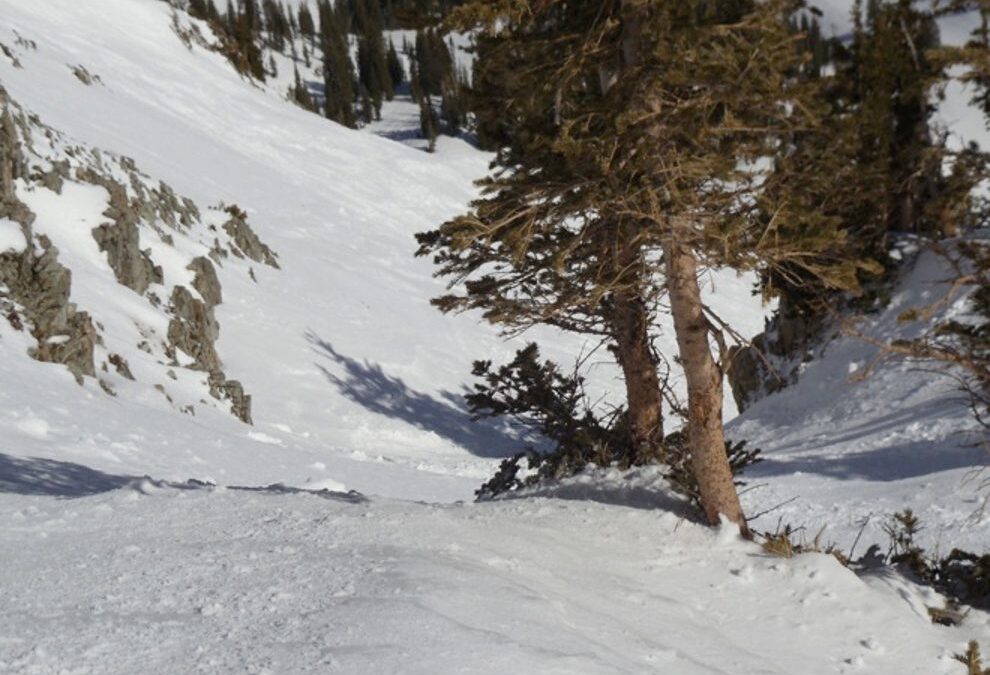
As Olivia Newton-John once sang, let’s get physical. Suppose it’s a blustery day, a wild wind tearing out of the south in sidelong swirls that skitter across the snow surface, obscuring all objects more than ten yards away. The snow seems in a panic to be someplace else, yet even snow driven by winds both fierce and fickle has to land somewhere, and that somewhere is often Macaroni Chute, a tight, steep, north-facing shot some five to ten turns long. You can check it out from the tram as it approaches Tower 4, to scout the quality of the wind-buff that loads in between the rock cliffs that define the chute’s boundaries.
The easiest way to gain entry to the goods is the gate at Tower 4. Once you are in the slot, keep your speed in check as the exit is guarded by dramatic shark fins of rock that will put a real dent in your day if you clip one. A hard left past the exit sends you towards the even steeper North Chute, while straight below lie the cliff features of Silver Fox and Rock Chute. If you traverse left out of Rock Chute you will find other pockets where the south wind will have left a present of uncut cream. Alternatively, if you head skier’s right out of Macaroni, you’ll be poised to hit Primrose Path. On the upper slope, aim for the scattered tree features to provide some reference in flat light, then hew to the right tree line for better visibility through the lower gully and on into Chip’s flats.
When the wind is transporting snow to Macaroni and the slopes immediately below it, you can lap run after run and never cross your own tracks. These are the true powder days, with perfection on demand for as long as your legs hold you up. You never experience that on a bluebird pow day, when all is ravaged in an hour. By taking what the mountain gives you, you discover other shades of perfection.
Skiing the mountain as you find it means you can’t always cling to familiar routes. Some skiers treat the tram as the mother ship, literally; they get separation anxiety if their run doesn’t conclude in the plaza. The problem with tram dependency is it limits one’s options when conditions are at their best along the resort’s boundaries. One of those boundaries resides looker’s right off the Gad 2 chair, through the first gate at the top of Bananas, past a short uphill bump that requires 2 minutes of sidestepping before the trail catches a gradual traverse that delivers you to the gate for Thunder Bowl. As you stand at this threshold, the trail falling off to your right is Tiger Tail, a worthy descent in its own right. After passing the “Open” sign, the first shot on your right highlights low shrubberies dotting succulent steeps. The next drop-in is more open at the top, with larger trees to play through, but tightens like a python’s coil as you get lower. Subsequent lines are ever more open, which creates more sun exposure, so keep that in mind when choosing your line.
The lower half of Thunder Bowl has two distinct features: to skier’s right is a large timbered area, which drops off at an extremely steep pitch (over 45o) littered with rock outcroppings, short stubby trees, and little rhythm to speak of; to skier’s left, directly down the fall line, is Exit Gully, which in a good snow year offers an open glade of coniferous delight. Thunder Bowl was a less popular destination before Exit Gully was cleared of trees by an avalanche that deposited the lumber against the top of Baby Thunder lift. Below this naturally cleared path is a steep section that breaks into two distinct fall lines that converge into a tight gully that drops you at the top of the Baby Thunder Chair. If that chair isn’t running, don’t ski any lower than the last traverse to the Gadzoom lift, or you’ll be walking.
One of the adventures available off the Thunder Bowl traverse is continuing through the backcountry gate, which leads around to Scottie’s Bowl. This bit of exploration presents some return access issues, so plan ahead before you tackle it. If the backcountry gate is closed, don’t cross it. Gate violations close access to Thunder Bowl for everybody, so please respect the patrol and your fellow seekers by respecting closed boundaries.
One reason we devote so much of our lives to skiing is that catching lines like Macaroni and Thunder Bowl isn’t like other forms of exercise. It’s not like going for a run, working out at the gym, or playing golf or tennis, if for no other reason than you can’t do any of these other activities while rocketing along at 40 mph down a steeply sloped forest. There’s curative, rejuvenating magic in finding the calm center of your own energy field, feeling as if the world is racing past while you dance in a single place that keeps on changing.

Related Articles
The Making of a Skier, Part IX: The ASTM, Carl Ettlinger and I
One of the many hats I wore as North American binding product manager for Salomon in the early 1980’s was that of delegate to the American Society for Testing and Materials (ASTM). I believe the first meeting of F8.14 – the sub-committee on ski safety – that I attended was in Pennsylvania. I was flying under the wings of Salomon’s seer of all standards and patents, Gilbert Delouche, and the binding product manager for the North American zone at that time (and my mentor), Joe Campisi.
I was a babe in the woods, but I soon caught on to the game under Delouche’s patience guidance. I recall a debate on the binding specification then being batted around in the technical committee chaired by Carl Ettlinger. Ettlinger wanted language that would require any release/retention setting of 10 or above to be “visually distinctive” from the rest of the scale.
In Memorium, Carl Ettlinger
Carl was a giant of a man whose outsized voice roiled every conversation like a burst dam and whose expansive vision reached across the mixed milieus of research, journalism, risk management and education. I knew him when he was at the peak of his powers, as he explained to me when I interviewed him for a “where are they now?” profile in Skiing History. He was able to conduct long-term research on injury patterns as well as analyze the particulars of the current binding market, turn around and package this knowledge into articles for Skiing and Skiing Trade News, followed up by a workshop tour that would bring enlightenment to the grassroots level. No one but Carl could have pulled this off, and Lord knows no one has had the requisite talent, energy and will power since.
But time and tide wait for no man, and Carl’s finely spun web of influence was eventually plucked apart. The loss of his pivotal positions in the press allowed him to slip from public view before we, the skiers of the world, realized we hadn’t taken the time to thank him.
We have the time to thank him now.
So thanks, Carl, for being first and foremost a teacher, for teaching is at the heart of the evangel’s mission.
Thanks for being so damn stubborn. Your insistence on improving skier safety wore through a wall of resistance as tough as Vermont marble.
Thanks for having a heart as big as that melon-sized head of yours. The fuel to your tireless mind was a caring heart that tried to embrace the world.
Thanks for all the stories once the Mount Gay flowed. Who knew we would have won the Vietnam War if only his superiors had listened? I can’t remember exactly how – he wasn’t the only one drinking Mount Gay – but I recall the light in his eyes as he relayed his twisted tales, taking us down successive rabbit-holes of digression that I lost track of at the seventh level.
That’s what I remember most vividly about my many interactions with Carl: his brain so teemed with thoughts he rushed to get them out in a verbal jailbreak that would travel around the cosmos until returning, many lost minutes later, to the subject that had inspired them. That was Carl: too many words for one sentence, too many tasks to tend to and all of it, every erg of his endless energy, devoted to a cause he never ceased to serve.
Fare thee well, Carl Ettlinger. The world misses you already for it will never see another quite like you, whose every moment seemed larger than life itself.
I raise my glass to you, old friend. Mount Gay, of course.
Jackson Hogen
June 23, 2020

Why This Buyer’s Guide?
Don’t read the 2021 Masterfit Buyer’s Guide in Partnership with Realskiers.com for its 62 ski reviews. I should know. I wrote or edited all of them.
Not that the ski reviews aren’t worth the read. But ski reviews on the web are as common as rice, while the Buyer’s Guide contains something no other publication, whether in digital, print or video format, can claim: the most respected, thorough and dependable boot reviews in the world.
This isn’t mere puffery. The Masterfit Boot Test is so well regarded by the supplier community that nearly every brand not only sends its following year’s line-up in four men’s sizes plus three for women, it also dispatches its top designers and/or product managers to a distant North American site for most of the test’s five-day duration.
