
This Revelation should have been titled, “Price Isn’t the Primary Criterion Anymore,” but that’s not as catchy as “Price Is No Object.” Apologies for any attendant confusion.
As consumers, we are trained to shop for the lowest price. The unfettered free-for-all that is e-commerce drives this point home with every search, by helpfully displaying the low-ball leaders prominently on the front page. I realize that despite what I am about to say, skiers will continue to root around the Internet for the lowest price as that’s what the online bazaar does best.
The point of today’s focused pensée is that the top tier of 2024 ski models in any given category will all sell at the same price, give or take $50. I mention the $50 fudge factor, not to identify where you can save fifty bucks, but to underline the insignificance of this amount over the likely ten-year tenure of a new pair of skis.
To put it in slightly different terms: do not let a $50 price difference govern your decision.
Muddying the waters of price comparison shopping is the gradually receding practice of having two published retail prices, one the traditional Manufacturer’s Suggested Retail Price (MSRP), and the other a Minimum Advertised Price (MAP), originally intended to demark a low-water-mark retail for new models but which quickly became the de facto retail price for virtually all major ski brands.
Then along came the pandemic, and with it the need to raise prices to help cover skyrocketing distribution costs. Rather than jack up the fictive MSRP, most suppliers chose to simply euthanize the MAP and anoint the MSRP as the one-and-only public price, thereby raising the price without appearing to raise the price. The few major brands that have continued to suggest an MSRP that is above the market norm all have a MAP that brings the actual cost to the consumer back to parity with the pack.
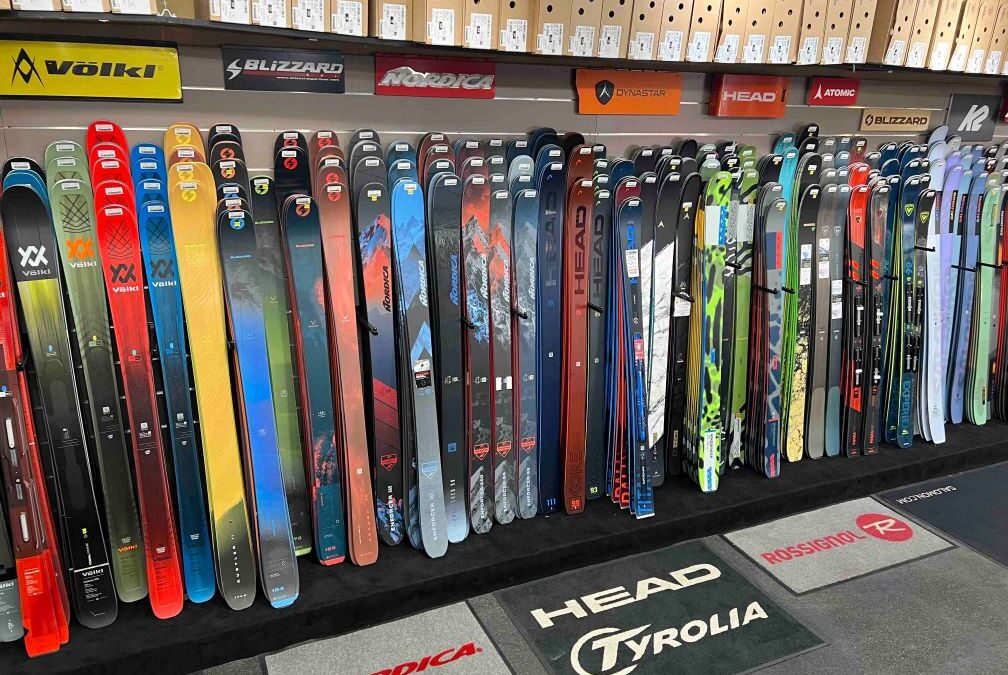
To illustrate my proposition (that skis generally arrive at the same retail price for a given genre), I compiled the public pricing for 15 models in the hotly competitive, image-setting Men’s All-Mountain West category. Eight set the norm at $799, four were slotted at $749, one was $50 on the high side of the mean, and two belonged to outliers Kästle ($1,199) and Stöckli ($1,249), whose luxury price tags presumably add to their cachet. Given that all but two perennial contrarians are within $50 of the de facto norm, price ought not be a significant factor in model selection, with the exception of atypical brands who clearly aren’t attempting to compete for your affections based on price.
To all the commissioners of the FTC who read my weekly Revelations, please don’t get your knickers in a knot over what appears to be industry-wide price collusion. The overall number of major brands that sell through the brick-and-mortar retail channel is small, some 12 to 16 in number, depending on who’s doing the counting, and the number of brand ownership groups is even smaller. Everyone knows how everyone else’s stuff is made, and they all shop for materials in the same marketplace. Given that all suppliers are dealing with what are intrinsically artisanal production methods and a seasonal sales cycle that’s weather-dependent, it shouldn’t be surprising their pricing coalesces around the same levels. (All things considered, it would be far weirder if there were a wide price dispersion for a given end user.)
Whither the deals of yesteryear?
Pricing for new, 2024 models may be at virtual parity, but there’s a parallel world of 2023 models still circulating through the marketplace, and every last one of them is on sale. Once a ski has passed its first birthday, its market value takes an immediate haircut, if not a scalping. Online megastores that fail to move their inventory in-season dump it at fire-sale prices via the ubiquitous top banner of Internet search results, and even some suppliers now sell their forecasting mistakes directly to the public at substantial discounts. The devaluation of the prior year’s products is a particular boon to the budget-conscious skier when there’s minimal model turnover, as was the case this year.
As has been the case since, well, forever, the best place to shop for bargains is the secondary market, particularly at fall ski swaps, ski-team fund raisers and pre-season sales, where the selection of used gear is likely to be the deepest you’ll see all season. I’ll reiterate my evergreen precaution to anyone dragging the bottom of the ski market for bargains: your best protection against committing a buying bummer is to know exactly what you’re looking for.
Benediction
If you do end up acquiring a fresh set-up this season, permit me to be the first to say, “thank you for choosing ownership over rental.” Someone has to keep motivating manufacturers to make better equipment for the rank-and-file skier, or the market will drift to opposite poles: competition skis to promote the brand internationally, and rental skis of one ilk or the other for everyone else. Every ski bought at a specialty ski shop (or its website) this season will help keep skiing alive one more year for real skiers.

Related Articles

Road Tripping
Among the many dissatisfactions of this most unusual season is that travel beyond one’s local environs has been roundly discouraged. Don’t get me wrong: I’m grateful down to my socks that we’re allowed to ski locally, and my version of same is pretty sweet. Pardon the plug, but between Alpine Meadows, Squaw Valley and Mt. Rose I have a smorgasbord of savory choices.
But skiing close to home and skiing on the road are two different beasts. Nothing is the same, really, and therein lies a great deal of the road trip’s charms.
To shed light on my premise, allow me to pull back the veil on my favorite away game, an annual pilgrimage to Little Cottonwood Canyon. By the end of this brief travelogue you will probably hate me, so please fill your vessel of good will to the rim before proceeding.
It’s About Nothing
In the last week of January,2009 I was able to spend a few days skiing in Little Cottonwood Canyon, which is always cathartic for my ravaged soul. The conditions were all over the map, the mountains having experienced a long, hot spell followed by rain, grapple, wet snow and finally dry snow driven by winds that could flense an adult walrus in a few minutes. Couldn’t have been better.
I had been preparing for the trip for weeks, psychologically. Two back surgeries the previous winter had reduced my training regimen from semi-annual to non-existent. Scheduling conflicts such as work kept me from visiting the areas that abound at home near Lake Tahoe, so I had zero ski days on a body with more fat on it than a French duck. I had as much chance of surviving Snowbird and Alta as a rib roast in a piranha tank.
Fortunately, the Lord is merciful, anti-inflammatory drugs are powerful and there are techniques that allow one to block out pain. There are also many wonderful people in this world with which to ski, kind people who stand quietly by, pretending to be in awe of Nature, while my chest heaves so violently in its futile quest for oxygen that tiny lung particles break lose and make for the exits. One such person is Guru Dave Powers, a man whose passion for the sport hasn’t diminished after thousands of days of riding gravity down the infinitely variable slopes and crannies of Snowbird. The Goo knows this hill, and in knowing it well knows so much more.

The Making of a Skier, Chapter XII: Putting Words into the Mouth of God & Other Mid-Life Adventures
When I was cut adrift by Head on June 13, 2001, my once glowing prospects dimmed considerably. The date is etched in memory because I hosted a small soirée that evening in honor of my darling wife’s 50th birthday. One of the attendees was Paul Hochman, who would play several roles in my life as I wandered in the wilderness of unemployment during what were supposed to be my peak earning years.
During the gaping hole in my career that spanned 2001-2011, I would eventually spend every cent of my inheritance, plus most of what I’d saved from earlier bouts with gainful employment, just keeping the household afloat. Despite a river of red ink, my resume would suggest that I was not only commercially active during this epoch, but had my hand in all sorts of ventures.
