

This Revelation should have been titled, “Price Isn’t the Primary Criterion Anymore,” but that’s not as catchy as “Price Is No Object.” Apologies for any attendant confusion.
As consumers, we are trained to shop for the lowest price. The unfettered free-for-all that is e-commerce drives this point home with every search, by helpfully displaying the low-ball leaders prominently on the front page. I realize that despite what I am about to say, skiers will continue to root around the Internet for the lowest price as that’s what the online bazaar does best.
The point of today’s focused pensée is that the top tier of 2024 ski models in any given category will all sell at the same price, give or take $50. I mention the $50 fudge factor, not to identify where you can save fifty bucks, but to underline the insignificance of this amount over the likely ten-year tenure of a new pair of skis.
To put it in slightly different terms: do not let a $50 price difference govern your decision.
Muddying the waters of price comparison shopping is the gradually receding practice of having two published retail prices, one the traditional Manufacturer’s Suggested Retail Price (MSRP), and the other a Minimum Advertised Price (MAP), originally intended to demark a low-water-mark retail for new models but which quickly became the de facto retail price for virtually all major ski brands.
Then along came the pandemic, and with it the need to raise prices to help cover skyrocketing distribution costs. Rather than jack up the fictive MSRP, most suppliers chose to simply euthanize the MAP and anoint the MSRP as the one-and-only public price, thereby raising the price without appearing to raise the price. The few major brands that have continued to suggest an MSRP that is above the market norm all have a MAP that brings the actual cost to the consumer back to parity with the pack.
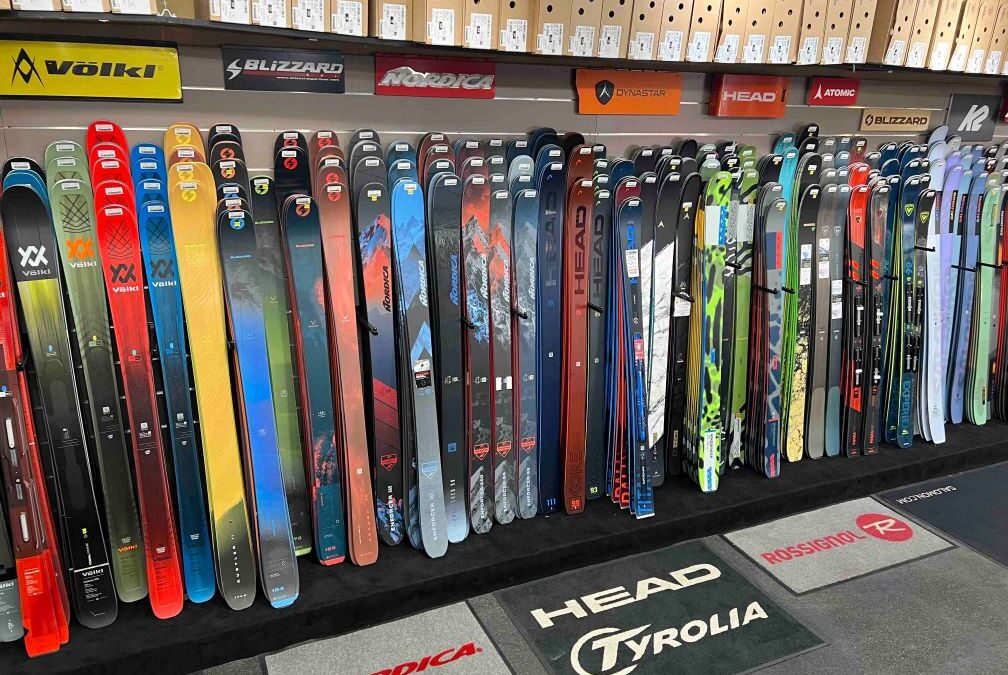
To illustrate my proposition (that skis generally arrive at the same retail price for a given genre), I compiled the public pricing for 15 models in the hotly competitive, image-setting Men’s All-Mountain West category. Eight set the norm at $799, four were slotted at $749, one was $50 on the high side of the mean, and two belonged to outliers Kästle ($1,199) and Stöckli ($1,249), whose luxury price tags presumably add to their cachet. Given that all but two perennial contrarians are within $50 of the de facto norm, price ought not be a significant factor in model selection, with the exception of atypical brands who clearly aren’t attempting to compete for your affections based on price.
To all the commissioners of the FTC who read my weekly Revelations, please don’t get your knickers in a knot over what appears to be industry-wide price collusion. The overall number of major brands that sell through the brick-and-mortar retail channel is small, some 12 to 16 in number, depending on who’s doing the counting, and the number of brand ownership groups is even smaller. Everyone knows how everyone else’s stuff is made, and they all shop for materials in the same marketplace. Given that all suppliers are dealing with what are intrinsically artisanal production methods and a seasonal sales cycle that’s weather-dependent, it shouldn’t be surprising their pricing coalesces around the same levels. (All things considered, it would be far weirder if there were a wide price dispersion for a given end user.)
Whither the deals of yesteryear?
Pricing for new, 2024 models may be at virtual parity, but there’s a parallel world of 2023 models still circulating through the marketplace, and every last one of them is on sale. Once a ski has passed its first birthday, its market value takes an immediate haircut, if not a scalping. Online megastores that fail to move their inventory in-season dump it at fire-sale prices via the ubiquitous top banner of Internet search results, and even some suppliers now sell their forecasting mistakes directly to the public at substantial discounts. The devaluation of the prior year’s products is a particular boon to the budget-conscious skier when there’s minimal model turnover, as was the case this year.
As has been the case since, well, forever, the best place to shop for bargains is the secondary market, particularly at fall ski swaps, ski-team fund raisers and pre-season sales, where the selection of used gear is likely to be the deepest you’ll see all season. I’ll reiterate my evergreen precaution to anyone dragging the bottom of the ski market for bargains: your best protection against committing a buying bummer is to know exactly what you’re looking for.
Benediction
If you do end up acquiring a fresh set-up this season, permit me to be the first to say, “thank you for choosing ownership over rental.” Someone has to keep motivating manufacturers to make better equipment for the rank-and-file skier, or the market will drift to opposite poles: competition skis to promote the brand internationally, and rental skis of one ilk or the other for everyone else. Every ski bought at a specialty ski shop (or its website) this season will help keep skiing alive one more year for real skiers.

Related Articles
Fit the Whole Skier
We bootfitters are naturally obsessed with feet, but the best bootfitters don’t just fit feet; they fit the whole skier. The “whole skier” includes more than just a quick survey of the lower leg and how it’s connected to the foot. It’s even more than all of the skier’s physical attributes, which include not only height and weight, but seated posture, stance, kinesthetic wiring, arch health and stiffness throughout the kinetic chain; the whole skier also includes his or her history with the sport and, most importantly, what sort of skier he or she wants to be.
One of the most obvious traits about almost all boot customers is his or her gender. (Please forgive me if I don’t overcomplicate what should be a simple point about body type.) The first step in a sales process that consists of winnowing all possible boots down to one is picking from the pile of unisex boots or the alternative world of women’s boots.
No-brainer, right? Not so fast. What if a particular woman were tall, with a long tibia and a tapered calf? Let’s add to her profile that she’s a good athlete with a background in dance. Up to now, she’s only been an occasional skier who rented her gear, but a new beau has persuaded her to take a deeper dive. She already has her season pass.

The Things We Do for Love, Part II
Dear Readers who regularly devour my weekly Revelations know that I have already written at length on the subject of Why Skiers Are Better than Everyone Else. Last Friday I was reminded of my timeless prose as I spent 45 minutes traversing a very short stretch of road that connects I-80 to Route 89, my proscribed path to Alpine Meadows. As I voluntarily descended into this automotive miasma, I could make out the dim form of the interstate traffic snaking down from the west, two dense strands of tightly linked vehicles stretching beyond the horizon.

Realskiers.com Trounces Field to Earn Second Stump-Bertoni Prize for Excellence
In a stunning upset that in retrospect appears inevitable, Realskiers.com has been awarded The Stump-Bertoni Prize for Excellence for the second year in a row.
For those cave-dwellers who snoozed through Realskiers.com’s first triumph in this gilded competition, permit me to bring you up to speed. Then as now, the battle for this cherished trophy (metaphorically speaking – the S-BP lacks sufficient funds for a memento commensurate with its prestige) was fierce, extending both of its eponymous founders to previously unknown limits.
The final ballot was determined by leg wrestling over Stump’s furious protest; he cogently argued that this sort of bias against the vertically challenged has no place in a free society. Bertoni imperiously overruled Stump’s evermore strident complaints, citing a lack of legible documentation, tardy submissions and a tendency to perspire copiously when provoked.
This year’s competition was no less fraught.
