

This Revelation should have been titled, “Price Isn’t the Primary Criterion Anymore,” but that’s not as catchy as “Price Is No Object.” Apologies for any attendant confusion.
As consumers, we are trained to shop for the lowest price. The unfettered free-for-all that is e-commerce drives this point home with every search, by helpfully displaying the low-ball leaders prominently on the front page. I realize that despite what I am about to say, skiers will continue to root around the Internet for the lowest price as that’s what the online bazaar does best.
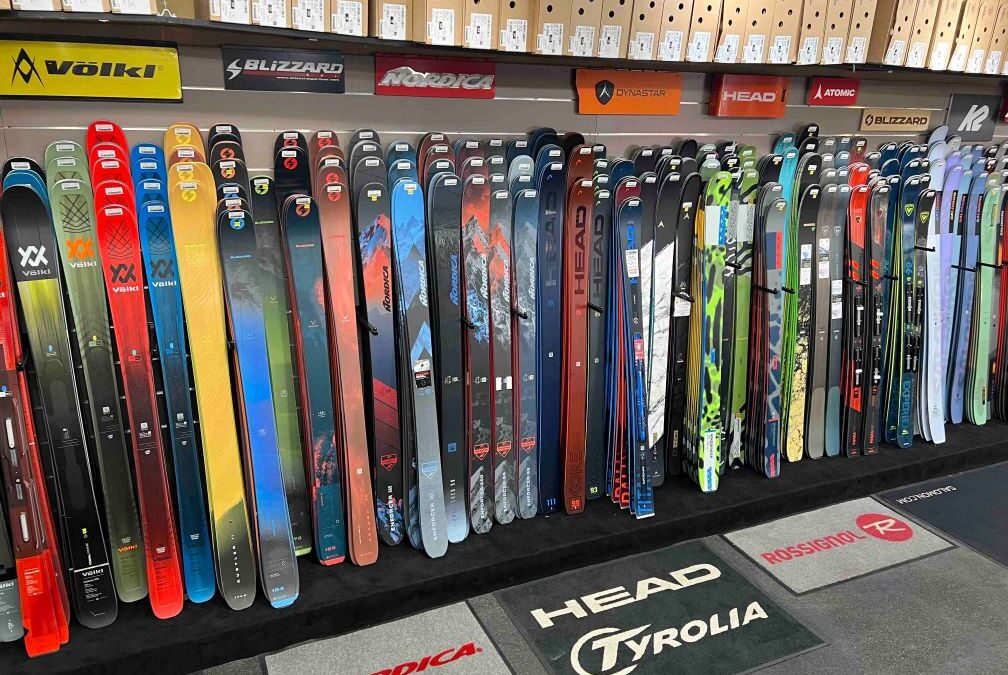
The point of today’s focused pensée is that the top tier of 2024 ski models in any given category will all sell at the same price, give or take $50. I mention the $50 fudge factor, not to identify where you can save fifty bucks, but to underline the insignificance of this amount over the likely ten-year tenure of a new pair of skis.
To put it in slightly different terms: do not let a $50 price difference govern your decision.
Muddying the waters of price comparison shopping is the gradually receding practice of having two published retail prices, one the traditional Manufacturer’s Suggested Retail Price (MSRP), and the other a Minimum Advertised Price (MAP), originally intended to demark a low-water-mark retail for new models but which quickly became the de facto retail price for virtually all major ski brands.
Then along came the pandemic, and with it the need to raise prices to help cover skyrocketing distribution costs. Rather than jack up the fictive MSRP, most suppliers chose to simply euthanize the MAP and anoint the MSRP as the one-and-only public price, thereby raising the price without appearing to raise the price. The few major brands that have continued to suggest an MSRP that is above the market norm all have a MAP that brings the actual cost to the consumer back to parity with the pack.
To illustrate my proposition (that skis generally arrive at the same retail price for a given genre), I compiled the public pricing for 15 models in the hotly competitive, image-setting Men’s All-Mountain West category. Eight set the norm at $799, four were slotted at $749, one was $50 on the high side of the mean, and two belonged to outliers Kästle ($1,199) and Stöckli ($1,249), whose luxury price tags presumably add to their cachet. Given that all but two perennial contrarians are within $50 of the de facto norm, price ought not be a significant factor in model selection, with the exception of atypical brands who clearly aren’t attempting to compete for your affections based on price.
To all the commissioners of the FTC who read my weekly Revelations, please don’t get your knickers in a knot over what appears to be industry-wide price collusion. The overall number of major brands that sell through the brick-and-mortar retail channel is small, some 12 to 16 in number, depending on who’s doing the counting, and the number of brand ownership groups is even smaller. Everyone knows how everyone else’s stuff is made, and they all shop for materials in the same marketplace. Given that all suppliers are dealing with what are intrinsically artisanal production methods and a seasonal sales cycle that’s weather-dependent, it shouldn’t be surprising their pricing coalesces around the same levels. (All things considered, it would be far weirder if there were a wide price dispersion for a given end user.)
Whither the deals of yesteryear?
Pricing for new, 2024 models may be at virtual parity, but there’s a parallel world of 2023 models still circulating through the marketplace, and every last one of them is on sale. Once a ski has passed its first birthday, its market value takes an immediate haircut, if not a scalping. Online megastores that fail to move their inventory in-season dump it at fire-sale prices via the ubiquitous top banner of Internet search results, and even some suppliers now sell their forecasting mistakes directly to the public at substantial discounts. The devaluation of the prior year’s products is a particular boon to the budget-conscious skier when there’s minimal model turnover, as was the case this year.
As has been the case since, well, forever, the best place to shop for bargains is the secondary market, particularly at fall ski swaps, ski-team fund raisers and pre-season sales, where the selection of used gear is likely to be the deepest you’ll see all season. I’ll reiterate my evergreen precaution to anyone dragging the bottom of the ski market for bargains: your best protection against committing a buying bummer is to know exactly what you’re looking for.
Benediction
If you do end up acquiring a fresh set-up this season, permit me to be the first to say, “thank you for choosing ownership over rental.” Someone has to keep motivating manufacturers to make better equipment for the rank-and-file skier, or the market will drift to opposite poles: competition skis to promote the brand internationally, and rental skis of one ilk or the other for everyone else. Every ski bought at a specialty ski shop (or its website) this season will help keep skiing alive one more year for real skiers.

Related Articles
Is 3D Imaging a Fad or the Future?
Any serious attempt at bootfitting begins with an assessment of the customer’s feet and lower legs. This appraisal can be as superficial as measuring each foot for length or as detailed as a complete skier profile accompanied by a few basic biomechanical evaluations.
Better bootfitters gather further information from a litany of details that lie outside the scope of the usual foot-measuring device, such as a Brannock. The veteran bootfitter watches how the customer walks, sits and assumes a skiing position, for starters. The savvy fitter can even spot limb-length differences and redistribute pressure around the foot in places no measuring stick can quantify.
If this sounds like a pretty sophisticated skill set, well, it is. Yet many, if not most, prospective boot buyers approach the bootfitting exercise with the same enthusiasm they usually reserve for a root canal. Suspicions are often confirmed when the first boot proffered seems crazily short. Even the most knowledgeable fitter is obliged to re-establish his/her credibility just to move the bootfit process pass square one.

Of Podcasts, Archives & Revelations
According to my tight-knit circle of advisors, idolaters, sycophants and astrologers, I was made for this medium.
Of course, any garden-variety sycophant will whisper words of inspirational twaddle, but the faint note of sincerity I detect in the smarm-storm of platitudes meant to buck me up has proven sufficient to spur me to action. I quickly acquired a very professional looking microphone and a pop filter to knock down my fierce sibilants. To preserve my objectivity, I opted not to take any lessons, follow any tutorials or otherwise prepare myself for this venture. By the powers vested in me as the Pontiff of Powder, I declare myself to be, now and forever after, a podcaster.
I’ll give you a moment to recover.

The Making of a Skier, Chapter XI: Desperate Measures
When Head humanely, if rather brusquely, terminated my tenure in 2001, the ski business in the U.S. was already facing stiff headwinds, a brewing storm that would turn into a full-on debacle when 9/11 disrupted all commerce. I became unemployed just in time for the job market to implode.
I don’t handle inactivity well. I started writing a very long, very dreadful novel, composed a handful of scripts for Warren Miller – and later, Jeremy Bloom – to recite and scribbled batches of brochure copy and white papers for industries as diverse as accounting software, instrumented football helmets that registered concussions and risk assessment based on location.
The pickings were slim, but they wouldn’t have amounted to anything at all were it not for a little help from my friends. Andy Bigford, who I’d worked with at Snow Country, hired me for the Warren Miller gig. A college chum kindly engaged me to write white papers on accounting fraud. But it was Dave Bertoni, an erstwhile colleague from Salomon days, who joined me in creating Desperate Measures: A Training Method for Selling Technical Products at Retail.
