
What if you had the chance to start over with a clean slate, not with something as monumental as a relationship – normally too complex to even contemplate – but something with more definable behavioral boundaries, like a ski test card, to choose a random example.
As with the stickier wicket of relationships, the hazards of institutional change to a ski test card are subtle but potentially profound. When the Test Guru discards or re-defines a test criterion for whatever reason, it’s a pebble tossed into the pond of continuity. At least one behavior can no longer be directly compared to its predecessor. The re-purposing of a test criterion changes the picture, dulling some edges while sharpening others. For example, if “Off-Piste Performance” is supplanted by “Terrain Versatility,” does this change how a tester rates a 110mm-wide plank that floats like a dream in freshies, but is a menace to humanity in a mogul field? I think it does, or perhaps I should say, it should.
While I’ve begun by sketching the fuzzy outlines of a muddle, not all test criteria are as open to liberal interpretation. A turn still can be trisected into a beginning, middle and end, with the goal still being continuity and connection. The antipode to this behavior is drift, aka “scrub” or the even more judgmental, “skid.” While anathema to the corduroy-carving purist, drift is an essential component in most off-trail turns, and a blessing to any skiers whose technical skills are suspect.
Then there’s the matter of speed management; what happens if you elect not to manage speed but indulge in it? Whether the speed boundary is discovered by design or by accident, a ski either can remain calm as it approaches max velocity or it can’t. It’s good to know if a ski has a high ceiling, even if you couldn’t reach it with a ladder.
Then there’s the other end of the accelerometer, the slower skier who isn’t about to drop the reins and let ‘em run? If the test criteria are to embrace all potential aspects of a skier’s descent, the total has to include the needs of the neediest (for nothing is harder than negotiating a turn at 2 mph). Another virtue we associate with the lower bands of the skills spectrum is ease, aka forgiveness, an attribute that in fact benefits skiers of every stripe. The essential ingredient in forgiveness is allowing for skier foibles in the areas of balance, weight distribution and skills acquisition.
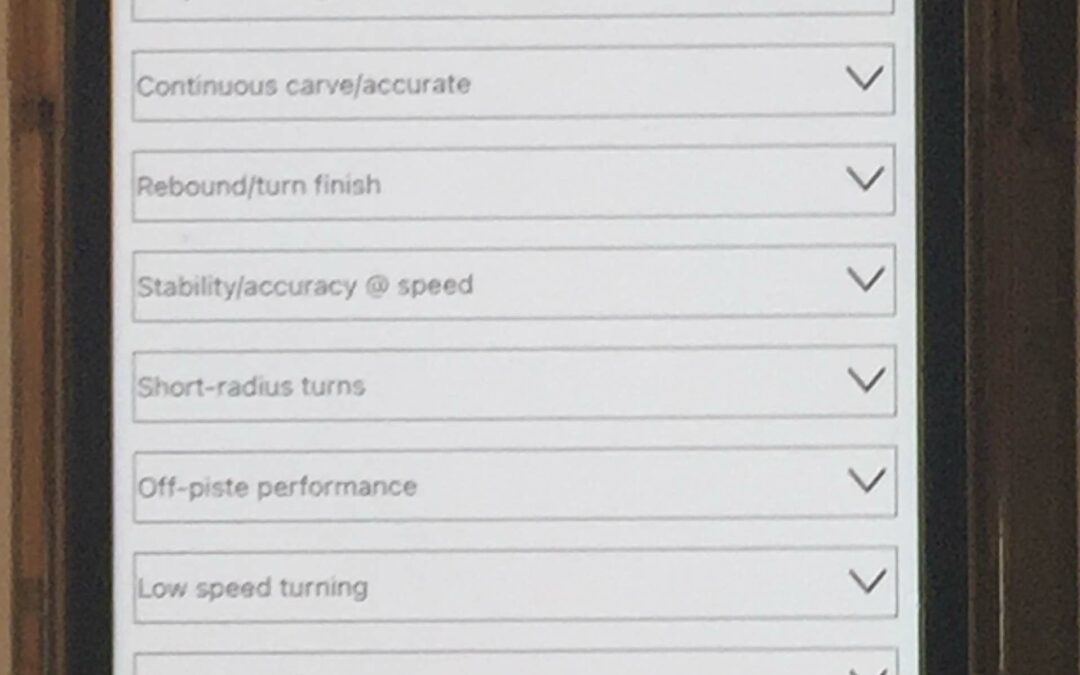
So, what does our clean-slate test card look like? Something like this:
NEW CRITERIA CURRENT REALSKIERS.COM CRITERIA
Turn Initiation RS: Early to Edge
Edge Grip RS: Continuous Carve/Accurate
Turn Finish/Rebound RS: Rebound/Turn Finish
Turn Shape Versatility RS: Short-Radius Turns
Stability @ Speed RS: Stability/Accuracy @ Speed
Low-Speed Turns RS: Low-speed turning
Drift RS: Drift/Scrub
Forgiveness/Ease RS: Forgiveness/Ease
Terrain Versatility RS: Off-Piste Performance
Overall Impression RS: Finesse/Power Balance
If one compares the two columns of test criteria, there aren’t many points of divergence, yet the subtle changes being proposed may result in a wider adoption of something like this new 10-point scale, as well as a weaving stronger thread connecting future Realskiers scores and those forever recorded in our archives.
By now, many of my perspicacious Dear Readers will wonder, “why this elaborate attempt to re-establish the foundational arguments underlying the Realskiers.com ski test criteria?” Because either we expand the field of shops submitting data or we take a different tack, one closer to the ski-maker’s model.
Here’s the backstory.
Once upon a time, more shops sent more of their troops to more ski test venues across this great land of ours. Then some ominous dominos began to fall:
- The pool of potential employees shrank as the costs of resort living skyrocketed.
- Staffing shortfalls meant fewer, if any, employees could be spared for ski testing.
- Under supplier pressure for earlier orders, the sell-in season shrank to a few weeks, with midseason order deadlines squeezing on-snow evaluations off the calendar.
The causes and consequences of change are difficult to untangle, but a concatenation of circumstances has reduced what was once a great confluence of ski shop test cards to a trickle. Part of the problem is that the pace of model turnover has slowed, so the need to vet new product has been diverted upstream. A shop doesn’t need to send five skiers to check out ten skis.
Whatever the sociological roots of declining test-card generation may prove to be, the fact is that fewer total cards means a wildly unequal distribution of test results in any given category. It’s hard to rationalize how a result could be “fair,” when one model records 20 data sets against a field that averages fewer than three new entrants for a comparable model.
Of course, the entire exercise of collecting on-snow impressions is subjective. It’s baked into the pie, as inseparable as wine is from a wine tasting. But experience and – there’s no other way to say it – skill, matter. So, getting a valid result, one that the unaffiliated third-party (that’s you, Dear Readers) can depend on, requires either a phalanx of testers that isn’t likely to materialize any time soon, or a rock-solid, veteran cadre with years of experience.
As I pen this pensée, I’m preparing to take Realskiers.com in either direction. Either we inspire more shop personnel to adopt something like the method I’ve proposed here, or we ditch a by-the-numbers approach in favor of narratives delivered by an all-star panel. We would gather a limited amount of test card data, but we wouldn’t report it as a form of numeric gospel.
It seems intrinsic to human nature to lend more credibility to numbers than words, a prejudice that will only grow more entrenched with the arrival of A.I.-bred reviews. But when it comes to rating a ski’s performance capabilities, we put too much faith in numbers and too little confidence in narratives. The late, great John Fry, who served as editor at SKI and founder/editor of Snow Country Magazine, compared ski testing to wine tasting; it’s not about the numbers, but the nuances of behavior that only language can capture.
One advantage to creating a new test card is it allows us to update the technology behind it, from a finicky app that always seemed to fail on Demo Day Eve, to a Google document that is easily replicated, aggregated and shared. This change alone may bring down the barriers to greater ski shop personnel participation. As soon as we can develop a workable prototype, I will share it with my Dear Readers so any and all who so choose can submit test cards this coming winter.

Related Articles
Is 3D Imaging a Fad or the Future?
Any serious attempt at bootfitting begins with an assessment of the customer’s feet and lower legs. This appraisal can be as superficial as measuring each foot for length or as detailed as a complete skier profile accompanied by a few basic biomechanical evaluations.
Better bootfitters gather further information from a litany of details that lie outside the scope of the usual foot-measuring device, such as a Brannock. The veteran bootfitter watches how the customer walks, sits and assumes a skiing position, for starters. The savvy fitter can even spot limb-length differences and redistribute pressure around the foot in places no measuring stick can quantify.
If this sounds like a pretty sophisticated skill set, well, it is. Yet many, if not most, prospective boot buyers approach the bootfitting exercise with the same enthusiasm they usually reserve for a root canal. Suspicions are often confirmed when the first boot proffered seems crazily short. Even the most knowledgeable fitter is obliged to re-establish his/her credibility just to move the bootfit process pass square one.
Of Podcasts, Archives & Revelations
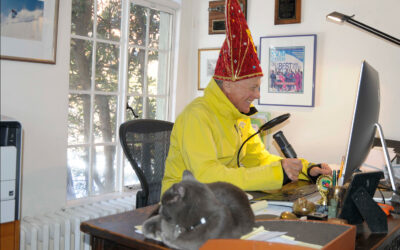
According to my tight-knit circle of advisors, idolaters, sycophants and astrologers, I was made for this medium.
Of course, any garden-variety sycophant will whisper words of inspirational twaddle, but the faint note of sincerity I detect in the smarm-storm of platitudes meant to buck me up has proven sufficient to spur me to action. I quickly acquired a very professional looking microphone and a pop filter to knock down my fierce sibilants. To preserve my objectivity, I opted not to take any lessons, follow any tutorials or otherwise prepare myself for this venture. By the powers vested in me as the Pontiff of Powder, I declare myself to be, now and forever after, a podcaster.
I’ll give you a moment to recover.

The Making of a Skier, Chapter XI: Desperate Measures
When Head humanely, if rather brusquely, terminated my tenure in 2001, the ski business in the U.S. was already facing stiff headwinds, a brewing storm that would turn into a full-on debacle when 9/11 disrupted all commerce. I became unemployed just in time for the job market to implode.
I don’t handle inactivity well. I started writing a very long, very dreadful novel, composed a handful of scripts for Warren Miller – and later, Jeremy Bloom – to recite and scribbled batches of brochure copy and white papers for industries as diverse as accounting software, instrumented football helmets that registered concussions and risk assessment based on location.
The pickings were slim, but they wouldn’t have amounted to anything at all were it not for a little help from my friends. Andy Bigford, who I’d worked with at Snow Country, hired me for the Warren Miller gig. A college chum kindly engaged me to write white papers on accounting fraud. But it was Dave Bertoni, an erstwhile colleague from Salomon days, who joined me in creating Desperate Measures: A Training Method for Selling Technical Products at Retail.
