
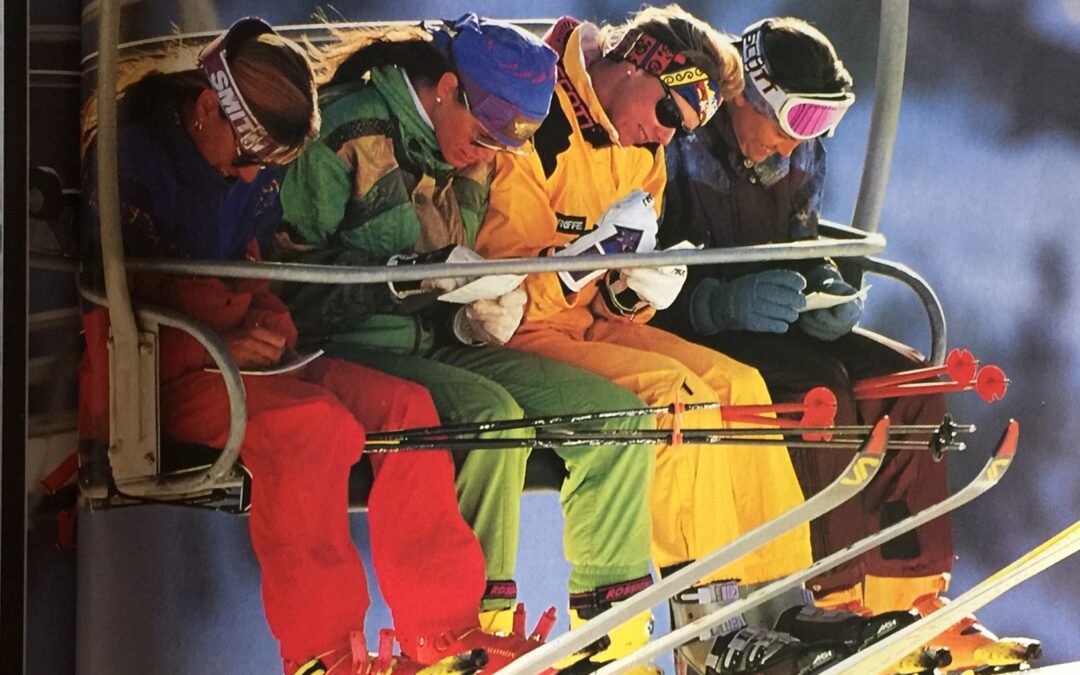

Before delving into the nitty-gritty of today’s Revelation, allow me to apologize for having missed a couple of deadlines, but I have a couple of very good excuses:
- I had to attend the recent reunion of what remains of our national ski show in order to maintain contact with the ski suppliers whose products I review, and
- I had to spend some quality time on snow, to be sure I was physically, emotionally and mentally prepared to properly evaluate a season’s worth of new skis.
To this end, I just spent three days at Snowbird, going up on the 7:45 tram and pounding down the miles until the distress signals emanating from every muscle in my body pierced the fog of euphoria I experience whenever I’m lucky enough to go and up and down this magnificent mountain. I know that if I can manage my business in its rushing gravity stream, I’m ready for the rigors ski testing.
My preparations were completed just in time, as next week the Mammoth Trade Fair convenes, an annual rite that blends commerce and camaraderie in equal measures. Its immanent appearance on the calendar has inspired me to share with my Dear Readers all the thoughts competing for my mind’s attention in the prelude to the most important event on Realskiers’ calendar.
My top-of-mind concern is one that would never have occurred to me when I began conducting ski tests in 1987, part of an overall strategy of laying the groundwork for Salomon’s first ski, launched just two years later. The looming fear that now forces its way into consciousness takes the form of prayer: Please God, bless the Realskiers Test Card App, that it not fail for any number of mysterious reasons that I neither understand nor know how to fix.
You see, since I abandoned paper test cards – that were immune to technological failure – for a digital format that could go kaput at any time, my greatest fear has been that the app would go sideways just when I most needed it to work. Which, of course, is exactly what it has done on more than one occasion. If I am trepidatious, it’s because I have every reason to be.
Bugs in the technological ointment aren’t the only macro-level threat to capturing ski test data. There’s always the weather, which at Mammoth (as well as Snowbird) has produced a record snowfall. While Mammoth is only a three-hour drive from Reno (where I reside), if a ground blizzard kicks up, it can be many more hours of something closely resembling sheer terror. It was only a few years ago we encountered winds well in excess of 100mph that shut down the whole area, with snowbanks so high there was literally no more space anywhere in town to stash the next snowfall.
Point being, it’s entirely possible we won’t be able to get there, or won’t be able to park anywhere should we get there, or perhaps we won’t be able to leave. All such logistical delights have occurred in recent memory.
But enough of such dreary conjectures: what if the weather breaks in our favor? Suppose we end up with two days of unrelenting powder?
I think you know the answer: we ski the bejesus out of it on every fat ski we can find. Last year produced a bonanza of new Big Mountain models, but hardly a trace of new snow in which to fairly evaluate them. If memory serves, it’s been four years since the Mammoth Trade Fair dates and powder-producing weather were on the same schedule. All we would need is one such day to shore up last year’s results and polish off the entire 2023/24 Powder category (waist widths over 113mm).
It’s a beautiful dream I will cherish until it’s dashed. Should it fail to materialize, I will find solace in testing the Frontside genre, home to the majority of new models for the 23/24 season. If hardpack prevails, I’d also revisit the Technical genre, what remains of the once dominant Carving category.
A Dim View of the Immediate Future
There are two twists to the market the 23/24 models will be entering next fall, factors which have the potential to affect the U.S. ski equipment business. For the first time in memory, the Mammoth Trade Fair will be held after retailers have had to submit their orders for the following fall. This would seem to undermine what had been the foundational idea for an on-snow trade show, to serve as an arena to test new products before committing to buy them.
Probably the largest single factor limiting shop employee attendance at the trade fair isn’t its diminished influence on the buying decision, but the chronic shortage of employees needed to cover the store in a period plagued by understaffing. It’s my hope that shops will nonetheless find a way to send a small delegation, for nothing fuels understanding of how to communicate a ski’s benefits better than actually skiing it.
The other major issue that will hang over all trade fair activities doesn’t involve product testing, but a seismic shift in the market to direct-to-consumer sales. Every major ski maker sells its wares directly to the public, bypassing a dealer network that helped establish the brand’s value over decades of representation. If a shop were to boycott every brand that sold direct, it wouldn’t have any vendors. Dealer/supplier relationships are further strained by early order deadlines coupled with suppliers’ online liquidation of carryover inventory at fire sales prices.
Let me pause here to remind one and all that specialty shops are where you find real bootfitters, without whom skiing with comfort and confidence is well neigh impossible. If you’re looking for the best bootfitters near where you live or ski, please check out Jackson’s List on Realskiers.com. While the primary business of Realskiers.com is helping skiers to find their perfect match in a ski, all efforts at finding a great ski are worthless unless the skier is also well and properly shod.
Trade fairs are the living embodiment of the symbiotic relationship between reps and the ski shops they serve. In a world in which more and more ski sales are siphoned away from the retail channel and sold directly from supplier to consumer, the livelihood of both reps and shops are as endangered as the snowy owl. Currently, the bond between ski shop and ski rep is one of the strongest threads holding the ski industry in the U.S. together.
Whilst noodling for several weeks on where we stand today and where we’ll be tomorrow, I conjured the image of skiing in the rain, one’s goggles overwhelmed by a miasma of fog and smeared raindrops, obscuring anything like a path forward. We’re suffering from a case of commercial vertigo, unsure of our collective bearings. It’s my fervent hope for us all that the fog lifts soon.

Related Articles
The Making of a Skier, Part X: The Mechanics & Managers Workshop Tour
When I left Salomon in the spring of 1987, my motivations could be distilled into three principal components:
• The parent company declared it was moving its Reno-based North American HQ back from whence it came. Neither I nor my family had the slightest desire to return to New England.
• I felt I was spending more energy battling factions within my own company than I was out-flanking our competition. I’d worked more or less without a break since June of 1978. My thin veneer of patience cracked.
• I wanted to write screenplays. Not that I had demonstrated any talent for creative writing or had any training in the field. I’d written reams of technical swill, brochure copy, training manuals and memos which created the illusion that I could at least write something, so why not screenplays?
Note that none of these factors involves finding a new job. At the time, I didn’t want to resume wearing the shackles of employment as they would interfere with my ludicrous screenwriting ambitions. Then the stock market went into a tailspin in October, crippling what little equity I’d managed to accrue on my minimalist salary. Oops.
The Five Stages of Ski Finish Awareness
Don’t let the title fool you. Although it sounds like it, this Revelation isn’t about the degree to which skiing is top of mind among Helsinki society. The purpose of this exposé is to shine a light on a subject about which almost all skiers are woefully uninformed, namely the condition of their skis’ bases and edges.
Just in case you don’t imagine this subject worthy of your attention, I hasten to point out that how well your skis are tuned and maintained isn’t just a factor, it is the factor that determines how well your skis perform. A properly tuned ski, regardless of brand or type, is a delight for skiers of any and all abilities while an untuned ski is such a detriment that even supreme skill cannot overcome its liabilities.
