
One of the foundational elements of many misunderstandings is cemented in place when one side of a relationship presumes the other is operating at a level of knowledge, vocabulary and general awareness that they do not, in fact, possess. No one likes to be taken advantage of, a concern that compels some consumers (most often male) to disguise their vulnerability by embellishing their resumes, beginning with the self-assessment of their skiing skills.
One of the problems with this sort of seemingly harmless puffery is that, if the salesperson takes this optimistic testimony at face value, he or she will automatically import a large bundle of presuppositions to the party. When a prospective ski buyer alleges advanced ability, salespeople are naturally going to presume there’s little need to revisit fundamentals. The rift between knowledge presumed and knowledge possessed has already begun to form, and only a return to basic training can heal it.
So, what sort of stuff do we, the ski salesmen and bootfitters who toil in America’s specialty ski shops, presume you know? Or looked at from a slightly different angle, what do we find ourselves explaining over and over to skiers who have been skiing for years, even decades, blissfully unaware of fundamentals so basic, no one has ever explained them?
In a properly sized shell, forefoot buckles can be finger-tight. Your forefoot does not respond well to being crushed. To help avoid over-tightening the second buckle on the lower shell, don’t over-tighten the first. I’m not advocating looseness; quite the opposite, I’m interested in the precision that comes from being close to the shell without resorting to excessive pressure.
If you struggle to get your boots on, heat them first. There’s more than one way to skin this cat, but a heated boot bag heats the liner and the shell, which is money.
Your toes will feel the end of a properly sized boot before you buckle it up. In fact, your toes touching the end of an unbuckled boot is one way to know it’s the right length shell.
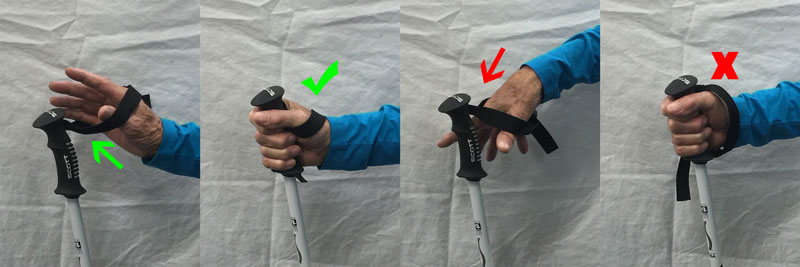
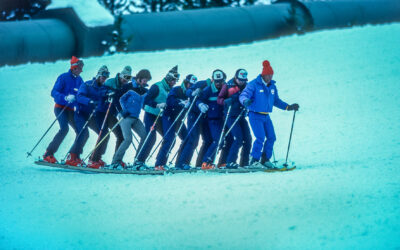
There is a correct way to hold a ski pole. Look around you in any chairlift line. A hefty percentage didn’t get the memo. Please see attendant illustration for do’s and don’ts.
Wear a thin sock made for skiing. You might think every skier must know this, but remember what we said in the opening sentence about presumptions. Thicker socks are more hindrance than help, and wearing two pairs (or more) is an affront to all that is holy.
An insole that matches your arch doesn’t just feel better, it connects the proprioceptors in your arch with the rest of your balance system, unconsciously making you a better skier. The surreal beauty of this connectivity is that it operates independently of conscious interference.
Store your boots buckled. It’s not about buckling them tightly, merely under enough tension to keep their shape. Make it a habit and you will have fewer fights with your footwear.
While we’re on the subject of common misconceptions, you were not going 70mph, I don’t care what your watch or phone or goggles say. It’s flat-out impossible.
For a quick refresher in basics subjects like those I’ve breezed over here, I refer you, your friends and your skiing neighbors to The Returning Skier’s Handbook. You can find it under the Gear Guide on the home page of Realskiers.com.
And for a master class in miscommunication, I refer you to this immortal Monty Python sketch about a rogue Hungarian phrase book: https://youtu.be/C1Sw0PDgHU4. Even f you don’t find it particularly relevant to the discussion at hand, it’s well worth the 4:20 it requires to view it.
Before I close the book on this week’s Revelation, I want to apologize to my sound engineer, Oscar Wilde, who happens to be a Russian Blue feline, about the “skin the cat” reference. Sorry, Oscar, I said it in a moment of weakness.

Related Articles
The Making of a Skier, Chapter XI: Desperate Measures
When Head humanely, if rather brusquely, terminated my tenure in 2001, the ski business in the U.S. was already facing stiff headwinds, a brewing storm that would turn into a full-on debacle when 9/11 disrupted all commerce. I became unemployed just in time for the job market to implode.
I don’t handle inactivity well. I started writing a very long, very dreadful novel, composed a handful of scripts for Warren Miller – and later, Jeremy Bloom – to recite and scribbled batches of brochure copy and white papers for industries as diverse as accounting software, instrumented football helmets that registered concussions and risk assessment based on location.
The pickings were slim, but they wouldn’t have amounted to anything at all were it not for a little help from my friends. Andy Bigford, who I’d worked with at Snow Country, hired me for the Warren Miller gig. A college chum kindly engaged me to write white papers on accounting fraud. But it was Dave Bertoni, an erstwhile colleague from Salomon days, who joined me in creating Desperate Measures: A Training Method for Selling Technical Products at Retail.
Reader Comments on Why Ski Sales Have Shrunk
In this week’s Revelation, I posted my top ten (twelve, actually) reasons why skis sales have shrunk, along with the musings of two Dear Readers on the subject. Note that the topic’s focus was ski sales at retail, not skier or skier/rider participation rates, subjects that are certainly related but just as certainly not the same.
Below are verbatim reader responses culled in the last 48 hours. I’ve corrected the odd typo, but otherwise left these contributions intact.
My thanks to all who took the time to tell their tales. – J
Top Reasons U.S. Ski Sales Have Shrunk
[As I wrapped up an earlier Revelation, I proposed to my beloved readership that they share their list of the top ten reasons U.S. ski sales have shrunk. I elicited only two written responses, so I’ll reproduce both here in their entirety, along with my musings on the subject. Consider these submissions tinder to light a fire under you, Dear Reader, to submit a list of your own.]
From Rick Pasturczak
1. Snowboarding-
I’ve noticed most snowboarders are 12 to 20 years old and once they become an adult, almost all stop. While I noticed most skiers continue on.
2. High school and college sports-
Schools now require practicing sports during Christmas and spring breaks taking away opportunities to hit the slopes and family vacations to the mountains. I’ve been told by many parents the coaches forbid them to ski.
3. Travel costs-
Lodging, airfare, ground transportation, and lift tickets.
4. Video games
5. Cost of lessons make it expensive to improve.
6. Confusing selection of equipment
7. Magazines and movies showing extreme skiing
8. Cruising. We need some resorts to be all inclusive.
9. Baggy pants. Bring back stretch pants and sex appeal.
10. Last, we need mother nature to be more consistent with snow.
