
One of the foundational elements of many misunderstandings is cemented in place when one side of a relationship presumes the other is operating at a level of knowledge, vocabulary and general awareness that they do not, in fact, possess. No one likes to be taken advantage of, a concern that compels some consumers (most often male) to disguise their vulnerability by embellishing their resumes, beginning with the self-assessment of their skiing skills.
One of the problems with this sort of seemingly harmless puffery is that, if the salesperson takes this optimistic testimony at face value, he or she will automatically import a large bundle of presuppositions to the party. When a prospective ski buyer alleges advanced ability, salespeople are naturally going to presume there’s little need to revisit fundamentals. The rift between knowledge presumed and knowledge possessed has already begun to form, and only a return to basic training can heal it.
So, what sort of stuff do we, the ski salesmen and bootfitters who toil in America’s specialty ski shops, presume you know? Or looked at from a slightly different angle, what do we find ourselves explaining over and over to skiers who have been skiing for years, even decades, blissfully unaware of fundamentals so basic, no one has ever explained them?
In a properly sized shell, forefoot buckles can be finger-tight. Your forefoot does not respond well to being crushed. To help avoid over-tightening the second buckle on the lower shell, don’t over-tighten the first. I’m not advocating looseness; quite the opposite, I’m interested in the precision that comes from being close to the shell without resorting to excessive pressure.
If you struggle to get your boots on, heat them first. There’s more than one way to skin this cat, but a heated boot bag heats the liner and the shell, which is money.
Your toes will feel the end of a properly sized boot before you buckle it up. In fact, your toes touching the end of an unbuckled boot is one way to know it’s the right length shell.
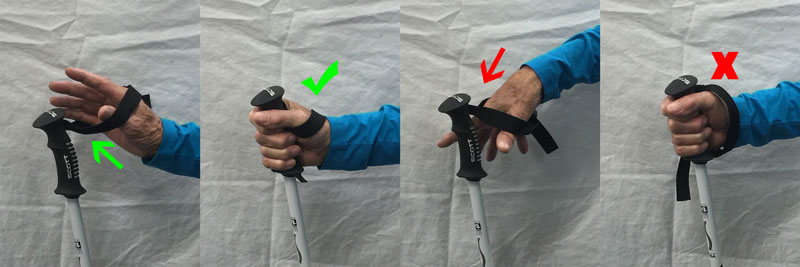
There is a correct way to hold a ski pole. Look around you in any chairlift line. A hefty percentage didn’t get the memo. Please see attendant illustration for do’s and don’ts.
Wear a thin sock made for skiing. You might think every skier must know this, but remember what we said in the opening sentence about presumptions. Thicker socks are more hindrance than help, and wearing two pairs (or more) is an affront to all that is holy.
An insole that matches your arch doesn’t just feel better, it connects the proprioceptors in your arch with the rest of your balance system, unconsciously making you a better skier. The surreal beauty of this connectivity is that it operates independently of conscious interference.
Store your boots buckled. It’s not about buckling them tightly, merely under enough tension to keep their shape. Make it a habit and you will have fewer fights with your footwear.
While we’re on the subject of common misconceptions, you were not going 70mph, I don’t care what your watch or phone or goggles say. It’s flat-out impossible.
For a quick refresher in basics subjects like those I’ve breezed over here, I refer you, your friends and your skiing neighbors to The Returning Skier’s Handbook. You can find it under the Gear Guide on the home page of Realskiers.com.
And for a master class in miscommunication, I refer you to this immortal Monty Python sketch about a rogue Hungarian phrase book: https://youtu.be/C1Sw0PDgHU4. Even f you don’t find it particularly relevant to the discussion at hand, it’s well worth the 4:20 it requires to view it.
Before I close the book on this week’s Revelation, I want to apologize to my sound engineer, Oscar Wilde, who happens to be a Russian Blue feline, about the “skin the cat” reference. Sorry, Oscar, I said it in a moment of weakness.

Related Articles

The Making of a Skier, Part IX: The ASTM, Carl Ettlinger and I
One of the many hats I wore as North American binding product manager for Salomon in the early 1980’s was that of delegate to the American Society for Testing and Materials (ASTM). I believe the first meeting of F8.14 – the sub-committee on ski safety – that I attended was in Pennsylvania. I was flying under the wings of Salomon’s seer of all standards and patents, Gilbert Delouche, and the binding product manager for the North American zone at that time (and my mentor), Joe Campisi.
I was a babe in the woods, but I soon caught on to the game under Delouche’s patience guidance. I recall a debate on the binding specification then being batted around in the technical committee chaired by Carl Ettlinger. Ettlinger wanted language that would require any release/retention setting of 10 or above to be “visually distinctive” from the rest of the scale.
In Memorium, Carl Ettlinger
Carl was a giant of a man whose outsized voice roiled every conversation like a burst dam and whose expansive vision reached across the mixed milieus of research, journalism, risk management and education. I knew him when he was at the peak of his powers, as he explained to me when I interviewed him for a “where are they now?” profile in Skiing History. He was able to conduct long-term research on injury patterns as well as analyze the particulars of the current binding market, turn around and package this knowledge into articles for Skiing and Skiing Trade News, followed up by a workshop tour that would bring enlightenment to the grassroots level. No one but Carl could have pulled this off, and Lord knows no one has had the requisite talent, energy and will power since.
But time and tide wait for no man, and Carl’s finely spun web of influence was eventually plucked apart. The loss of his pivotal positions in the press allowed him to slip from public view before we, the skiers of the world, realized we hadn’t taken the time to thank him.
We have the time to thank him now.
So thanks, Carl, for being first and foremost a teacher, for teaching is at the heart of the evangel’s mission.
Thanks for being so damn stubborn. Your insistence on improving skier safety wore through a wall of resistance as tough as Vermont marble.
Thanks for having a heart as big as that melon-sized head of yours. The fuel to your tireless mind was a caring heart that tried to embrace the world.
Thanks for all the stories once the Mount Gay flowed. Who knew we would have won the Vietnam War if only his superiors had listened? I can’t remember exactly how – he wasn’t the only one drinking Mount Gay – but I recall the light in his eyes as he relayed his twisted tales, taking us down successive rabbit-holes of digression that I lost track of at the seventh level.
That’s what I remember most vividly about my many interactions with Carl: his brain so teemed with thoughts he rushed to get them out in a verbal jailbreak that would travel around the cosmos until returning, many lost minutes later, to the subject that had inspired them. That was Carl: too many words for one sentence, too many tasks to tend to and all of it, every erg of his endless energy, devoted to a cause he never ceased to serve.
Fare thee well, Carl Ettlinger. The world misses you already for it will never see another quite like you, whose every moment seemed larger than life itself.
I raise my glass to you, old friend. Mount Gay, of course.
Jackson Hogen
June 23, 2020
Why This Buyer’s Guide?
Don’t read the 2021 Masterfit Buyer’s Guide in Partnership with Realskiers.com for its 62 ski reviews. I should know. I wrote or edited all of them.
Not that the ski reviews aren’t worth the read. But ski reviews on the web are as common as rice, while the Buyer’s Guide contains something no other publication, whether in digital, print or video format, can claim: the most respected, thorough and dependable boot reviews in the world.
This isn’t mere puffery. The Masterfit Boot Test is so well regarded by the supplier community that nearly every brand not only sends its following year’s line-up in four men’s sizes plus three for women, it also dispatches its top designers and/or product managers to a distant North American site for most of the test’s five-day duration.
