
One of the foundational elements of many misunderstandings is cemented in place when one side of a relationship presumes the other is operating at a level of knowledge, vocabulary and general awareness that they do not, in fact, possess. No one likes to be taken advantage of, a concern that compels some consumers (most often male) to disguise their vulnerability by embellishing their resumes, beginning with the self-assessment of their skiing skills.
One of the problems with this sort of seemingly harmless puffery is that, if the salesperson takes this optimistic testimony at face value, he or she will automatically import a large bundle of presuppositions to the party. When a prospective ski buyer alleges advanced ability, salespeople are naturally going to presume there’s little need to revisit fundamentals. The rift between knowledge presumed and knowledge possessed has already begun to form, and only a return to basic training can heal it.
So, what sort of stuff do we, the ski salesmen and bootfitters who toil in America’s specialty ski shops, presume you know? Or looked at from a slightly different angle, what do we find ourselves explaining over and over to skiers who have been skiing for years, even decades, blissfully unaware of fundamentals so basic, no one has ever explained them?
In a properly sized shell, forefoot buckles can be finger-tight. Your forefoot does not respond well to being crushed. To help avoid over-tightening the second buckle on the lower shell, don’t over-tighten the first. I’m not advocating looseness; quite the opposite, I’m interested in the precision that comes from being close to the shell without resorting to excessive pressure.
If you struggle to get your boots on, heat them first. There’s more than one way to skin this cat, but a heated boot bag heats the liner and the shell, which is money.
Your toes will feel the end of a properly sized boot before you buckle it up. In fact, your toes touching the end of an unbuckled boot is one way to know it’s the right length shell.
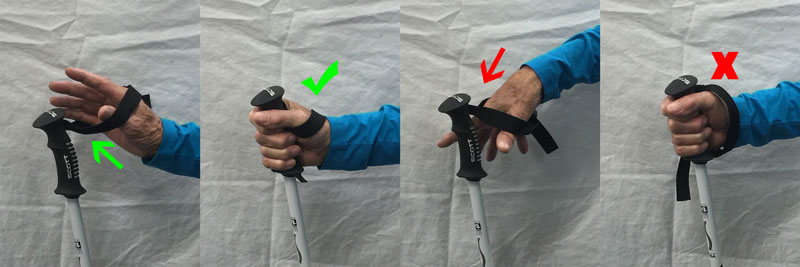
There is a correct way to hold a ski pole. Look around you in any chairlift line. A hefty percentage didn’t get the memo. Please see attendant illustration for do’s and don’ts.
Wear a thin sock made for skiing. You might think every skier must know this, but remember what we said in the opening sentence about presumptions. Thicker socks are more hindrance than help, and wearing two pairs (or more) is an affront to all that is holy.
An insole that matches your arch doesn’t just feel better, it connects the proprioceptors in your arch with the rest of your balance system, unconsciously making you a better skier. The surreal beauty of this connectivity is that it operates independently of conscious interference.
Store your boots buckled. It’s not about buckling them tightly, merely under enough tension to keep their shape. Make it a habit and you will have fewer fights with your footwear.
While we’re on the subject of common misconceptions, you were not going 70mph, I don’t care what your watch or phone or goggles say. It’s flat-out impossible.
For a quick refresher in basics subjects like those I’ve breezed over here, I refer you, your friends and your skiing neighbors to The Returning Skier’s Handbook. You can find it under the Gear Guide on the home page of Realskiers.com.
And for a master class in miscommunication, I refer you to this immortal Monty Python sketch about a rogue Hungarian phrase book: https://youtu.be/C1Sw0PDgHU4. Even f you don’t find it particularly relevant to the discussion at hand, it’s well worth the 4:20 it requires to view it.
Before I close the book on this week’s Revelation, I want to apologize to my sound engineer, Oscar Wilde, who happens to be a Russian Blue feline, about the “skin the cat” reference. Sorry, Oscar, I said it in a moment of weakness.
Related Articles

The Ripple Effect
As I’ve observed in this space before, product managers spend most of their time in the future; the present for them is two years away for the rest of us. So when the coronavirus shut down the 19/20 ski season, it triggered an automatic response in the R&D lobes lodged deep in my noggin: what impact will this have two years down the road?
If I knew the answer to this question with any certainty, I should be running a hedge fund, not scribbling about skiing. But after checking with several of the bellwether players in U.S. market, I have some idea of what’s in store.
Realskiers 2021 Women’s Ski Test: A Series of Linked Recoveries
If you ever saw footage of early-1970’s mogul contests, you understand the expression, “linked recoveries.” This turn of phrase sums up my repeated attempts to capture coverage of the primary players in the 2021 women’s Alpine ski market.
Before we learned coronavirus wasn’t street jargon for overindulging in imported beer, I had a plan in place. I’d paid handsomely to have my test card app refreshed just in time for the major western trade fairs at Mammoth Mountain, CA and Snow Basin, UT, which convened on overlapping dates.
2021 Frontside
The frontside of the mountain may not be the most topographically diverse part of the hill, but the skiers who populate it are the most polyglot we’ve got. Timid intermediates, cruising seniors, the...
