
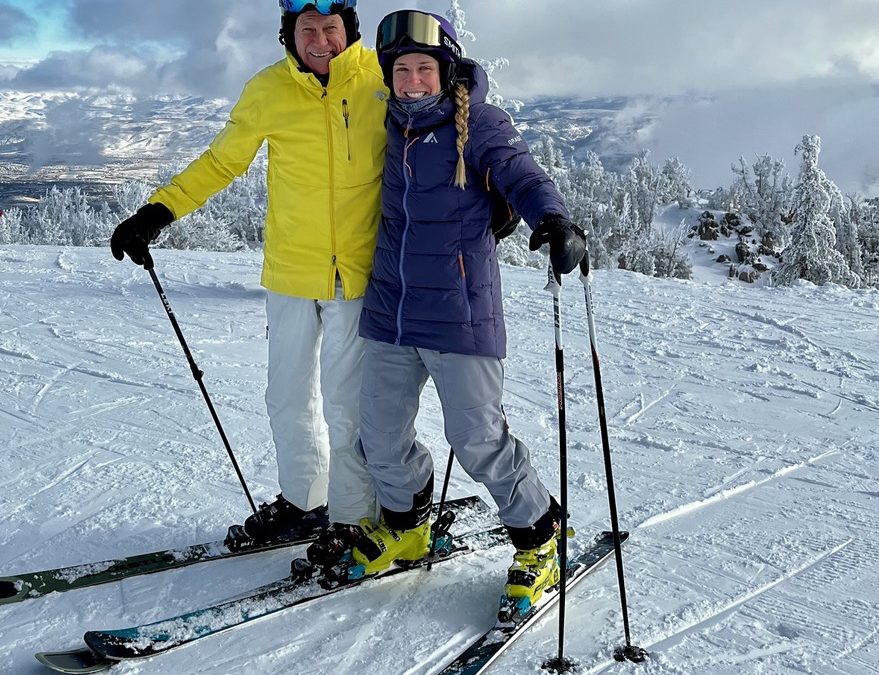
Last Thursday, I skied for the first time since recovering from lumbar fusion surgery. I use the term “recovering,” as that’s the blanket term for whatever time it takes to restore the functionality that the surgery was meant to ameliorate. It’s been 14 months since surgeons reassembled my lower back from whatever bits were still serviceable. I’m still recovering from my recovery.
The whole process got off to a rocky start when a pre-op EGK revealed an abnormality in my heartbeat, requiring a cardiologist to clear me for surgery. Eventually I was okayed to filet, but not before other members of the medical community caught wind of the immense billing opportunity my frailties were engendering. So, we took a bone marrow extraction using a method perfected by the Chilean secret police, the results of which were inconclusive, so a hematologist was added to the team. I wore a heartbeat monitor for a week here and there that had to be glued on and was best removed by a sharp machete. After examining all the evidence, the ultra-expert at the end of the advisory chain declared that my blood was fine, everybody can relax.
Testing begets more testing, and soon we’re doing a CT scan of my beleaguered brain. At my next appointment with my primary care physician, she cautiously inquired if I knew what the word, “atrophy” meant. When I told her I was familiar with the term, she cleared her throat and said that I had global brain atrophy and was losing brain mass at a precipitous rate.
Which is how I ended up in the care of a neurologist who examined every slide in my brain scan before announcing there wasn’t the slightest evidence of atrophy on any of them. Case dismissed.
The only symptom that remained was some variant of vertigo, with its attendant balance issues, along with intermittent bouts of tinnitus. The neurologist administered a standard test for cognition/memory which the PA informed me I aced. In any case, the neurologist said I no longer needed his services and that was that.
Except that the vertigo persists and I can’t get an appointment with an ENT until later this week. So, when I ventured out to ski last Thursday, it was with the expectation that the skies would be blue and the snow would be groomed. Neither forecast proved accurate, but at least there was snow and I could see where I was aiming, kinda. In my exuberance/stupidity, I had grabbed a fair-weather goggle lens, dark as coal, so my balance sensors weren’t picking up many clues. My back tightened up in anticipation of immanent disaster.
The next two hours were not pretty, but at least my skills partially returned. With the patient oversight of my dear friends Nick Allen and his daughter Lara, I ultimately fashioned a few respectable runs. But all the key elements that go into high-performance, all-terrain skiing – strength, quickness, endurance, anticipation, multi-axis manipulation of the ski – were in short supply. I had to remind myself that in January of 2025 I would spontaneously generate full-body spasms with enough electricity to run a blender. All things considered, I’m winning.
What did I learn from this odd gift of a first day back on skis?
- Pay attention to the details. Going out with a dark lens on an overcast day was dumb. I forgot my Leki glove bra wasn’t on the pair of gloves I carelessly grabbed. I wasn’t gliding on the new snow because I didn’t wax properly. Details matter.
- Vertigo really sucks. Skiing is a sport of balance, so when your balance system is on the fritz, you never really feel inside your own skin. Brain fog and real fog are a deadly mix.
- Aging erodes elasticity. You don’t bounce back from serious injury, you crawl back. But no matter the injury or its consequences, skiers will do all that they can to remain skiers.
The first time on skis in over a year made two things abundantly clear: I’m going to complete the long, multi-stage arc of recovery and ski deeper into my dotage. But I can’t resuscitate the market conditions that made realskiers.com possible.
What Happens Next?
Seemingly, nothing. At some point, I’ll shut off the auto-renew function, but the members’ site and its lode of archived content will remain up until we can no longer afford to operate. If you’ve recently re-subscribed and would like a refund, just let me know and I’ll reverse the charge.
Regardless of the status of the site and its contents, if you’ve ever had any correspondence with me you perforce have my email, which I don’t intend to change. I’ll still respond to member queries through the end of this season.
Once Realskiers goes dark, where will you be able to get reliable information on gear selection? Instead of rummaging around on the Internet – a fertile breeding ground for misinformation – find the best brick-and-mortar specialty ski shop near where you live or ski. (If you don’t already have a favorite shop, I suggest you find your new retail ally on Jackson’s List).
As I have been advising my Dear Readers and Dear Listeners for years, the most important piece of equipment you will ever buy are your boots, and boot buying entails bootfitting. If you think you can successfully shop for boots online, you’re skating on thin ice. Compounding the problems of long-distance fitting, BOA’s successful infiltration of the boot market takes the focus away from fitting close to the shell, imparting a sensation of all-around comfort that can mask the absence of proper underfoot support, among other potential pitfalls. To be clear, I’m not saying don’t buy a boot equipped with BOA; I’m saying don’t buy any boot, BOA or not, without a veteran bootfitter’s guidance.
Even if ski boots were as easy to fit as slippers, you would still need the other services that only a specialty shop can perform, headlined by ski base and edge prep. A well-equipped shop can substantially modify a ski’s on-snow characteristics by playing with base grinds and edge angles. For example, I can take my Volkl M7 Mantra (in a 178cm), which is essentially a Power ski, and use a modified thumbprint pattern and careful edge beveling to help it slip and slide laterally through tight troughs and trees, essentially turning a powerhouse into a pussycat. I realize that specialty grinds like a thumbprint cost more than a standard ski tune – okay, quite a bit more – but they should. The right tune on the right ski is a game changer.
Once you’re in the care of a specialty shop, you’ll discover other ability amplifiers such ZipFit inner boots (nod to the late, great Sven Coomer for the enduring value of his liners) and Booster power straps. Among the several ski accessories that have become essential equipment for me is the heated boot bag (another Coomer creation), without which I doubt I could even get my boots on.
A Peek Over the Horizon
As I reported earlier this season, ski prices remained remarkably stable for over a decade, but the epoch of price stability appears to be over. Next season’s price bumps are actually pretty modest, mostly up only $50 or $75, and many returning models are holding price. While adding $50 to what it costs to ski in toto is effectively trivial, if you’re looking to save a few shekels, all indications are you’d be better off buying this season than next.
Knowing my propensity to pontificate, I doubt these words will be the last to find publication in these hallowed pages. But the end is nigh, and I already feel the pangs of missing you all.

Related Articles

My IT Angel has Ascended
A chasm has opened inside me, of the sort that can never be re-filled. Brian Frias passed away last Friday, February 20, doing what he loved, skiing with the daughter he cherished. He was taken...
Odds and Ends
Last Thursday, I skied for the first time since recovering from lumbar fusion surgery. I use the term “recovering,” as that’s the blanket term for whatever time it takes to restore the functionality...
Larry Prosor belongs in the U.S. Ski & Snowboard Hall of Fame
Larry Prosor didn’t just document the birth of extreme skiing in America, he ignited it. The spark was lit by a nine-page barrage of eye-popping images lovingly displayed in the pages of Powder...
