
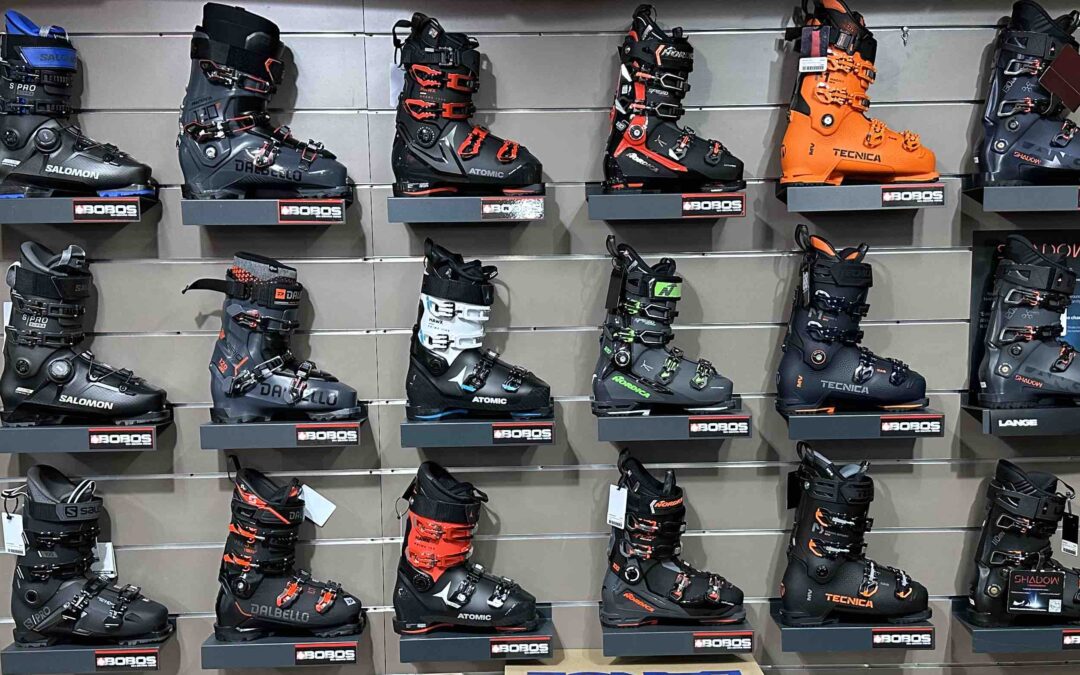

At the risk of reiterating an axiom with which all skiers should be familiar, your choice of boots is infinitely more important than your choice of skis. Yet most skiers have only the foggiest notion of how to select their ideal boot from the myriad choices available. Even if someone liked their old boots and just wanted a new pair of the same, the “same” most likely was dropped from the product line years ago.
A recent tour of some of the Internet’s most absurd ski-vending sites revealed that the latest crop of new and returning skiers is as lost in the weeds as ever. (I base this conclusion on consumers’ stated level of ecstasy with set-ups purchased online, when a more objective appraisal would suggest that they would have done at least as well choosing a new boot at random.) While most of the advice I’m about to impart fails to qualify as new, there are nonetheless thousands of skiers who would benefit from re-visiting these basic rules of engagement.
As I’ve been informing my Dear Readers for over a decade, there are two numbers on every boot model that help guide the decision-making process. One is a flex-index number that has a direct correlation to price, and the other is the width of the forefoot in millimeters, which has a direct correlation to fit (but doesn’t influence the price).
While these two numbers are important – because they’re all you have to go on – they can’t help but be misleading as both are make-believe. The flex index number is not governed by any standard, so boot makers are free to decide just how stiff, say, a “130” feels; the only certainty is that a boot with a higher flex number should be stiffer in forward flex resistance than the same model in a lower flex. There is no guarantee of any kind that Brand A’s boot of a given flex index will feel the same as another brand’s boot marked with the same flex index.
So how stiff a boot should one get? Generally, more skilled skiers are steered into stiffer boots and the less proficient are proffered something softer, but even this vague bit of advice won’t adequately inform the buying decision. The rule of thumb ought to be, buy the stiffest boot you can comfortably deflect from its static position. If you can’t budge the cuff at room temperature, the boot is too stiff, and if the cuff all but collapses under normal pressure, it’s too soft.
Before moving on to the forefoot-width size, there’s another factor to flex selection that isn’t revealed in any number: stiffer – ergo, more expensive – boots are better made. Small details in the liner, buckles and strap are common as one moves up the price/flex ladder, and even the materials from which the shell and cuff are made can be compromised at lower price points. The cost of added stiffness and overall quality is most commonly pegged at $100 for every 10-point jump in flex index, so a 130-flex model will carry a price tag $100 above a 120-flex model in the same product family.
While finding the right flex is important, most skiers are rightly more concerned with fit than flex, mostly because an ill-fitting boot is a daily drag that can be as insistent as a toothache. The number that indicates a boot’s fit properties is keyed off the widest point in the forefoot, but it’s really an indicator of the global volume inside the boot. The narrowest boots made for the non-racing community usually measure 98mm at the widest point in the forefoot; medium-lasted boots use 100mm as a reference point; and wide boots come in at 102mm or 104mm.
Like the flex index number, the forefoot figure is misleading in that it applies only to one size, usually a 26.5. A 27.5 in the same boot will be proportionately bigger in every dimension, including the reference width. Mercifully, last volume isn’t tethered to price, so high-volume (HV) boots don’t cost a penny more than medium- or low-volume versions of the same model.
One problem with the current way of classifying ski boots by forefoot width is that it suggests that this dimension is the most important determinant of a proper fit, when it is the most easily fudged by the bootfitter. Having a relaxed and comfortable forefoot is, of course, vital to a skier’s happiness, but securing the rear-foot, home of the ankle and heel, is far more important. From the perspective of the bootfitter, the boot’s basic structure in the rear-foot is relatively hard to modify, while changing the forefoot dimensions is a piece of cake. (The new BOA system found on a sampling of four brands somewhat complicates making adjustments to the forefoot area, but hopefully the BOA system has enough range to make this objection moot.)
Point being, if you are narrow in the heel but medium to wide in the forefoot, you need to get a narrow shell that holds your heel down, then modify the forefoot shape to match the foot. Do not let a little pinch on the forefoot drive you to a wider boot that sacrifices heel hold, particularly since creating volume in this area is easy, while narrowing the heel and instep area can be a laborious task with limited chance of success.
Should you follow my counsel and procure a narrow-lasted shell for your medium-volume forefoot, before you go whacking away at the shell or inner boot in this area, put a proper insole under you. A proper insole is more than just a fit aid; it connects the balance receptors in your arches with the vestibular system in your inner ear so it’s easier to stay upright. For this connection to work optimally, an arch support has to be added to your boots in the guise of a custom or off-the-rack insole.
“What about the insoles that come with my boots?” I hear you cry. Even in the best of boots, the stock insoles that come with them are mere placeholders and next to worthless for an arch begging for contact with something more substantial. Lest you think I overstate my case, allow me to share a bootfitting adventure from last year.
I was contacted by a woman concerned that her husband was losing his sense of equilibrium. He was a very good skier, yet he found himself occasionally losing his balance. Medical experts speculated that it could be nerve damage due to exposure to Agent Orange during the Vietnam War. I reminded the good wife that I was unlikely to undo neurological damage, but I promised her to give it my best shot.
The subject – let’s call him Jay – came into Bobo’s with his Alpine boots, a pair of Tecnica Mach1, 130-flex boots. They included off-the-rack insoles that didn’t have a prayer of contacting his high arches, so I built him a new pair, taking care to ensure contact between skier and device all along the length of his arch. As soon as Jay stood up, he could instantly feel his balance had returned. Hugs and tears all around, and Jay is back skiing again like he used to.
Obviously, if Jay had any neurological damage, the insoles I built didn’t cure it, but they did allow his innate balance system to function more or less as designed. Point being, Dear Readers, an insole that connects with the arch isn’t a frill or indulgence, but a necessity.
The alert Dear Reader will note that what I haven’t advised you to do is search for a particular brand or model. While self-guided research may lead you to a short list of possible candidates, you shouldn’t complete your search alone. While boot reviews at credible sites like America’s Best Bootfitters will help narrow the field, the final model and size selection should be made in collaboration with an experienced bootfitter. As I’ve advised my Realskiers.com clients over the years, you’re not looking for a boot, you’re looking for a bootfitter, and together you will find your bliss.

Related Articles

The Making of a Skier, Part IX: The ASTM, Carl Ettlinger and I
One of the many hats I wore as North American binding product manager for Salomon in the early 1980’s was that of delegate to the American Society for Testing and Materials (ASTM). I believe the first meeting of F8.14 – the sub-committee on ski safety – that I attended was in Pennsylvania. I was flying under the wings of Salomon’s seer of all standards and patents, Gilbert Delouche, and the binding product manager for the North American zone at that time (and my mentor), Joe Campisi.
I was a babe in the woods, but I soon caught on to the game under Delouche’s patience guidance. I recall a debate on the binding specification then being batted around in the technical committee chaired by Carl Ettlinger. Ettlinger wanted language that would require any release/retention setting of 10 or above to be “visually distinctive” from the rest of the scale.
Why This Buyer’s Guide?
Don’t read the 2021 Masterfit Buyer’s Guide in Partnership with Realskiers.com for its 62 ski reviews. I should know. I wrote or edited all of them.
Not that the ski reviews aren’t worth the read. But ski reviews on the web are as common as rice, while the Buyer’s Guide contains something no other publication, whether in digital, print or video format, can claim: the most respected, thorough and dependable boot reviews in the world.
This isn’t mere puffery. The Masterfit Boot Test is so well regarded by the supplier community that nearly every brand not only sends its following year’s line-up in four men’s sizes plus three for women, it also dispatches its top designers and/or product managers to a distant North American site for most of the test’s five-day duration.

The Ripple Effect
As I’ve observed in this space before, product managers spend most of their time in the future; the present for them is two years away for the rest of us. So when the coronavirus shut down the 19/20 ski season, it triggered an automatic response in the R&D lobes lodged deep in my noggin: what impact will this have two years down the road?
If I knew the answer to this question with any certainty, I should be running a hedge fund, not scribbling about skiing. But after checking with several of the bellwether players in U.S. market, I have some idea of what’s in store.
