
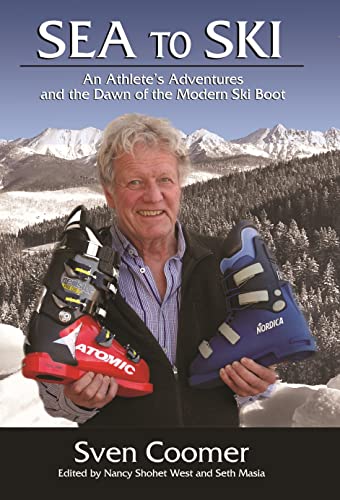

If you own a pair of Alpine ski boots, you are skiing in a product whose origins can be traced directly back to one man, Sven Coomer. There are two dominant strains in Alpine boot DNA, the three-piece, open-throat design, and the two-piece shells that populate most of the market. Coomer invented the progenitors of both while he was working at Nordica during the transition from leather to plastic boots.
If that was Coomer’s only contribution to today’s ski boot market, he would already stand head and shoulders above the other pioneers in plastic boot design, including Bob Lange, whose first efforts in this arena elevated boot performance at the cost of even a modicum of comfort. After leaving Nordica once he realized the brand was moving away from elite performance in order to create more aesthetically appealing designs, Coomer’s creative juices continued to flow. He was the first to use silicone to make inner boots more form-fitting. He invented custom insoles that could be molded in the ski shop, creating an entire category that is currently considered essential to high-performance skiing. To do this job right, he opened a ski shop at Mammoth Mountain called Footloose, so he could work closely with professional skiers to optimize his design. Footloose continues to be a benchmark specialty shop in part because its training in bootfitting has been passed on from Coomer to subsequent generations.
While consulting at Atomic, he conceived a way to create a flexible shell around the forefoot, allowing energy from the skier to flow more directly to the ball of the foot. This was anything but a self-evident solution, as every other boot on the market operated on the assumption that only a stiff shell could transmit skier movement to the ski. The Atomic Hawx series in which his ideas were incorporated provided the platform Atomic needed to climb from the back of the market pack into a successful series that continues to provide the bulk of Atomic’s boot sales.
While working at the Brixia factory in Asolo, Italy that made San Marco and Munari boots, Coomer created the only boot model that incorporated an internal fit system in a classic, two-piece, four-buckle shell. Munari lacked the marketing muscle to make much of this invention, so Coomer’s design never found the market acceptance it deserved.
But another Coomer invention that he is rarely credited for creating has become practically de rigueur for anyone who hopes to put on a 130-flex boot, the heated boot bag. Coomer conceived of the heated bag when he was working with the race community – where a 130-flex boot is considered soft – to which he retained close ties since training with the French, Italian, Austrian and German ski teams in his youth. Race-caliber boots, then as now, are very difficult to squirm into when at room temperature, much less cold. After heating in Coomer’s bag, they slide on like slippers.
One Coomer design that’s still in production is the Zipfit inner boot, that uses a cork and vegetable oil composite that flows around the foot in less than 10 seconds, creating an anatomically accurate fit that doesn’t distort the shell or crush the foot as conventional foam-injection can. Coomer retained control of the Zipfit project, allowing him to bequeath it intact to family members who will carry on the tradition of optimizing ski boot function and fit.
I would be remiss if I didn’t reference Coomer’s contribution to my own preoccupation, ski testing. First at Mammoth, then Mt. Rose, he and Doug Pfeiffer conducted the first formal ski tests, the results of which appeared in the pages of Skiing Magazine.
One has to be a keen observer of the boot development scene to recognize where Coomer left his mark, as more than one of his collaborators would take all the credit after successfully commercializing his foundational concepts. Had he been more self-aggrandizing, his name would be branded on almost every part of the modern ski boot.
Coomer has recently published his autobiography, Sea to Ski, a slender tome that belies the impact of the life it traces. Coomer concentrates on his remarkable youth – he was on the Australian Olympic modern pentathlon team at the tender age of 16 – leaving only a few pages to outline the highlights of his career in ski boot design. Given the number of times his inventions have been attributed to others, one might expect Coomer to set the record straight and settle a few scores, but you won’t catch a whiff of recrimination here.
What you will find is the story of an extraordinary athlete who exceled at every sport he touched, who also happened to possess an exceptional talent for product development. Coomer left his mark wherever he went in his prolific, peripatetic career, impressions that are still with us to this day. In recognition of a lifetime of unparalleled accomplishments, Sven Coomer will be formally inducted into the U.S. Ski & Snowboard Hall of Fame this spring, an honor that is long overdue.
The next time you bend over to buckle your boots, remember the man who, more than any other, contributed to its design. God bless you, Sven Coomer; we’ll never see another like you.

Related Articles

Road Tripping
Among the many dissatisfactions of this most unusual season is that travel beyond one’s local environs has been roundly discouraged. Don’t get me wrong: I’m grateful down to my socks that we’re allowed to ski locally, and my version of same is pretty sweet. Pardon the plug, but between Alpine Meadows, Squaw Valley and Mt. Rose I have a smorgasbord of savory choices.
But skiing close to home and skiing on the road are two different beasts. Nothing is the same, really, and therein lies a great deal of the road trip’s charms.
To shed light on my premise, allow me to pull back the veil on my favorite away game, an annual pilgrimage to Little Cottonwood Canyon. By the end of this brief travelogue you will probably hate me, so please fill your vessel of good will to the rim before proceeding.
It’s About Nothing
In the last week of January,2009 I was able to spend a few days skiing in Little Cottonwood Canyon, which is always cathartic for my ravaged soul. The conditions were all over the map, the mountains having experienced a long, hot spell followed by rain, grapple, wet snow and finally dry snow driven by winds that could flense an adult walrus in a few minutes. Couldn’t have been better.
I had been preparing for the trip for weeks, psychologically. Two back surgeries the previous winter had reduced my training regimen from semi-annual to non-existent. Scheduling conflicts such as work kept me from visiting the areas that abound at home near Lake Tahoe, so I had zero ski days on a body with more fat on it than a French duck. I had as much chance of surviving Snowbird and Alta as a rib roast in a piranha tank.
Fortunately, the Lord is merciful, anti-inflammatory drugs are powerful and there are techniques that allow one to block out pain. There are also many wonderful people in this world with which to ski, kind people who stand quietly by, pretending to be in awe of Nature, while my chest heaves so violently in its futile quest for oxygen that tiny lung particles break lose and make for the exits. One such person is Guru Dave Powers, a man whose passion for the sport hasn’t diminished after thousands of days of riding gravity down the infinitely variable slopes and crannies of Snowbird. The Goo knows this hill, and in knowing it well knows so much more.

The Making of a Skier, Chapter XII: Putting Words into the Mouth of God & Other Mid-Life Adventures
When I was cut adrift by Head on June 13, 2001, my once glowing prospects dimmed considerably. The date is etched in memory because I hosted a small soirée that evening in honor of my darling wife’s 50th birthday. One of the attendees was Paul Hochman, who would play several roles in my life as I wandered in the wilderness of unemployment during what were supposed to be my peak earning years.
During the gaping hole in my career that spanned 2001-2011, I would eventually spend every cent of my inheritance, plus most of what I’d saved from earlier bouts with gainful employment, just keeping the household afloat. Despite a river of red ink, my resume would suggest that I was not only commercially active during this epoch, but had my hand in all sorts of ventures.
