
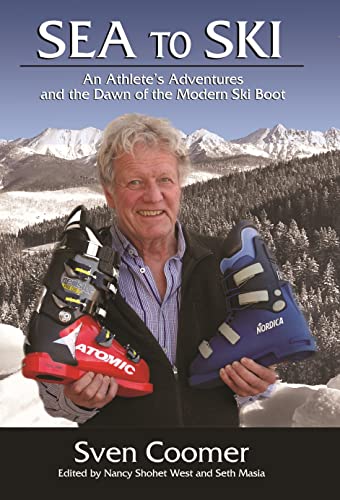

If you own a pair of Alpine ski boots, you are skiing in a product whose origins can be traced directly back to one man, Sven Coomer. There are two dominant strains in Alpine boot DNA, the three-piece, open-throat design, and the two-piece shells that populate most of the market. Coomer invented the progenitors of both while he was working at Nordica during the transition from leather to plastic boots.
If that was Coomer’s only contribution to today’s ski boot market, he would already stand head and shoulders above the other pioneers in plastic boot design, including Bob Lange, whose first efforts in this arena elevated boot performance at the cost of even a modicum of comfort. After leaving Nordica once he realized the brand was moving away from elite performance in order to create more aesthetically appealing designs, Coomer’s creative juices continued to flow. He was the first to use silicone to make inner boots more form-fitting. He invented custom insoles that could be molded in the ski shop, creating an entire category that is currently considered essential to high-performance skiing. To do this job right, he opened a ski shop at Mammoth Mountain called Footloose, so he could work closely with professional skiers to optimize his design. Footloose continues to be a benchmark specialty shop in part because its training in bootfitting has been passed on from Coomer to subsequent generations.
While consulting at Atomic, he conceived a way to create a flexible shell around the forefoot, allowing energy from the skier to flow more directly to the ball of the foot. This was anything but a self-evident solution, as every other boot on the market operated on the assumption that only a stiff shell could transmit skier movement to the ski. The Atomic Hawx series in which his ideas were incorporated provided the platform Atomic needed to climb from the back of the market pack into a successful series that continues to provide the bulk of Atomic’s boot sales.
While working at the Brixia factory in Asolo, Italy that made San Marco and Munari boots, Coomer created the only boot model that incorporated an internal fit system in a classic, two-piece, four-buckle shell. Munari lacked the marketing muscle to make much of this invention, so Coomer’s design never found the market acceptance it deserved.
But another Coomer invention that he is rarely credited for creating has become practically de rigueur for anyone who hopes to put on a 130-flex boot, the heated boot bag. Coomer conceived of the heated bag when he was working with the race community – where a 130-flex boot is considered soft – to which he retained close ties since training with the French, Italian, Austrian and German ski teams in his youth. Race-caliber boots, then as now, are very difficult to squirm into when at room temperature, much less cold. After heating in Coomer’s bag, they slide on like slippers.
One Coomer design that’s still in production is the Zipfit inner boot, that uses a cork and vegetable oil composite that flows around the foot in less than 10 seconds, creating an anatomically accurate fit that doesn’t distort the shell or crush the foot as conventional foam-injection can. Coomer retained control of the Zipfit project, allowing him to bequeath it intact to family members who will carry on the tradition of optimizing ski boot function and fit.
I would be remiss if I didn’t reference Coomer’s contribution to my own preoccupation, ski testing. First at Mammoth, then Mt. Rose, he and Doug Pfeiffer conducted the first formal ski tests, the results of which appeared in the pages of Skiing Magazine.
One has to be a keen observer of the boot development scene to recognize where Coomer left his mark, as more than one of his collaborators would take all the credit after successfully commercializing his foundational concepts. Had he been more self-aggrandizing, his name would be branded on almost every part of the modern ski boot.
Coomer has recently published his autobiography, Sea to Ski, a slender tome that belies the impact of the life it traces. Coomer concentrates on his remarkable youth – he was on the Australian Olympic modern pentathlon team at the tender age of 16 – leaving only a few pages to outline the highlights of his career in ski boot design. Given the number of times his inventions have been attributed to others, one might expect Coomer to set the record straight and settle a few scores, but you won’t catch a whiff of recrimination here.
What you will find is the story of an extraordinary athlete who exceled at every sport he touched, who also happened to possess an exceptional talent for product development. Coomer left his mark wherever he went in his prolific, peripatetic career, impressions that are still with us to this day. In recognition of a lifetime of unparalleled accomplishments, Sven Coomer will be formally inducted into the U.S. Ski & Snowboard Hall of Fame this spring, an honor that is long overdue.
The next time you bend over to buckle your boots, remember the man who, more than any other, contributed to its design. God bless you, Sven Coomer; we’ll never see another like you.

Related Articles
Fit the Whole Skier
We bootfitters are naturally obsessed with feet, but the best bootfitters don’t just fit feet; they fit the whole skier. The “whole skier” includes more than just a quick survey of the lower leg and how it’s connected to the foot. It’s even more than all of the skier’s physical attributes, which include not only height and weight, but seated posture, stance, kinesthetic wiring, arch health and stiffness throughout the kinetic chain; the whole skier also includes his or her history with the sport and, most importantly, what sort of skier he or she wants to be.
One of the most obvious traits about almost all boot customers is his or her gender. (Please forgive me if I don’t overcomplicate what should be a simple point about body type.) The first step in a sales process that consists of winnowing all possible boots down to one is picking from the pile of unisex boots or the alternative world of women’s boots.
No-brainer, right? Not so fast. What if a particular woman were tall, with a long tibia and a tapered calf? Let’s add to her profile that she’s a good athlete with a background in dance. Up to now, she’s only been an occasional skier who rented her gear, but a new beau has persuaded her to take a deeper dive. She already has her season pass.

The Things We Do for Love, Part II
Dear Readers who regularly devour my weekly Revelations know that I have already written at length on the subject of Why Skiers Are Better than Everyone Else. Last Friday I was reminded of my timeless prose as I spent 45 minutes traversing a very short stretch of road that connects I-80 to Route 89, my proscribed path to Alpine Meadows. As I voluntarily descended into this automotive miasma, I could make out the dim form of the interstate traffic snaking down from the west, two dense strands of tightly linked vehicles stretching beyond the horizon.

Realskiers.com Trounces Field to Earn Second Stump-Bertoni Prize for Excellence
In a stunning upset that in retrospect appears inevitable, Realskiers.com has been awarded The Stump-Bertoni Prize for Excellence for the second year in a row.
For those cave-dwellers who snoozed through Realskiers.com’s first triumph in this gilded competition, permit me to bring you up to speed. Then as now, the battle for this cherished trophy (metaphorically speaking – the S-BP lacks sufficient funds for a memento commensurate with its prestige) was fierce, extending both of its eponymous founders to previously unknown limits.
The final ballot was determined by leg wrestling over Stump’s furious protest; he cogently argued that this sort of bias against the vertically challenged has no place in a free society. Bertoni imperiously overruled Stump’s evermore strident complaints, citing a lack of legible documentation, tardy submissions and a tendency to perspire copiously when provoked.
This year’s competition was no less fraught.
