
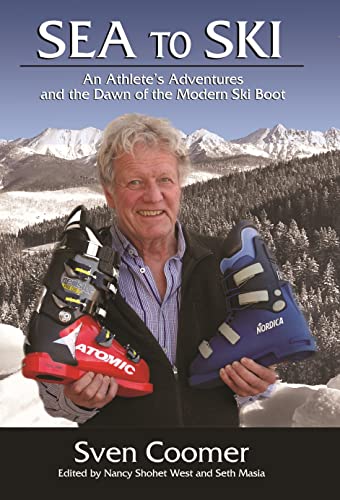

If you own a pair of Alpine ski boots, you are skiing in a product whose origins can be traced directly back to one man, Sven Coomer. There are two dominant strains in Alpine boot DNA, the three-piece, open-throat design, and the two-piece shells that populate most of the market. Coomer invented the progenitors of both while he was working at Nordica during the transition from leather to plastic boots.
If that was Coomer’s only contribution to today’s ski boot market, he would already stand head and shoulders above the other pioneers in plastic boot design, including Bob Lange, whose first efforts in this arena elevated boot performance at the cost of even a modicum of comfort. After leaving Nordica once he realized the brand was moving away from elite performance in order to create more aesthetically appealing designs, Coomer’s creative juices continued to flow. He was the first to use silicone to make inner boots more form-fitting. He invented custom insoles that could be molded in the ski shop, creating an entire category that is currently considered essential to high-performance skiing. To do this job right, he opened a ski shop at Mammoth Mountain called Footloose, so he could work closely with professional skiers to optimize his design. Footloose continues to be a benchmark specialty shop in part because its training in bootfitting has been passed on from Coomer to subsequent generations.
While consulting at Atomic, he conceived a way to create a flexible shell around the forefoot, allowing energy from the skier to flow more directly to the ball of the foot. This was anything but a self-evident solution, as every other boot on the market operated on the assumption that only a stiff shell could transmit skier movement to the ski. The Atomic Hawx series in which his ideas were incorporated provided the platform Atomic needed to climb from the back of the market pack into a successful series that continues to provide the bulk of Atomic’s boot sales.
While working at the Brixia factory in Asolo, Italy that made San Marco and Munari boots, Coomer created the only boot model that incorporated an internal fit system in a classic, two-piece, four-buckle shell. Munari lacked the marketing muscle to make much of this invention, so Coomer’s design never found the market acceptance it deserved.
But another Coomer invention that he is rarely credited for creating has become practically de rigueur for anyone who hopes to put on a 130-flex boot, the heated boot bag. Coomer conceived of the heated bag when he was working with the race community – where a 130-flex boot is considered soft – to which he retained close ties since training with the French, Italian, Austrian and German ski teams in his youth. Race-caliber boots, then as now, are very difficult to squirm into when at room temperature, much less cold. After heating in Coomer’s bag, they slide on like slippers.
One Coomer design that’s still in production is the Zipfit inner boot, that uses a cork and vegetable oil composite that flows around the foot in less than 10 seconds, creating an anatomically accurate fit that doesn’t distort the shell or crush the foot as conventional foam-injection can. Coomer retained control of the Zipfit project, allowing him to bequeath it intact to family members who will carry on the tradition of optimizing ski boot function and fit.
I would be remiss if I didn’t reference Coomer’s contribution to my own preoccupation, ski testing. First at Mammoth, then Mt. Rose, he and Doug Pfeiffer conducted the first formal ski tests, the results of which appeared in the pages of Skiing Magazine.
One has to be a keen observer of the boot development scene to recognize where Coomer left his mark, as more than one of his collaborators would take all the credit after successfully commercializing his foundational concepts. Had he been more self-aggrandizing, his name would be branded on almost every part of the modern ski boot.
Coomer has recently published his autobiography, Sea to Ski, a slender tome that belies the impact of the life it traces. Coomer concentrates on his remarkable youth – he was on the Australian Olympic modern pentathlon team at the tender age of 16 – leaving only a few pages to outline the highlights of his career in ski boot design. Given the number of times his inventions have been attributed to others, one might expect Coomer to set the record straight and settle a few scores, but you won’t catch a whiff of recrimination here.
What you will find is the story of an extraordinary athlete who exceled at every sport he touched, who also happened to possess an exceptional talent for product development. Coomer left his mark wherever he went in his prolific, peripatetic career, impressions that are still with us to this day. In recognition of a lifetime of unparalleled accomplishments, Sven Coomer will be formally inducted into the U.S. Ski & Snowboard Hall of Fame this spring, an honor that is long overdue.
The next time you bend over to buckle your boots, remember the man who, more than any other, contributed to its design. God bless you, Sven Coomer; we’ll never see another like you.

Related Articles

The Best Women’s Skis of 2020
Before getting down to the business of picking favorites, let’s re-examine the fundamental question, what makes a ski a women’s ski?
Not to be flippant, but any ski its maker markets as a women’s model qualifies in that it will come in shorter lengths, which are scaled to match smaller people, a considerable percentage of which are women. To drive this point home, the women’s models will also be decorated in themes deemed – however correctly – to be more appealing to women.

The Best Skis of 2020
I’m of two minds when it comes to the “best of” business. I realize that many consumers appreciate this shortcut to any further research, take the gold medal as Gospel and act on it. From the designer’s perspective, even though I might make dozens of prototypes, I would still only manufacture one model. From where the ski review purveyor sits, for any given set of criteria, it stands to reason that the ski with highest aggregate score would be the best.
The other side of the coin is that there is no best ski, nor can there be. Within the key All-Mountain categories where most consumers correctly shop, the diversity of on-snow behaviors is astounding. It’s impossible for all these skis to register identically with all the skier types who might consider them. Since there is no one definition of “best,” it’s not possible to identify a single “best” ski for all skiers.

Resurrecting Realskiers Resources: The Revival of Ancient Review Archives & The Restoration of the Test Card App
One of the most popular features on Realskiers.com’s member site is our Ski Review Archive, where Recommended ski reviews dating back to 2015 can be easily exhumed and examined. Longtime site subscribers know that this is only a partial collection, that in fact our review archive reaches back to the turn of the millennium.
We’ve been keeping these well-aged scrolls under wraps in part because, like actual ancient documents, the software they were written on (so to speak) has grown old and rickety. There are some serious downsides to continuing to operate obsolete platforms, but to a certain cadre of our readers their contents are as precious as holy relics.
