
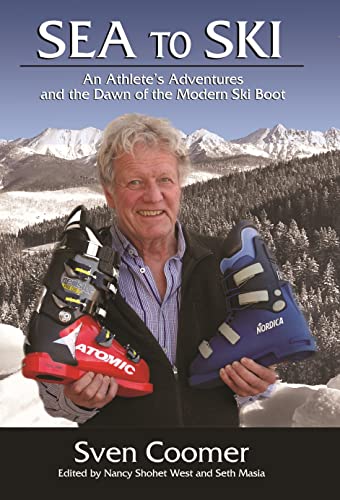

If you own a pair of Alpine ski boots, you are skiing in a product whose origins can be traced directly back to one man, Sven Coomer. There are two dominant strains in Alpine boot DNA, the three-piece, open-throat design, and the two-piece shells that populate most of the market. Coomer invented the progenitors of both while he was working at Nordica during the transition from leather to plastic boots.
If that was Coomer’s only contribution to today’s ski boot market, he would already stand head and shoulders above the other pioneers in plastic boot design, including Bob Lange, whose first efforts in this arena elevated boot performance at the cost of even a modicum of comfort. After leaving Nordica once he realized the brand was moving away from elite performance in order to create more aesthetically appealing designs, Coomer’s creative juices continued to flow. He was the first to use silicone to make inner boots more form-fitting. He invented custom insoles that could be molded in the ski shop, creating an entire category that is currently considered essential to high-performance skiing. To do this job right, he opened a ski shop at Mammoth Mountain called Footloose, so he could work closely with professional skiers to optimize his design. Footloose continues to be a benchmark specialty shop in part because its training in bootfitting has been passed on from Coomer to subsequent generations.
While consulting at Atomic, he conceived a way to create a flexible shell around the forefoot, allowing energy from the skier to flow more directly to the ball of the foot. This was anything but a self-evident solution, as every other boot on the market operated on the assumption that only a stiff shell could transmit skier movement to the ski. The Atomic Hawx series in which his ideas were incorporated provided the platform Atomic needed to climb from the back of the market pack into a successful series that continues to provide the bulk of Atomic’s boot sales.
While working at the Brixia factory in Asolo, Italy that made San Marco and Munari boots, Coomer created the only boot model that incorporated an internal fit system in a classic, two-piece, four-buckle shell. Munari lacked the marketing muscle to make much of this invention, so Coomer’s design never found the market acceptance it deserved.
But another Coomer invention that he is rarely credited for creating has become practically de rigueur for anyone who hopes to put on a 130-flex boot, the heated boot bag. Coomer conceived of the heated bag when he was working with the race community – where a 130-flex boot is considered soft – to which he retained close ties since training with the French, Italian, Austrian and German ski teams in his youth. Race-caliber boots, then as now, are very difficult to squirm into when at room temperature, much less cold. After heating in Coomer’s bag, they slide on like slippers.
One Coomer design that’s still in production is the Zipfit inner boot, that uses a cork and vegetable oil composite that flows around the foot in less than 10 seconds, creating an anatomically accurate fit that doesn’t distort the shell or crush the foot as conventional foam-injection can. Coomer retained control of the Zipfit project, allowing him to bequeath it intact to family members who will carry on the tradition of optimizing ski boot function and fit.
I would be remiss if I didn’t reference Coomer’s contribution to my own preoccupation, ski testing. First at Mammoth, then Mt. Rose, he and Doug Pfeiffer conducted the first formal ski tests, the results of which appeared in the pages of Skiing Magazine.
One has to be a keen observer of the boot development scene to recognize where Coomer left his mark, as more than one of his collaborators would take all the credit after successfully commercializing his foundational concepts. Had he been more self-aggrandizing, his name would be branded on almost every part of the modern ski boot.
Coomer has recently published his autobiography, Sea to Ski, a slender tome that belies the impact of the life it traces. Coomer concentrates on his remarkable youth – he was on the Australian Olympic modern pentathlon team at the tender age of 16 – leaving only a few pages to outline the highlights of his career in ski boot design. Given the number of times his inventions have been attributed to others, one might expect Coomer to set the record straight and settle a few scores, but you won’t catch a whiff of recrimination here.
What you will find is the story of an extraordinary athlete who exceled at every sport he touched, who also happened to possess an exceptional talent for product development. Coomer left his mark wherever he went in his prolific, peripatetic career, impressions that are still with us to this day. In recognition of a lifetime of unparalleled accomplishments, Sven Coomer will be formally inducted into the U.S. Ski & Snowboard Hall of Fame this spring, an honor that is long overdue.
The next time you bend over to buckle your boots, remember the man who, more than any other, contributed to its design. God bless you, Sven Coomer; we’ll never see another like you.

Related Articles

The Making of a Skier, Part IX: The ASTM, Carl Ettlinger and I
One of the many hats I wore as North American binding product manager for Salomon in the early 1980’s was that of delegate to the American Society for Testing and Materials (ASTM). I believe the first meeting of F8.14 – the sub-committee on ski safety – that I attended was in Pennsylvania. I was flying under the wings of Salomon’s seer of all standards and patents, Gilbert Delouche, and the binding product manager for the North American zone at that time (and my mentor), Joe Campisi.
I was a babe in the woods, but I soon caught on to the game under Delouche’s patience guidance. I recall a debate on the binding specification then being batted around in the technical committee chaired by Carl Ettlinger. Ettlinger wanted language that would require any release/retention setting of 10 or above to be “visually distinctive” from the rest of the scale.
In Memorium, Carl Ettlinger
Carl was a giant of a man whose outsized voice roiled every conversation like a burst dam and whose expansive vision reached across the mixed milieus of research, journalism, risk management and education. I knew him when he was at the peak of his powers, as he explained to me when I interviewed him for a “where are they now?” profile in Skiing History. He was able to conduct long-term research on injury patterns as well as analyze the particulars of the current binding market, turn around and package this knowledge into articles for Skiing and Skiing Trade News, followed up by a workshop tour that would bring enlightenment to the grassroots level. No one but Carl could have pulled this off, and Lord knows no one has had the requisite talent, energy and will power since.
But time and tide wait for no man, and Carl’s finely spun web of influence was eventually plucked apart. The loss of his pivotal positions in the press allowed him to slip from public view before we, the skiers of the world, realized we hadn’t taken the time to thank him.
We have the time to thank him now.
So thanks, Carl, for being first and foremost a teacher, for teaching is at the heart of the evangel’s mission.
Thanks for being so damn stubborn. Your insistence on improving skier safety wore through a wall of resistance as tough as Vermont marble.
Thanks for having a heart as big as that melon-sized head of yours. The fuel to your tireless mind was a caring heart that tried to embrace the world.
Thanks for all the stories once the Mount Gay flowed. Who knew we would have won the Vietnam War if only his superiors had listened? I can’t remember exactly how – he wasn’t the only one drinking Mount Gay – but I recall the light in his eyes as he relayed his twisted tales, taking us down successive rabbit-holes of digression that I lost track of at the seventh level.
That’s what I remember most vividly about my many interactions with Carl: his brain so teemed with thoughts he rushed to get them out in a verbal jailbreak that would travel around the cosmos until returning, many lost minutes later, to the subject that had inspired them. That was Carl: too many words for one sentence, too many tasks to tend to and all of it, every erg of his endless energy, devoted to a cause he never ceased to serve.
Fare thee well, Carl Ettlinger. The world misses you already for it will never see another quite like you, whose every moment seemed larger than life itself.
I raise my glass to you, old friend. Mount Gay, of course.
Jackson Hogen
June 23, 2020

Why This Buyer’s Guide?
Don’t read the 2021 Masterfit Buyer’s Guide in Partnership with Realskiers.com for its 62 ski reviews. I should know. I wrote or edited all of them.
Not that the ski reviews aren’t worth the read. But ski reviews on the web are as common as rice, while the Buyer’s Guide contains something no other publication, whether in digital, print or video format, can claim: the most respected, thorough and dependable boot reviews in the world.
This isn’t mere puffery. The Masterfit Boot Test is so well regarded by the supplier community that nearly every brand not only sends its following year’s line-up in four men’s sizes plus three for women, it also dispatches its top designers and/or product managers to a distant North American site for most of the test’s five-day duration.
