
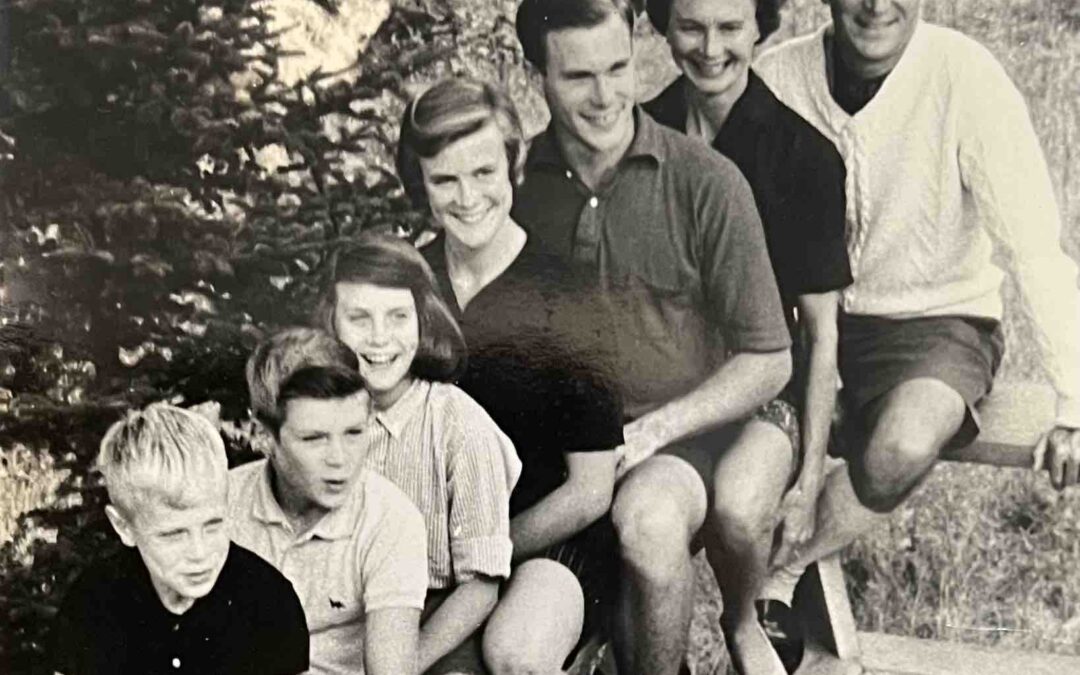

I was the fifth of five children. While I naturally lacked the capacity to appreciate my circumstances in my childhood, the fact that I was an unwelcome accident would cast a shadow across my early youth that only the passage of time and an adult’s awareness have illuminated.
We were a skiing family, which meant that I would go to Big Bromley along with my siblings on many a winter weekend, but I wasn’t invited to ski with them. The extent of family support for my early ski days was limited to equipping me with gear that had barely survived several lifetimes of service. My boots were the same rudimentary leather affairs that almost everyone used back in the day, their laminated soles split and warped by neglect, and my skis were wooden Northlands that had long since succumbed to the ravages of time and nature.
Skis of this era – the mid-1950’s – were unfinished wood, meaning that if you wanted them to slide, you had to paint on a gooey, green base wax, and if you wanted them to dig into New England ice, it was up to the skier to screw on segmented edges that would inevitably dislodge, rust, or both. The skis that were handed down to me were missing most of the base wax, with only splotches here and there to commemorate the treatment they once received. The edges were, shall we say, discontinuous.
The only advantage to this arrangement was that the sticky bases made it easier for me to climb uphill, an obligatory ordeal as my parents wouldn’t buy me a lift ticket (a whopping $1.25) until I was nine. In the wet snow of spring, I would accumulate several inches of packed corn snow on my bases in a single ascent, so to ski down I would have to take off my skis and try, with my woolen mittens, to scrape off as much as I could. On a few rare and glorious occasions, brother Robin and sister Lyn would ride the J-bar lift up the Lord’s Prayer so I could meet them at the top, where Robin would use one of my skis to skive the accumulated glop off the other.
While this pit-stop service would initially allow me to glide, the snow would begin to re-attach itself as soon as I was in motion, so I would decelerate even when I was pointed straight downhill. If the self-arrest were particularly sudden, I would pitch forward and come right out of my laced-up boots. As my ski socks wouldn’t be washed all winter, they would remain bonded to the ill-fitting boots, leaving me barefoot in the middle of the run. The only other proven method for stopping was running straight into the rock wall at the base, much to the amusement of the sunbathers stretched out on their chaises longues just above me.
When I tired of this exercise, I would wander into the Boar’s Head Lodge and scuffle forlornly among the tables of chattering families until some motherly soul would inquire if I were lost, and perhaps, hungry? Yes on both counts, I would eagerly assent, hinting broadly that a French fry or two would help ease the pain of a lost child whose parents had abandoned him. When my mother and father eventually arrived on the scene, they would scold me for telling tales, but I didn’t care, as I knew damn well they would never in a million years buy me so much as a potato chip, an indulgence to which I wasn’t entitled. In the short drive home, the conversation I overheard intimated that my parents found my subterfuge to be more humorous than harmful, and anyway, it didn’t cost them anything.
If you should think my parents callous for routinely leaving me in such sorry shape, their attitude was no doubt colored by the fact that I couldn’t see doodly-squat, creating the impression that I lacked the coordination that came naturally to my elder siblings, ergo, unworthy of investment in a skill I would probably never develop. When they finally bought me glasses – again at the pivotal age of nine – I required a 9.25 diopter correction in one eye and 9.5 in the other, plus adjustments for astigmatism. For those of you blessed with perfect vision, this means my visual acuity was on the cusp of legal blindness.
I’ll never forget putting on glasses for the first time and gazing out the optometrist’s second-floor office at a red building across the street. To my bottomless amazement, I could see every brick! Who would have guessed that red buildings were made of individual bricks? My lenses may have been as thick as those used in telescopes, and heavy enough to dig notches into my nose, but at last I could see a ball tossed in my direction before it hit me in the face.
My godfather, Bill Parrish, owned both a legendry lodge, Johnny Seesaw’s, and a ski equipment importing business, which brought the price of new skis for the last issue (aka, me) down to something like thirty bucks, ending the cycle of hand-me downs. Not that the new skis were any great shakes: my Quebec-made Le Trappeurs would expire prematurely when a bubble in the base material allowed snow to insinuate itself between the P-Tex and the wood beneath, firing me into a grove of trees and ending the brief rein of my new rides, tossing me back into the used-ski pool.
The next skis turned out to be a battered pair of Head Competition GS’s, several steps above anything I’d ever experienced. They too, would die in battle when I attempted a sudden, violent turn while straight-running the face of Bromley, which pulled all the screws in one heel piece clean out of the ski. I can’t say the binding released, as my six-foot, six-inch long thongs kept me connected until the unmoored tip stuck in the snow and unceremoniously dumped me.
The cycle of skiing on obsolete gear would finally end in 1967, when I worked all summer at a day camp in Landgrove, Vermont for $15 a week, earning me enough to buy a pair of spanking-new Rossignol Stratos with Look Nevada bindings from Hickory & Tweed, in Armonk, New York. But even new gear doesn’t bestow new skills, and as I’d never had a lesson (as foreign an idea to my parents as speaking Mandarin) and my coach at Andover was more focused on brother Robin, who routinely won Skimeister for his excellence in all events, while I was better known for my spectacular crashes. Oh well, at least I had some really good skis and my skills would eventually blossom long after my woeful days of amateur competition were concluded.
While acquiring new skis would definitely boost my battered self-esteem, the corrosive effects of parental disregard would stay with me to this day. It didn’t help that my parents didn’t care for children disturbing the tranquility of their dinner, so in my early youth Lyn, Robin and I would eat in the kitchen while they were served their meals in the adjacent dining room. In due course, Lyn, then Robin, graduated to the adults’ table, leaving me to eat alone in the kitchen. By the time I was allowed to move up, the other sibs had all moved out. I remained as the living embodiment of a mistake, the accident that had upset the perfect symmetry of their plans.
On the occasion of my eldest brother’s third marriage, my mother – who would soon succumb to dementia – finally let down her guard. Smiling brightly as if sharing an inside joke, she giddily exclaimed, “At least he didn’t ask if I could send you back!” Implicit in her blithe remembrance, of course, is that’s exactly what my father would have preferred.
Over the course of many years, a suite of surgeries – for a detached retina, a torn retina, cataracts and a botched LASIX procedure – would enable me to see the world more or less as it is. But nothing has ever mitigated the fact that, behind my baby blues, there forever lingers the knowledge that I was never part of the plan, nor would I ever be.

Related Articles

The Making of a Skier, Part IX: The ASTM, Carl Ettlinger and I
One of the many hats I wore as North American binding product manager for Salomon in the early 1980’s was that of delegate to the American Society for Testing and Materials (ASTM). I believe the first meeting of F8.14 – the sub-committee on ski safety – that I attended was in Pennsylvania. I was flying under the wings of Salomon’s seer of all standards and patents, Gilbert Delouche, and the binding product manager for the North American zone at that time (and my mentor), Joe Campisi.
I was a babe in the woods, but I soon caught on to the game under Delouche’s patience guidance. I recall a debate on the binding specification then being batted around in the technical committee chaired by Carl Ettlinger. Ettlinger wanted language that would require any release/retention setting of 10 or above to be “visually distinctive” from the rest of the scale.

Why This Buyer’s Guide?
Don’t read the 2021 Masterfit Buyer’s Guide in Partnership with Realskiers.com for its 62 ski reviews. I should know. I wrote or edited all of them.
Not that the ski reviews aren’t worth the read. But ski reviews on the web are as common as rice, while the Buyer’s Guide contains something no other publication, whether in digital, print or video format, can claim: the most respected, thorough and dependable boot reviews in the world.
This isn’t mere puffery. The Masterfit Boot Test is so well regarded by the supplier community that nearly every brand not only sends its following year’s line-up in four men’s sizes plus three for women, it also dispatches its top designers and/or product managers to a distant North American site for most of the test’s five-day duration.
The Ripple Effect
As I’ve observed in this space before, product managers spend most of their time in the future; the present for them is two years away for the rest of us. So when the coronavirus shut down the 19/20 ski season, it triggered an automatic response in the R&D lobes lodged deep in my noggin: what impact will this have two years down the road?
If I knew the answer to this question with any certainty, I should be running a hedge fund, not scribbling about skiing. But after checking with several of the bellwether players in U.S. market, I have some idea of what’s in store.
