

Last week in this space I bid a fond farewell to a trio of outstanding skis that have ruled their slice of the market for the better part of a decade. No sooner had I sent the text off into the ether than my wandering mind dusted off some fuzzy memories that prompted me to wonder, what was the most popular ski ever sold on this continent?
It couldn’t be a recent model, if for no other reason than the current ski market is wildly diverse and fragmented compared to the relatively homogenous ski world prior to the ascension of shaped skis, and even more impactfully, fat skis. Not only are there many more models being offered today by each established brand, the total number of skis sold in North America has shrunk by roughly two-thirds, from somewhere north of 1.5 million pairs to something south of half a million. The recent bulge in backcountry activity, while adding to the total number of skis sold, has further diluted the chances of any one model dominating sales.
The period when the U.S. market supported the most brands and sold the most skis was also an epoch when there were really only two archetypes: a light and lively slalom ski and a beefier giant slalom, with the former far more popular than the latter. The peak of this period began around 1980 and continued into the mid-90’s, when curvaceous carving skis and plump powder models began to warp the market into what we have today.
If you were a skier back then, you already know where this train of thought is heading. In an ocean of candidates, there was one mega-star, the teal-green Rossignol 4S Kevlar. Its defining technical feature was a Vibration Absorption System (VAS) that the brand had been optimizing since it first appeared in the SM and SP models in 1980. Originally comprised of steel wires in a visco-elastic substrate, aka, rubber, the distinctive external plate – a snippet of aluminum alloy (Zicral) riding a rubbery cushion – wasn’t added until 1984. It bears noting that some variation of this principle – converting vibrational shock into elastic movement against resistance – is alive and well in many, if not most, of the skis using Titanal laminates today.
The 4S VAS had already earned a legion of fans before Rossi added the coup de grâce, the addition of Kevlar fiber to the mix, in 1987. The use of high-tech fibers is now commonplace – although carbon, not aramid fiber like Kevlar, has become the most common choice due to its lower cost and wide-spread availability – but in its era, Rossi was way ahead of the curve. To complete the package, Rossi shifted the ski’s dominant color to a soft, teal green that fit the moment perfectly.
By “moment,” I mean “half a decade,” for that’s roughly how long the original 4S K ruled the roost. Rossignol was the most important ski brand in America, with an enormous, well-cultivated armada of racers and ex-racers as brand ambassadors. The 4S K’s trademark mint tint didn’t just seem to be everywhere; it was everywhere.
All race ski designs are subjected to constant tinkering, and so it came to pass that the 4S Kevlar evolved into the 7S K, which continued the reign of Rossi slalom skis well into the 1990’s. The 4S moniker would one day be slapped on a foam-core package ski just to exploit the name, but it never pretended to the success of its namesake and it mercifully slipped away into anonymity.
As I’m sure you’re aware, Dear Reader, there is no such thing as a skinny, shapeless slalom ski – intended to be skied in at least a 200cm length, no less – anymore. Ubiquitous grooming has obviated the need to make an endless string of short turns, and the shallower, abbreviated sidecuts of today’s much fatter skis encourage a longer-radius, partially skidded turn. If the 4S K were introduced today, it might inspire curiosity, but precious few sales.
In point of fact, Rossi did introduce a concept ski based on a modern slalom design, but the concept The Essential is meant to illustrate is recyclability, using an archetype with which all major ski makers are familiar. I don’t think anyone at Rossignol believes Americans are suddenly going to put their feet together and start to dart in and out of the fall line with the agility of agitated atoms. The conditions that made the 4S K so enduringly popular – that could make any ski so universally endorsed – simply don’t exist anymore.
But skis still need to cope with vibration, and the principles that made VAS so effective in its day still pertain. Ski models may come and go to fit the exigencies of a shifting market, but the science behind the technologies that keep skis connected to a high-speed turn never goes out of style.

Related Articles

Road Tripping
Among the many dissatisfactions of this most unusual season is that travel beyond one’s local environs has been roundly discouraged. Don’t get me wrong: I’m grateful down to my socks that we’re allowed to ski locally, and my version of same is pretty sweet. Pardon the plug, but between Alpine Meadows, Squaw Valley and Mt. Rose I have a smorgasbord of savory choices.
But skiing close to home and skiing on the road are two different beasts. Nothing is the same, really, and therein lies a great deal of the road trip’s charms.
To shed light on my premise, allow me to pull back the veil on my favorite away game, an annual pilgrimage to Little Cottonwood Canyon. By the end of this brief travelogue you will probably hate me, so please fill your vessel of good will to the rim before proceeding.
It’s About Nothing
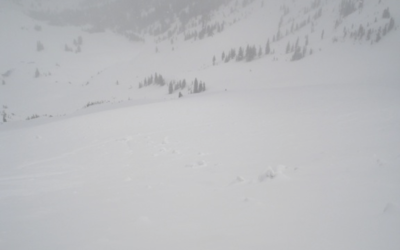
In the last week of January,2009 I was able to spend a few days skiing in Little Cottonwood Canyon, which is always cathartic for my ravaged soul. The conditions were all over the map, the mountains having experienced a long, hot spell followed by rain, grapple, wet snow and finally dry snow driven by winds that could flense an adult walrus in a few minutes. Couldn’t have been better.
I had been preparing for the trip for weeks, psychologically. Two back surgeries the previous winter had reduced my training regimen from semi-annual to non-existent. Scheduling conflicts such as work kept me from visiting the areas that abound at home near Lake Tahoe, so I had zero ski days on a body with more fat on it than a French duck. I had as much chance of surviving Snowbird and Alta as a rib roast in a piranha tank.
Fortunately, the Lord is merciful, anti-inflammatory drugs are powerful and there are techniques that allow one to block out pain. There are also many wonderful people in this world with which to ski, kind people who stand quietly by, pretending to be in awe of Nature, while my chest heaves so violently in its futile quest for oxygen that tiny lung particles break lose and make for the exits. One such person is Guru Dave Powers, a man whose passion for the sport hasn’t diminished after thousands of days of riding gravity down the infinitely variable slopes and crannies of Snowbird. The Goo knows this hill, and in knowing it well knows so much more.
The Making of a Skier, Chapter XII: Putting Words into the Mouth of God & Other Mid-Life Adventures
When I was cut adrift by Head on June 13, 2001, my once glowing prospects dimmed considerably. The date is etched in memory because I hosted a small soirée that evening in honor of my darling wife’s 50th birthday. One of the attendees was Paul Hochman, who would play several roles in my life as I wandered in the wilderness of unemployment during what were supposed to be my peak earning years.
During the gaping hole in my career that spanned 2001-2011, I would eventually spend every cent of my inheritance, plus most of what I’d saved from earlier bouts with gainful employment, just keeping the household afloat. Despite a river of red ink, my resume would suggest that I was not only commercially active during this epoch, but had my hand in all sorts of ventures.
