

Last week in this space I bid a fond farewell to a trio of outstanding skis that have ruled their slice of the market for the better part of a decade. No sooner had I sent the text off into the ether than my wandering mind dusted off some fuzzy memories that prompted me to wonder, what was the most popular ski ever sold on this continent?
It couldn’t be a recent model, if for no other reason than the current ski market is wildly diverse and fragmented compared to the relatively homogenous ski world prior to the ascension of shaped skis, and even more impactfully, fat skis. Not only are there many more models being offered today by each established brand, the total number of skis sold in North America has shrunk by roughly two-thirds, from somewhere north of 1.5 million pairs to something south of half a million. The recent bulge in backcountry activity, while adding to the total number of skis sold, has further diluted the chances of any one model dominating sales.
The period when the U.S. market supported the most brands and sold the most skis was also an epoch when there were really only two archetypes: a light and lively slalom ski and a beefier giant slalom, with the former far more popular than the latter. The peak of this period began around 1980 and continued into the mid-90’s, when curvaceous carving skis and plump powder models began to warp the market into what we have today.
If you were a skier back then, you already know where this train of thought is heading. In an ocean of candidates, there was one mega-star, the teal-green Rossignol 4S Kevlar. Its defining technical feature was a Vibration Absorption System (VAS) that the brand had been optimizing since it first appeared in the SM and SP models in 1980. Originally comprised of steel wires in a visco-elastic substrate, aka, rubber, the distinctive external plate – a snippet of aluminum alloy (Zicral) riding a rubbery cushion – wasn’t added until 1984. It bears noting that some variation of this principle – converting vibrational shock into elastic movement against resistance – is alive and well in many, if not most, of the skis using Titanal laminates today.
The 4S VAS had already earned a legion of fans before Rossi added the coup de grâce, the addition of Kevlar fiber to the mix, in 1987. The use of high-tech fibers is now commonplace – although carbon, not aramid fiber like Kevlar, has become the most common choice due to its lower cost and wide-spread availability – but in its era, Rossi was way ahead of the curve. To complete the package, Rossi shifted the ski’s dominant color to a soft, teal green that fit the moment perfectly.
By “moment,” I mean “half a decade,” for that’s roughly how long the original 4S K ruled the roost. Rossignol was the most important ski brand in America, with an enormous, well-cultivated armada of racers and ex-racers as brand ambassadors. The 4S K’s trademark mint tint didn’t just seem to be everywhere; it was everywhere.
All race ski designs are subjected to constant tinkering, and so it came to pass that the 4S Kevlar evolved into the 7S K, which continued the reign of Rossi slalom skis well into the 1990’s. The 4S moniker would one day be slapped on a foam-core package ski just to exploit the name, but it never pretended to the success of its namesake and it mercifully slipped away into anonymity.
As I’m sure you’re aware, Dear Reader, there is no such thing as a skinny, shapeless slalom ski – intended to be skied in at least a 200cm length, no less – anymore. Ubiquitous grooming has obviated the need to make an endless string of short turns, and the shallower, abbreviated sidecuts of today’s much fatter skis encourage a longer-radius, partially skidded turn. If the 4S K were introduced today, it might inspire curiosity, but precious few sales.
In point of fact, Rossi did introduce a concept ski based on a modern slalom design, but the concept The Essential is meant to illustrate is recyclability, using an archetype with which all major ski makers are familiar. I don’t think anyone at Rossignol believes Americans are suddenly going to put their feet together and start to dart in and out of the fall line with the agility of agitated atoms. The conditions that made the 4S K so enduringly popular – that could make any ski so universally endorsed – simply don’t exist anymore.
But skis still need to cope with vibration, and the principles that made VAS so effective in its day still pertain. Ski models may come and go to fit the exigencies of a shifting market, but the science behind the technologies that keep skis connected to a high-speed turn never goes out of style.

Related Articles
Fit the Whole Skier
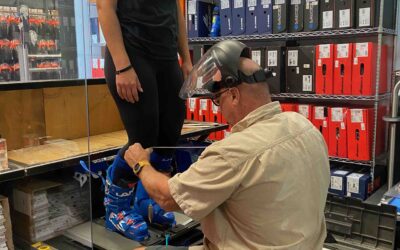
We bootfitters are naturally obsessed with feet, but the best bootfitters don’t just fit feet; they fit the whole skier. The “whole skier” includes more than just a quick survey of the lower leg and how it’s connected to the foot. It’s even more than all of the skier’s physical attributes, which include not only height and weight, but seated posture, stance, kinesthetic wiring, arch health and stiffness throughout the kinetic chain; the whole skier also includes his or her history with the sport and, most importantly, what sort of skier he or she wants to be.
One of the most obvious traits about almost all boot customers is his or her gender. (Please forgive me if I don’t overcomplicate what should be a simple point about body type.) The first step in a sales process that consists of winnowing all possible boots down to one is picking from the pile of unisex boots or the alternative world of women’s boots.
No-brainer, right? Not so fast. What if a particular woman were tall, with a long tibia and a tapered calf? Let’s add to her profile that she’s a good athlete with a background in dance. Up to now, she’s only been an occasional skier who rented her gear, but a new beau has persuaded her to take a deeper dive. She already has her season pass.
The Things We Do for Love, Part II
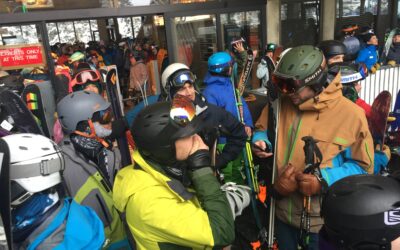
Dear Readers who regularly devour my weekly Revelations know that I have already written at length on the subject of Why Skiers Are Better than Everyone Else. Last Friday I was reminded of my timeless prose as I spent 45 minutes traversing a very short stretch of road that connects I-80 to Route 89, my proscribed path to Alpine Meadows. As I voluntarily descended into this automotive miasma, I could make out the dim form of the interstate traffic snaking down from the west, two dense strands of tightly linked vehicles stretching beyond the horizon.

Realskiers.com Trounces Field to Earn Second Stump-Bertoni Prize for Excellence
In a stunning upset that in retrospect appears inevitable, Realskiers.com has been awarded The Stump-Bertoni Prize for Excellence for the second year in a row.
For those cave-dwellers who snoozed through Realskiers.com’s first triumph in this gilded competition, permit me to bring you up to speed. Then as now, the battle for this cherished trophy (metaphorically speaking – the S-BP lacks sufficient funds for a memento commensurate with its prestige) was fierce, extending both of its eponymous founders to previously unknown limits.
The final ballot was determined by leg wrestling over Stump’s furious protest; he cogently argued that this sort of bias against the vertically challenged has no place in a free society. Bertoni imperiously overruled Stump’s evermore strident complaints, citing a lack of legible documentation, tardy submissions and a tendency to perspire copiously when provoked.
This year’s competition was no less fraught.
