
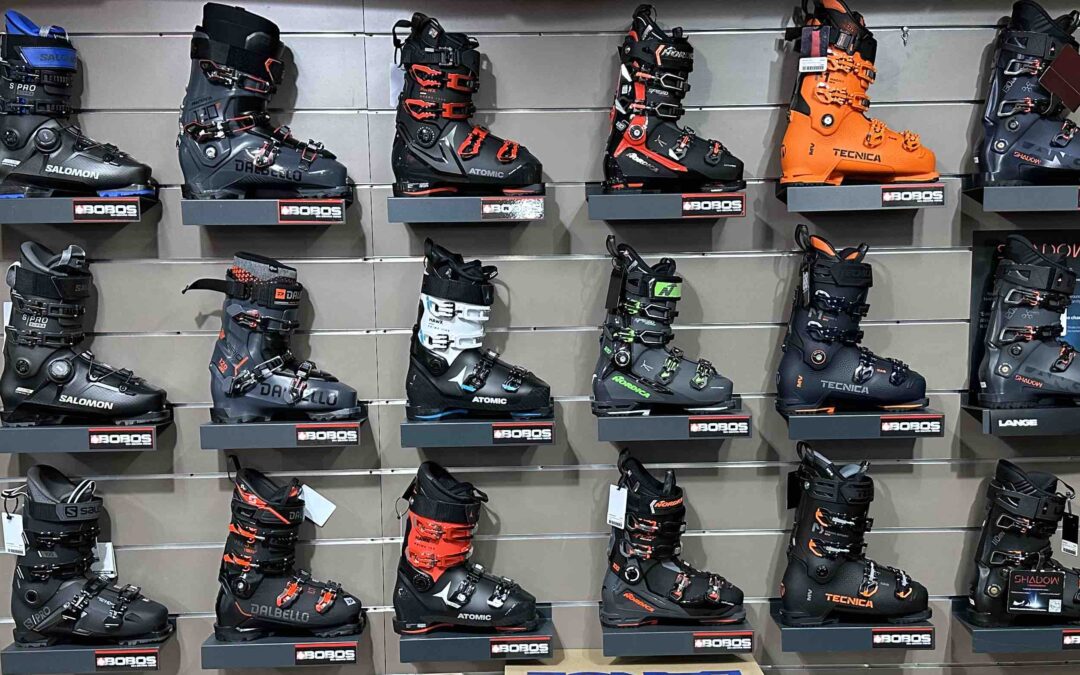

As far as I know, October isn’t “National Buy Your Ski Boots Now” Month, but it should be. Carryover stock will never be more abundant, and new models will still have a full range of sizes, which won’t be true forever. Perhaps most importantly, bootfitters are also in relatively strong supply, so with any luck the one waiting on you won’t be juggling three customers at once. It’s a perfect storm of abundance: values on last year’s models, selection on this year’s new arrivals and personalized service are all at their peak.
The following ever-relevant Revelation was first published as Lessons in Empathy on March 13, 2018.
Almost everyone who submits to the tender mercies of a bootfitter has a history, baggage of prior bouts on the boot bench that turned out poorly. If they wear a crust of mistrust before they bare their feet before a shiny new bootfitter, it’s because experience has taught them that no matter how well the boots seem to fit in the shop, they will transform into untamable hellions the first time they tread on snow.
To chip away at the mistrust crust, the bootfitter must demonstrate that this time, things will be better. He calls out every bone in the foot as he glides over it, caresses the configuration of the arch and puts the ankle through its paces. He contemplates the shape of the calf, the height of the instep and the angle formed by the row of metatarsals. He explains your case as if he were a dermatologist diagnosing an inexplicable rash you picked up on a cruise to Borneo.
The true test of the bootfitter’s perspicacity comes when the first trial boot appears. Before the customer’s tootsies are allowed to descend into the dark maw of the boot’s throat, he receives a litany of provisos and disclaimers not unlike those rattled off near the end every drug commercial on TV.
Your toe(s) will touch the end. Don’t panic. They’ll never be tighter than they are right now. We’ll warm them up later, then you’ll see I’m not lying. You’ll get used to turning your foot 90 degrees. That shooting pain on the outside of your foot? Don’t worry about it! I know your toe is at the end, but I wouldn’t call it “smushed.”
While the bootfitter is applying all this verbal Valium, the oft-abused boot-fittee is balancing on one foot, thinking, Why shouldn’t I panic? A life-before-my-eyes newsreel of old boots that killed my feet is unspooling in the memory storage shed. BTW, my foot isn’t moving, it’s trapped. I’m halfway in this bloody boot and it’s trying to ingest my instep, which is already cramping up as I drop in. The shooting pain you refer to is, or was, my pinky toe, whose hue is now moving through the spectrum of reds, on its way to ultra-violet. And, yes, since you ask, my big toe and whatever you called the one next to it are, I believe, permanently dislocated.
In the scrum between customer and bootfitter, third-party sympathies naturally side with the beleaguered customer. All the pain and suffering seem one-sided. As one who has spent many hours on the other side of this unequal equation, allow me to assure my readership that such is not the case. The myriad difficulties of fit diagnostics aside, bootfitters must wrestle with hard plastics and argumentative tools that shred flesh far more readily than they deform plastic.
Then there are the infinite mysteries of trying to figure out what, Dear Customer, you are all about. Feet present countless problems all on their own, magnified by the fact that they are at the base of a kinetic chain with issues at every junction between the foundation and the source of most intractable boot fit problems, the brain. As the author of your own skiing history, you leave out unflattering bits that would reveal volumes and replace them with self-assessments leavened with large doses of imagination.
The partners in the bootfitter/customer dance need to bring both head and heart to their relationship. Bootfitters have to explain to customers what they’re thinking, where they’re going with model and size selection and why. Customers need to provide detailed history and feedback and be as honest as they can about skills assessment and goals.
Pardon my veering down a side road, but it’s a source of amazement to this observer that practically every skier on the hill has at least one video camera on his or her person yet almost no one has footage to show a bootfitter that would illuminate his or her skill set. But I digress.
In the final analysis, bootfitting is hard on both parties, fitter and fittee alike. Feet weren’t made for ski boots and by all indications boots don’t seem made for feet. Of all the components that make up the modern ski/boot/binding system, boots could use the most re-imagining.
The relationship between bootfitter and skier could also use some re-imagining. For it to work, it has to be a collaboration based on mutual respect and dependent on communication skills. As pricing can be a deal-breaker, both sides would be well advised to put their negotiating chips on the table at the outset rather than leaving all discussion to a mutually unsatisfying conclusion.
The underlying secret to a great boot fit is the same as the secret solution to many of life’s challenges: approach it with an open mind and an open heart.

Related Articles

The Things We Do for Love, Part II
Dear Readers who regularly devour my weekly Revelations know that I have already written at length on the subject of Why Skiers Are Better than Everyone Else. Last Friday I was reminded of my timeless prose as I spent 45 minutes traversing a very short stretch of road that connects I-80 to Route 89, my proscribed path to Alpine Meadows. As I voluntarily descended into this automotive miasma, I could make out the dim form of the interstate traffic snaking down from the west, two dense strands of tightly linked vehicles stretching beyond the horizon.

Realskiers.com Trounces Field to Earn Second Stump-Bertoni Prize for Excellence
In a stunning upset that in retrospect appears inevitable, Realskiers.com has been awarded The Stump-Bertoni Prize for Excellence for the second year in a row.
For those cave-dwellers who snoozed through Realskiers.com’s first triumph in this gilded competition, permit me to bring you up to speed. Then as now, the battle for this cherished trophy (metaphorically speaking – the S-BP lacks sufficient funds for a memento commensurate with its prestige) was fierce, extending both of its eponymous founders to previously unknown limits.
The final ballot was determined by leg wrestling over Stump’s furious protest; he cogently argued that this sort of bias against the vertically challenged has no place in a free society. Bertoni imperiously overruled Stump’s evermore strident complaints, citing a lack of legible documentation, tardy submissions and a tendency to perspire copiously when provoked.
This year’s competition was no less fraught.
Just How Strange Will the 21/22 Ski Market Be?
To (temporarily) kowtow to the cult of brevity, the short answer is, “not very.”
To elaborate, most major ski brands didn’t derail the introduction of new products that were in the works well before the pandemic dropped the hammer. There’s a rhythm to the product renewal cycle that shifts the spotlight every year to a different model family within any brand’s global collection; that rhythm was largely respected despite the unique obstacles imposed on the process this year. If most of the models appearing in 21/22 catalogs seem similar to what was offered this year, it’s because this is how the line renewal machinery ordinarily operates.
What’s difficult to judge from outside the R&D pipeline is what we’re not seeing. That is, were there more new models or upgrades to existing star products ready to launch that were put on hold to avoid overloading a potentially weakened distribution network? Possibly; what might have been a planned six-model launch may have been trimmed to three or four, for example.
Happily, there’s no real downside to this scenario for the prospective ski buyer. All essential model family refreshing and line extensions will unfold as forecast. If you haven’t bought a ski in three or four years – I believe the average span between new ski purchases is over seven – the entire universe of Alpine skis is new to you. You may spot some names you recognize, but the skis that bear the name will almost assuredly be different.
