
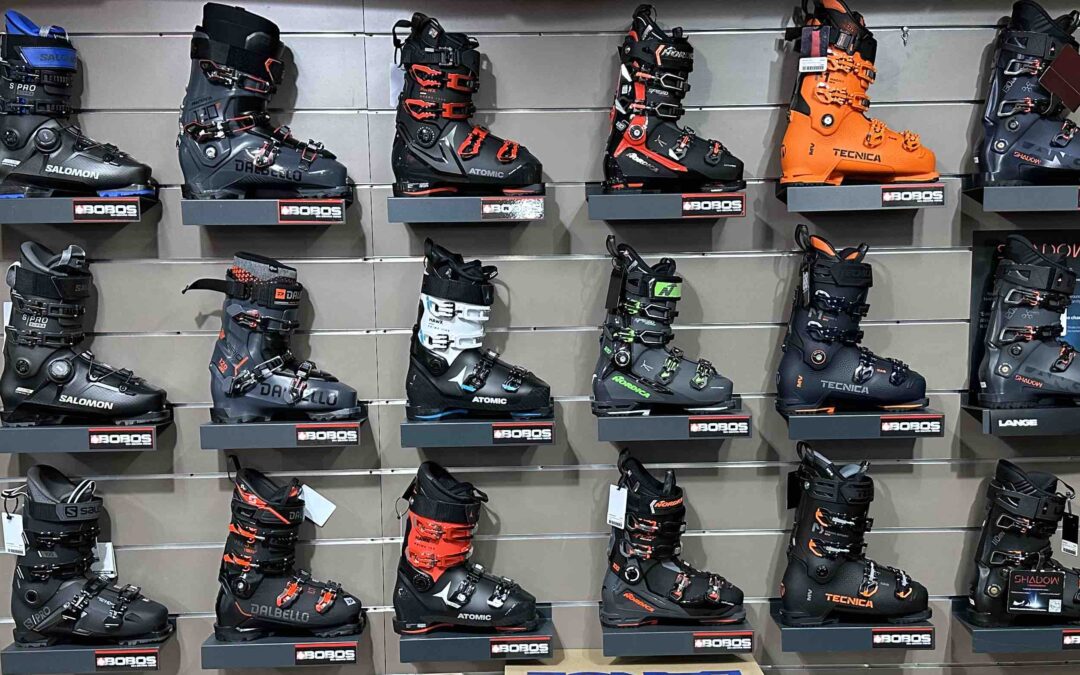

As far as I know, October isn’t “National Buy Your Ski Boots Now” Month, but it should be. Carryover stock will never be more abundant, and new models will still have a full range of sizes, which won’t be true forever. Perhaps most importantly, bootfitters are also in relatively strong supply, so with any luck the one waiting on you won’t be juggling three customers at once. It’s a perfect storm of abundance: values on last year’s models, selection on this year’s new arrivals and personalized service are all at their peak.
The following ever-relevant Revelation was first published as Lessons in Empathy on March 13, 2018.
Almost everyone who submits to the tender mercies of a bootfitter has a history, baggage of prior bouts on the boot bench that turned out poorly. If they wear a crust of mistrust before they bare their feet before a shiny new bootfitter, it’s because experience has taught them that no matter how well the boots seem to fit in the shop, they will transform into untamable hellions the first time they tread on snow.
To chip away at the mistrust crust, the bootfitter must demonstrate that this time, things will be better. He calls out every bone in the foot as he glides over it, caresses the configuration of the arch and puts the ankle through its paces. He contemplates the shape of the calf, the height of the instep and the angle formed by the row of metatarsals. He explains your case as if he were a dermatologist diagnosing an inexplicable rash you picked up on a cruise to Borneo.
The true test of the bootfitter’s perspicacity comes when the first trial boot appears. Before the customer’s tootsies are allowed to descend into the dark maw of the boot’s throat, he receives a litany of provisos and disclaimers not unlike those rattled off near the end every drug commercial on TV.
Your toe(s) will touch the end. Don’t panic. They’ll never be tighter than they are right now. We’ll warm them up later, then you’ll see I’m not lying. You’ll get used to turning your foot 90 degrees. That shooting pain on the outside of your foot? Don’t worry about it! I know your toe is at the end, but I wouldn’t call it “smushed.”
While the bootfitter is applying all this verbal Valium, the oft-abused boot-fittee is balancing on one foot, thinking, Why shouldn’t I panic? A life-before-my-eyes newsreel of old boots that killed my feet is unspooling in the memory storage shed. BTW, my foot isn’t moving, it’s trapped. I’m halfway in this bloody boot and it’s trying to ingest my instep, which is already cramping up as I drop in. The shooting pain you refer to is, or was, my pinky toe, whose hue is now moving through the spectrum of reds, on its way to ultra-violet. And, yes, since you ask, my big toe and whatever you called the one next to it are, I believe, permanently dislocated.
In the scrum between customer and bootfitter, third-party sympathies naturally side with the beleaguered customer. All the pain and suffering seem one-sided. As one who has spent many hours on the other side of this unequal equation, allow me to assure my readership that such is not the case. The myriad difficulties of fit diagnostics aside, bootfitters must wrestle with hard plastics and argumentative tools that shred flesh far more readily than they deform plastic.
Then there are the infinite mysteries of trying to figure out what, Dear Customer, you are all about. Feet present countless problems all on their own, magnified by the fact that they are at the base of a kinetic chain with issues at every junction between the foundation and the source of most intractable boot fit problems, the brain. As the author of your own skiing history, you leave out unflattering bits that would reveal volumes and replace them with self-assessments leavened with large doses of imagination.
The partners in the bootfitter/customer dance need to bring both head and heart to their relationship. Bootfitters have to explain to customers what they’re thinking, where they’re going with model and size selection and why. Customers need to provide detailed history and feedback and be as honest as they can about skills assessment and goals.
Pardon my veering down a side road, but it’s a source of amazement to this observer that practically every skier on the hill has at least one video camera on his or her person yet almost no one has footage to show a bootfitter that would illuminate his or her skill set. But I digress.
In the final analysis, bootfitting is hard on both parties, fitter and fittee alike. Feet weren’t made for ski boots and by all indications boots don’t seem made for feet. Of all the components that make up the modern ski/boot/binding system, boots could use the most re-imagining.
The relationship between bootfitter and skier could also use some re-imagining. For it to work, it has to be a collaboration based on mutual respect and dependent on communication skills. As pricing can be a deal-breaker, both sides would be well advised to put their negotiating chips on the table at the outset rather than leaving all discussion to a mutually unsatisfying conclusion.
The underlying secret to a great boot fit is the same as the secret solution to many of life’s challenges: approach it with an open mind and an open heart.

Related Articles

Is 3D Imaging a Fad or the Future?
Any serious attempt at bootfitting begins with an assessment of the customer’s feet and lower legs. This appraisal can be as superficial as measuring each foot for length or as detailed as a complete skier profile accompanied by a few basic biomechanical evaluations.
Better bootfitters gather further information from a litany of details that lie outside the scope of the usual foot-measuring device, such as a Brannock. The veteran bootfitter watches how the customer walks, sits and assumes a skiing position, for starters. The savvy fitter can even spot limb-length differences and redistribute pressure around the foot in places no measuring stick can quantify.
If this sounds like a pretty sophisticated skill set, well, it is. Yet many, if not most, prospective boot buyers approach the bootfitting exercise with the same enthusiasm they usually reserve for a root canal. Suspicions are often confirmed when the first boot proffered seems crazily short. Even the most knowledgeable fitter is obliged to re-establish his/her credibility just to move the bootfit process pass square one.
Of Podcasts, Archives & Revelations
According to my tight-knit circle of advisors, idolaters, sycophants and astrologers, I was made for this medium.
Of course, any garden-variety sycophant will whisper words of inspirational twaddle, but the faint note of sincerity I detect in the smarm-storm of platitudes meant to buck me up has proven sufficient to spur me to action. I quickly acquired a very professional looking microphone and a pop filter to knock down my fierce sibilants. To preserve my objectivity, I opted not to take any lessons, follow any tutorials or otherwise prepare myself for this venture. By the powers vested in me as the Pontiff of Powder, I declare myself to be, now and forever after, a podcaster.
I’ll give you a moment to recover.

The Making of a Skier, Chapter XI: Desperate Measures
When Head humanely, if rather brusquely, terminated my tenure in 2001, the ski business in the U.S. was already facing stiff headwinds, a brewing storm that would turn into a full-on debacle when 9/11 disrupted all commerce. I became unemployed just in time for the job market to implode.
I don’t handle inactivity well. I started writing a very long, very dreadful novel, composed a handful of scripts for Warren Miller – and later, Jeremy Bloom – to recite and scribbled batches of brochure copy and white papers for industries as diverse as accounting software, instrumented football helmets that registered concussions and risk assessment based on location.
The pickings were slim, but they wouldn’t have amounted to anything at all were it not for a little help from my friends. Andy Bigford, who I’d worked with at Snow Country, hired me for the Warren Miller gig. A college chum kindly engaged me to write white papers on accounting fraud. But it was Dave Bertoni, an erstwhile colleague from Salomon days, who joined me in creating Desperate Measures: A Training Method for Selling Technical Products at Retail.
